
- Bible
- Read the Bible
- Bible Versions
- Verse of the Day
- Reading Plans
- Verses by Topic
- Books of the Bible
- Bible Images
- Study
- Commentaries
- Concordances
- Dictionaries
- Encyclopedias
- Sermons
- Bible Atlas & Maps
- BP Wiki
- Devotionals
- Today's Devotionals
- All Devotionals
- Inspirational Quotes
- More
- Picture Quotes
- Videos
- Inspirational
- Bible Study
- What The Bible Says
- Bible Q&As
- Daily Bread
- Bible by Genre
- Bible Stories
- Random Bible Verse
- Community
- Store
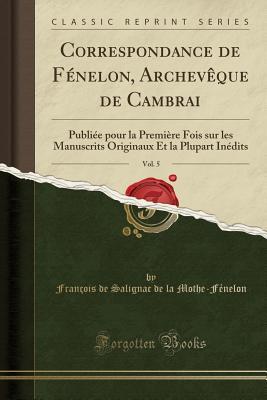
Correspondance de F�nelon, Archev�que de Cambrai, Vol. 5: Publi�e Pour La Premi�re Fois Sur Les Manuscrits Originaux Et La Plupart In�dits (Classic Reprint)
by Francois Fenelon
Excerpt from Correspondance de Fenelon, Archeveque de Cambrai, Vol. 5: Publiee pour la Premiere Fois sur les Manuscrits Originaux Et la Plupart Inedits
Au reste, les lettres que l'on trouvera ici reu nies, ne sont pas a beaucoup pres les seules qui prouventde zele infatigable et l'assiduite con stante de Fenelon pour ses fonctions episcopales. Il suffit de parcourir rapidement les diverses parties de sa Correspondance, pour se convain cre que jamais aucun prelat ne fut plus assidu que lui a soutenir et a ranimer, par ses visites pastorales la religion des peuples que la Provi dence avoit places sous sa conduite. Les titres seuls de ses lettres, c'est - a - dire, les lieux diffe rens d'ou elles sont datees, montrent qu'il visi toit regulierement chaque annee une partie con siderable de son diocese. Les troubles memes de la guerre ne lui faisoient pas suspendre cet exercice de zele et les egards que sa reputation lui attiroit de la part des generaux ennemis, le mettoient en etat de procurer a ses diocesains, avec les secours de la religion, le soulagement des calamites temporelles que les armees trai nent presque toujours a leur suite.
About the Publisher
Forgotten Books publishes hundreds of thousands of rare and classic books. Find more at www.forgottenbooks.comwww.forgottenbooks.com
This book is a reproduction of an important historical work. Forgotten Books uses state-of-the-art technology to digitally reconstruct the work, preserving the original format whilst repairing imperfections present in the aged copy. In rare cases, an imperfection in the original, such as a blemish or missing page, may be replicated in our edition. We do, however, repair the vast majority of imperfections successfully; any imperfections that remain are intentionally left to preserve the state of such historical works.
Au reste, les lettres que l'on trouvera ici reu nies, ne sont pas a beaucoup pres les seules qui prouventde zele infatigable et l'assiduite con stante de Fenelon pour ses fonctions episcopales. Il suffit de parcourir rapidement les diverses parties de sa Correspondance, pour se convain cre que jamais aucun prelat ne fut plus assidu que lui a soutenir et a ranimer, par ses visites pastorales la religion des peuples que la Provi dence avoit places sous sa conduite. Les titres seuls de ses lettres, c'est - a - dire, les lieux diffe rens d'ou elles sont datees, montrent qu'il visi toit regulierement chaque annee une partie con siderable de son diocese. Les troubles memes de la guerre ne lui faisoient pas suspendre cet exercice de zele et les egards que sa reputation lui attiroit de la part des generaux ennemis, le mettoient en etat de procurer a ses diocesains, avec les secours de la religion, le soulagement des calamites temporelles que les armees trai nent presque toujours a leur suite.
About the Publisher
Forgotten Books publishes hundreds of thousands of rare and classic books. Find more at www.forgottenbooks.comwww.forgottenbooks.com
This book is a reproduction of an important historical work. Forgotten Books uses state-of-the-art technology to digitally reconstruct the work, preserving the original format whilst repairing imperfections present in the aged copy. In rare cases, an imperfection in the original, such as a blemish or missing page, may be replicated in our edition. We do, however, repair the vast majority of imperfections successfully; any imperfections that remain are intentionally left to preserve the state of such historical works.
BUY NOW
Paperback, 554 pages
Published December 12th 2018 by Forgotten Books
Subscribe
Get Bible verse every day in your inbox
Read on Mobile


Group of Brands


© 2026 Bibleportal.com All rights reserved.
Francois Fenelon (1651 - 1715)
He was inducted into the Acadmie Francaise in 1693 and named Archbishop of Cambrai in 1695. During his time as the educator and teacher of the Duke, Fenelon wrote several entertaining and educational works, including the extensive novel Les Aventures de Telemaque, fils d'Ulysse (The Adventures of Telemachus, son of Ulysses), which depicted the ideal of a wise king. When this novel began circulating anonymously among the court, having been fragmentarily published in 1699 without his knowledge, Louis XIV, who saw many criticisms of his absolutistic style of rule in Telemaque, stopped the printing and banned Fenelon from court. Fenelon then retreated to his bishopric in Cambrai, where he remained active writing theological and political treatises until his death on January 17, 1715.In Church history, Fenelon is known especially for his part in the Quietism debate with his earlier patron Bossuet. In his work Explication des maximes des Saints sur la vie interieure (Explanation of the Adages of the Saints on the Inner Life) in 1697, he defended Madame du Guyon, the main representative of Quietistic mysticism. He provided proof that her "heretical" teachings could also be seen in recognized saints. In 1697, Fenelon called on the pope for a decision in the Quietism debate. After long advisement, the Pope banned the Explication in 1699. Fenelon complied with the pope's decision immediately and allowed the remaining copies of his book to be destroyed.
Francois de Salignac de la Mothe-Fenelon, more commonly known as Francois Fenelon, was a French Roman Catholic theologian, poet and writer. He today is remembered mostly as one of the main advocates of quietism and as the author of The Adventures of Telemachus, a scabrous attack on the French monarchy, first published in 1699.
Francois Fenelon (specifically Francois de Salignac de la Motte-Fenelon) was born on August 6, 1651, at Fenelon Castle in Perigord. Fenelon studied at the seminary Saint-Sulpice in Paris, where he was ordained as a priest. Fenelon published his pedagogical work Traite de l'education des filles (Treatise on the Education of Girls) in 1681, which brought him much attention, not only in France, but abroad as well. At this time, he met Jacques Benigne Bossuet, Bishop of Meaux, who soon became his patron and through whose influence Fenelon was contracted by Louis XIV to carry out the re-conversion of the Hugenots in the provinces of Saintonge and Poitou in 1686 and was appointed in 1689 as educator of his grandson and potential successor, the Duc de Bourgogne. Because of this position, he gained much influence at the court.
He was inducted into the Academie Francaise in 1693 and named Archbishop of Cambrai in 1695. During his time as the educator and teacher of the Duke, Fenelon wrote several entertaining and educational works, including the extensive novel Les Aventures de Telemaque, fils d'Ulysse (The Adventures of Telemachus, son of Ulysses), which depicted the ideal of a wise king. When this novel began circulating anonymously among the court, having been fragmentarily published in 1699 without his knowledge, Louis XIV, who saw many criticisms of his absolutistic style of rule in Telemaque, stopped the printing and banned Fenelon from court. Fenelon then retreated to his bishopric in Cambrai, where he remained active writing theological and political treatises until his death on January 17, 1715.
In Church history, Fenelon is known especially for his part in the Quietism debate with his earlier patron Bossuet. In his work Explication des maximes des Saints sur la vie interieure (Explanation of the Adages of the Saints on the Inner Life) in 1697, he defended Madame du Guyon, the main representative of Quietistic mysticism. He provided proof that her "heretical" teachings could also be seen in recognized saints. In 1697, Fenelon called on the pope for a decision in the Quietism debate. After long advisement, the Pope banned the Explication in 1699. Fenelon complied with the pope's decision immediately and allowed the remaining copies of his book to be destroyed.
... Show more