
- Bible
- Read the Bible
- Bible Versions
- Verse of the Day
- Reading Plans
- Verses by Topic
- Books of the Bible
- Bible Images
- Study
- Commentaries
- Concordances
- Dictionaries
- Encyclopedias
- Sermons
- Bible Atlas & Maps
- BP Wiki
- Devotionals
- Today's Devotionals
- All Devotionals
- Inspirational Quotes
- More
- Picture Quotes
- Videos
- Inspirational
- Bible Study
- What The Bible Says
- Bible Q&As
- Daily Bread
- Bible by Genre
- Bible Stories
- Random Bible Verse
- Community
- Store
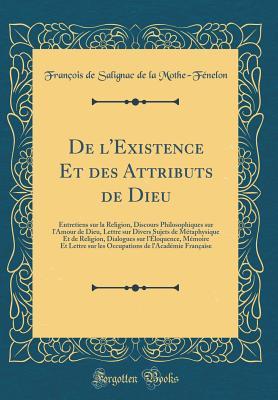
Excerpt from De l'Existence Et des Attributs de Dieu: Entretiens sur la Religion, Discours Philosophiques sur l'Amour de Dieu, Lettre sur Divers Sujets de M�taphysique Et de Religion, Dialogues sur l'�loquence, M�moire Et Lettre sur les Occupations de l'Acad�mie Fran�aise
Je ne puis ouvrir loeyeux sans admirer i'mqui �clate dans toute la nature: le moindre coup d'oeil su�t pour opemvoir la main qui fait tout. Que les hommes � m�diter les v�rit�s abstraites, et � remonter aux premiers principes, connaissent la Divinit� par son id�e; c'est un chemin s�r pour arriver � la source de toute v�rit�. Mais plus ce chemin est droit et court, plus il est rude et inaccessible au commun des hommes qui d�pendent de leur imagination. C'est une d�monstration si simple qu'elle �chappe, par sa simplicit� aux esprits impables des op�rations purement intellectuelles. Plus cette voie de trouver le premier Etre est parfaite, moins il y a d'esprits capables de la suivre.
About the Publisher
Forgotten Books publishes hundreds of thousands of rare and classic books. Find more at www.forgottenbooks.comwww.forgottenbooks.com
This book is a reproduction of an important historical work. Forgotten Books uses state-of-the-art technology to digitally reconstruct the work, preserving the original format whilst repairing imperfections present in the aged copy. In rare cases, an imperfection in the original, such as a blemish or missing page, may be replicated in our edition. We do, however, repair the vast majority of imperfections successfully; any imperfections that remain are intentionally left to preserve the state of such historical works.
Je ne puis ouvrir loeyeux sans admirer i'mqui �clate dans toute la nature: le moindre coup d'oeil su�t pour opemvoir la main qui fait tout. Que les hommes � m�diter les v�rit�s abstraites, et � remonter aux premiers principes, connaissent la Divinit� par son id�e; c'est un chemin s�r pour arriver � la source de toute v�rit�. Mais plus ce chemin est droit et court, plus il est rude et inaccessible au commun des hommes qui d�pendent de leur imagination. C'est une d�monstration si simple qu'elle �chappe, par sa simplicit� aux esprits impables des op�rations purement intellectuelles. Plus cette voie de trouver le premier Etre est parfaite, moins il y a d'esprits capables de la suivre.
About the Publisher
Forgotten Books publishes hundreds of thousands of rare and classic books. Find more at www.forgottenbooks.comwww.forgottenbooks.com
This book is a reproduction of an important historical work. Forgotten Books uses state-of-the-art technology to digitally reconstruct the work, preserving the original format whilst repairing imperfections present in the aged copy. In rare cases, an imperfection in the original, such as a blemish or missing page, may be replicated in our edition. We do, however, repair the vast majority of imperfections successfully; any imperfections that remain are intentionally left to preserve the state of such historical works.
BUY NOW
Hardcover, 584 pages
Published October 19th 2018 by Forgotten Books
Subscribe
Get Bible verse every day in your inbox
Read on Mobile


Group of Brands


© 2026 Bibleportal.com All rights reserved.
Francois Fenelon (1651 - 1715)
He was inducted into the Acadmie Francaise in 1693 and named Archbishop of Cambrai in 1695. During his time as the educator and teacher of the Duke, Fenelon wrote several entertaining and educational works, including the extensive novel Les Aventures de Telemaque, fils d'Ulysse (The Adventures of Telemachus, son of Ulysses), which depicted the ideal of a wise king. When this novel began circulating anonymously among the court, having been fragmentarily published in 1699 without his knowledge, Louis XIV, who saw many criticisms of his absolutistic style of rule in Telemaque, stopped the printing and banned Fenelon from court. Fenelon then retreated to his bishopric in Cambrai, where he remained active writing theological and political treatises until his death on January 17, 1715.In Church history, Fenelon is known especially for his part in the Quietism debate with his earlier patron Bossuet. In his work Explication des maximes des Saints sur la vie interieure (Explanation of the Adages of the Saints on the Inner Life) in 1697, he defended Madame du Guyon, the main representative of Quietistic mysticism. He provided proof that her "heretical" teachings could also be seen in recognized saints. In 1697, Fenelon called on the pope for a decision in the Quietism debate. After long advisement, the Pope banned the Explication in 1699. Fenelon complied with the pope's decision immediately and allowed the remaining copies of his book to be destroyed.
Francois de Salignac de la Mothe-Fenelon, more commonly known as Francois Fenelon, was a French Roman Catholic theologian, poet and writer. He today is remembered mostly as one of the main advocates of quietism and as the author of The Adventures of Telemachus, a scabrous attack on the French monarchy, first published in 1699.
Francois Fenelon (specifically Francois de Salignac de la Motte-Fenelon) was born on August 6, 1651, at Fenelon Castle in Perigord. Fenelon studied at the seminary Saint-Sulpice in Paris, where he was ordained as a priest. Fenelon published his pedagogical work Traite de l'education des filles (Treatise on the Education of Girls) in 1681, which brought him much attention, not only in France, but abroad as well. At this time, he met Jacques Benigne Bossuet, Bishop of Meaux, who soon became his patron and through whose influence Fenelon was contracted by Louis XIV to carry out the re-conversion of the Hugenots in the provinces of Saintonge and Poitou in 1686 and was appointed in 1689 as educator of his grandson and potential successor, the Duc de Bourgogne. Because of this position, he gained much influence at the court.
He was inducted into the Academie Francaise in 1693 and named Archbishop of Cambrai in 1695. During his time as the educator and teacher of the Duke, Fenelon wrote several entertaining and educational works, including the extensive novel Les Aventures de Telemaque, fils d'Ulysse (The Adventures of Telemachus, son of Ulysses), which depicted the ideal of a wise king. When this novel began circulating anonymously among the court, having been fragmentarily published in 1699 without his knowledge, Louis XIV, who saw many criticisms of his absolutistic style of rule in Telemaque, stopped the printing and banned Fenelon from court. Fenelon then retreated to his bishopric in Cambrai, where he remained active writing theological and political treatises until his death on January 17, 1715.
In Church history, Fenelon is known especially for his part in the Quietism debate with his earlier patron Bossuet. In his work Explication des maximes des Saints sur la vie interieure (Explanation of the Adages of the Saints on the Inner Life) in 1697, he defended Madame du Guyon, the main representative of Quietistic mysticism. He provided proof that her "heretical" teachings could also be seen in recognized saints. In 1697, Fenelon called on the pope for a decision in the Quietism debate. After long advisement, the Pope banned the Explication in 1699. Fenelon complied with the pope's decision immediately and allowed the remaining copies of his book to be destroyed.
... Show more