
- Bible
- Read the Bible
- Bible Versions
- Verse of the Day
- Reading Plans
- Verses by Topic
- Books of the Bible
- Bible Images
- Study
- Commentaries
- Concordances
- Dictionaries
- Encyclopedias
- Sermons
- Bible Atlas & Maps
- BP Wiki
- Devotionals
- Today's Devotionals
- Light of the World
- All Devotionals
- Inspirational Quotes
- More
- Picture Quotes
- Videos
- Inspirational
- Bible Study
- What The Bible Says
- Bible Q&As
- Daily Bread
- Bible by Genre
- Bible Stories
- Random Bible Verse
- Community
- Store
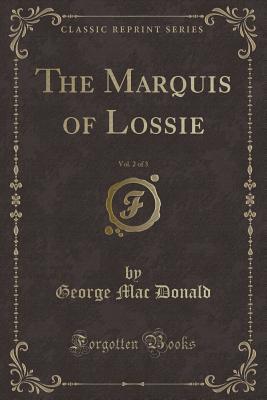
The Marquis of Lossie, Vol. 2 of 3 (Classic Reprint)
by George MacDonald
Excerpt from The Marquis of Lossie, Vol. 2 of 3
It was more than Malcolm had expected He ran: he might yet have a chance of trying to turn her in the right direction. He knew that Liftore was neither in the house nor at the stable. With the help of the earl's groom, he was round in ten minutes. Florimel was all but ready like some other ladies she could dress quickly when she had good reason. She sprang from Malcolm's hand to the saddle, and led as straight northward as she could go, never looking behind her till she drew rein on the top of Hampstead Heath. When he rode up to her, Malcolm, she said, looking at him half-ashamed, I don't think my father would have minded your wearing his clothes.
About the Publisher
Forgotten Books publishes hundreds of thousands of rare and classic books. Find more at www.forgottenbooks.comwww.forgottenbooks.com
This book is a reproduction of an important historical work. Forgotten Books uses state-of-the-art technology to digitally reconstruct the work, preserving the original format whilst repairing imperfections present in the aged copy. In rare cases, an imperfection in the original, such as a blemish or missing page, may be replicated in our edition. We do, however, repair the vast majority of imperfections successfully; any imperfections that remain are intentionally left to preserve the state of such historical works.
It was more than Malcolm had expected He ran: he might yet have a chance of trying to turn her in the right direction. He knew that Liftore was neither in the house nor at the stable. With the help of the earl's groom, he was round in ten minutes. Florimel was all but ready like some other ladies she could dress quickly when she had good reason. She sprang from Malcolm's hand to the saddle, and led as straight northward as she could go, never looking behind her till she drew rein on the top of Hampstead Heath. When he rode up to her, Malcolm, she said, looking at him half-ashamed, I don't think my father would have minded your wearing his clothes.
About the Publisher
Forgotten Books publishes hundreds of thousands of rare and classic books. Find more at www.forgottenbooks.comwww.forgottenbooks.com
This book is a reproduction of an important historical work. Forgotten Books uses state-of-the-art technology to digitally reconstruct the work, preserving the original format whilst repairing imperfections present in the aged copy. In rare cases, an imperfection in the original, such as a blemish or missing page, may be replicated in our edition. We do, however, repair the vast majority of imperfections successfully; any imperfections that remain are intentionally left to preserve the state of such historical works.
BUY NOW
Paperback, 316 pages
Published October 31st 2018 by Forgotten Books (first published September 27th 2015)
Subscribe
Get Bible verse every day in your inbox
Read on Mobile


Group of Brands


© 2026 Bibleportal.com All rights reserved.
George MacDonald was a Scottish author, poet, and Christian minister.
Known particularly for his poignant fairy tales and fantasy novels, George MacDonald inspired many authors, such as W. H. Auden, J. R. R. Tolkien, C. S. Lewis, E. Nesbit and Madeleine L'Engle. G. K. Chesterton cited The Princess and the Goblin as a book that had "made a difference to my whole existence."
Even Mark Twain, who initially disliked MacDonald, became friends with him, and there is some evidence that Twain was influenced by MacDonald.
MacDonald grew up influenced by his Congregational Church, with an atmosphere of Calvinism. But MacDonald never felt comfortable with some aspects of Calvinist doctrine; indeed, legend has it that when the doctrine of predestination was first explained to him, he burst into tears (although assured that he was one of the elect). Later novels, such as Robert Falconer and Lilith, show a distaste for the idea that God's electing love is limited to some and denied to others.
... Show more