
- Bible
- Read the Bible
- Bible Versions
- Verse of the Day
- Reading Plans
- Verses by Topic
- Books of the Bible
- Bible Images
- Study
- Commentaries
- Concordances
- Dictionaries
- Encyclopedias
- Sermons
- Bible Atlas & Maps
- BP Wiki
- Devotionals
- Today's Devotionals
- Light of the World
- All Devotionals
- Inspirational Quotes
- More
- Picture Quotes
- Videos
- Inspirational
- Bible Study
- What The Bible Says
- Bible Q&As
- Daily Bread
- Bible by Genre
- Bible Stories
- Random Bible Verse
- Community
- Store
Whose breath blew out the light within our brains?*
*Paraphrased from the poem, “The Man With the Hoe,” by Edwin Markham.
For centuries historians have referred to the Middle Ages as the Dark Ages. And to the extent that a major battle between good and evil was being waged during the Middle Ages, it was indeed a dark period.
Fortunately the forces of good won that battle, but then their members started bickering, and they allowed the devil to divide them and to ultimately gain the upper hand.
Centuries from now, what appellation will historians apply to the passed two hundred years? Is it possible that during the passed two hundred years, humanity has been led into an even darker age?
After reading this book with its editorial comments, you decide.
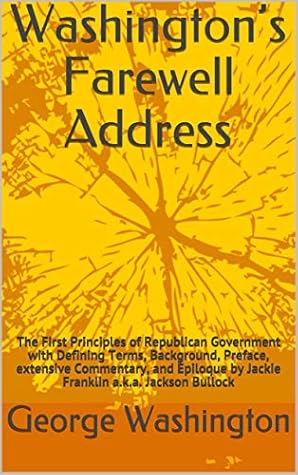
When Washington delivered his Farewell Address on September 19, 1796, the nation was in a bind, not unlike that in which we find ourselves today.
For reasons, perhaps, too diabolical for most people to believe, Americans have been led away from the views of our first president. Our current state of affairs is unfortunate; George’s advice is as important today as it was two hundred years ago. We can all profit from a review of his first principles of government.
This is a supplement to a synergistic, symbiotic series of books published by Jackie Franklin that include Instant Wisdom, The Big Lie, Write Me In!, Don’t Start Me Talkin’, Mentor & Protégé, Redneck Blue, The Real Enemy, Insight, The Hoodwinking of America, and Indoctrinated Ignorance along with our edition of The Secret Driving Force of Globalization, and The Zionists. Read them all. They’ll blow your mind.
*Paraphrased from the poem, “The Man With the Hoe,” by Edwin Markham.
For centuries historians have referred to the Middle Ages as the Dark Ages. And to the extent that a major battle between good and evil was being waged during the Middle Ages, it was indeed a dark period.
Fortunately the forces of good won that battle, but then their members started bickering, and they allowed the devil to divide them and to ultimately gain the upper hand.
Centuries from now, what appellation will historians apply to the passed two hundred years? Is it possible that during the passed two hundred years, humanity has been led into an even darker age?
After reading this book with its editorial comments, you decide.
When Washington delivered his Farewell Address on September 19, 1796, the nation was in a bind, not unlike that in which we find ourselves today.
For reasons, perhaps, too diabolical for most people to believe, Americans have been led away from the views of our first president. Our current state of affairs is unfortunate; George’s advice is as important today as it was two hundred years ago. We can all profit from a review of his first principles of government.
This is a supplement to a synergistic, symbiotic series of books published by Jackie Franklin that include Instant Wisdom, The Big Lie, Write Me In!, Don’t Start Me Talkin’, Mentor & Protégé, Redneck Blue, The Real Enemy, Insight, The Hoodwinking of America, and Indoctrinated Ignorance along with our edition of The Secret Driving Force of Globalization, and The Zionists. Read them all. They’ll blow your mind.
BUY NOW
Kindle Edition, 98 pages
Published August 10th 2019
Subscribe
Get Bible verse every day in your inbox
Read on Mobile


Group of Brands


© 2026 Bibleportal.com All rights reserved.
George Washington was the commander of the Continental Army in the American Revolutionary War (1775-1783) and served as the first President of the United States of America (1789-1797). For his central role in the formation of the United States, he is often referred to as the father of his country.
Washington was baptized into the Church of England. In 1765, when the Church of England was still the state religion, he served on the vestry (lay council) for his local church. Throughout his life, he spoke of the value of righteousness, and of seeking and offering thanks for the "blessings of Heaven."
The Electoral College elected Washington unanimously in 1789, and again in the 1792 election; he remains the only president to receive 100% of the electoral votes.
Washington proved an able administrator. An excellent delegator and judge of talent and character, he held regular cabinet meetings to debate issues before making a final decision. In handling routine tasks, he was "systematic, orderly, energetic, solicitous of the opinion of others but decisive, intent upon general goals and the consistency of particular actions with them.
Washington died in 1799. He has been consistently ranked by scholars as one of the greatest U.S. Presidents.
... Show more