
- Bible
- Read the Bible
- Bible Versions
- Verse of the Day
- Reading Plans
- Verses by Topic
- Books of the Bible
- Bible Images
- Study
- Commentaries
- Concordances
- Dictionaries
- Encyclopedias
- Sermons
- Bible Atlas & Maps
- BP Wiki
- Devotionals
- Today's Devotionals
- Light of the World
- All Devotionals
- Inspirational Quotes
- More
- Picture Quotes
- Videos
- Inspirational
- Bible Study
- What The Bible Says
- Bible Q&As
- Daily Bread
- Bible by Genre
- Bible Stories
- Random Bible Verse
- Community
- Store
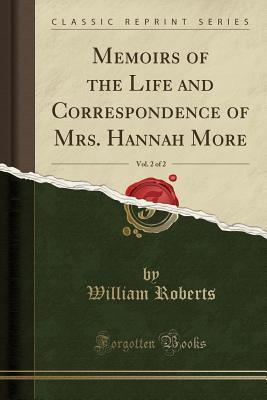
Memoirs of the Life and Correspondence of Mrs. Hannah More, Vol. 2 of 2 (Classic Reprint)
by Hannah More
Excerpt from Memoirs of the Life and Correspondence of Mrs. Hannah More, Vol. 2 of 2
We commence the year 1797 with the following letter from Bishop Porteus.
St. James's Square, Jan. 16, 1797.
My dear Mrs. More,
For many virtues I allow you a very competent degree of merit; but none at all for what you call temperance, but what I call niggardliness, in writing. If you would be a little more liberal and even profuse in this article, your character would stand much higher in my estimation than it does at present. You would hear the history of Fulham (which is not so eventful or so pregnant with revolutions as that of France) from Mrs. Kennicott. One of our evening books was a collection of Arabic Poems, translated into English by Mr. Carlisle, Professor of Arabic at Cambridge. The originals are prefixed to the translations, but we chose to read the latter. They are not all equally good, but the greater part of them are exquisitely beautiful, and the more so for being totally unlike all the oriental poetry I ever read before, which, to say the truth, I am not in general much enamoured of. They resemble very much the best European sonnets and elegies, but are much superior to them. And what think you of an Arabic riddle and charade? Mr. Pitt, I am told, is quite in raptures with them, and can say most of them by heart. But there is another book with which we are still more delighted (I ought to add edified) than all the rest, and that is what I dare say you have devoured with your usual voracity on such subjects, - Gisborne's Duties of the Female Sex. It is, in all respects, excellent. I hope it will be read by every female that can read in the kingdom. I told Lady Elgin that she should make her little pupil read it immediately. How unfortunate have we been about the French fleet, yet how thankful ought we to be to Providence for defeating their destructive projects!
About the Publisher
Forgotten Books publishes hundreds of thousands of rare and classic books. Find more at www.forgottenbooks.comwww.forgottenbooks.com
This book is a reproduction of an important historical work. Forgotten Books uses state-of-the-art technology to digitally reconstruct the work, preserving the original format whilst repairing imperfections present in the aged copy. In rare cases, an imperfection in the original, such as a blemish or missing page, may be replicated in our edition. We do, however, repair the vast majority of imperfections successfully; any imperfections that remain are intentionally left to preserve the state of such historical works.
We commence the year 1797 with the following letter from Bishop Porteus.
St. James's Square, Jan. 16, 1797.
My dear Mrs. More,
For many virtues I allow you a very competent degree of merit; but none at all for what you call temperance, but what I call niggardliness, in writing. If you would be a little more liberal and even profuse in this article, your character would stand much higher in my estimation than it does at present. You would hear the history of Fulham (which is not so eventful or so pregnant with revolutions as that of France) from Mrs. Kennicott. One of our evening books was a collection of Arabic Poems, translated into English by Mr. Carlisle, Professor of Arabic at Cambridge. The originals are prefixed to the translations, but we chose to read the latter. They are not all equally good, but the greater part of them are exquisitely beautiful, and the more so for being totally unlike all the oriental poetry I ever read before, which, to say the truth, I am not in general much enamoured of. They resemble very much the best European sonnets and elegies, but are much superior to them. And what think you of an Arabic riddle and charade? Mr. Pitt, I am told, is quite in raptures with them, and can say most of them by heart. But there is another book with which we are still more delighted (I ought to add edified) than all the rest, and that is what I dare say you have devoured with your usual voracity on such subjects, - Gisborne's Duties of the Female Sex. It is, in all respects, excellent. I hope it will be read by every female that can read in the kingdom. I told Lady Elgin that she should make her little pupil read it immediately. How unfortunate have we been about the French fleet, yet how thankful ought we to be to Providence for defeating their destructive projects!
About the Publisher
Forgotten Books publishes hundreds of thousands of rare and classic books. Find more at www.forgottenbooks.comwww.forgottenbooks.com
This book is a reproduction of an important historical work. Forgotten Books uses state-of-the-art technology to digitally reconstruct the work, preserving the original format whilst repairing imperfections present in the aged copy. In rare cases, an imperfection in the original, such as a blemish or missing page, may be replicated in our edition. We do, however, repair the vast majority of imperfections successfully; any imperfections that remain are intentionally left to preserve the state of such historical works.
Paperback, 508 pages
Published April 24th 2018 by Forgotten Books
Subscribe
Get Bible verse every day in your inbox
Read on Mobile


Group of Brands


© 2026 Bibleportal.com All rights reserved.
Hannah More was an English religious writer and philanthropist. She can be said to have made three reputations in the course of her long life: as a clever verse-writer and witty talker in the circle of Johnson, Reynolds and Garrick, as a writer on moral and religious subjects on the Puritanic side, and as a practical philanthropist.
She was instrumental in setting up twelve schools by 1800 where reading, the Bible and the catechism - but not writing - were taught to local children. The More sisters met with a good deal of opposition in their works: the farmers thought that education, even to the limited extent of learning to read, would be fatal to agriculture, and the clergy, whose neglect she was making good, accused her of Methodist tendencies.
In her old age, philanthropists from all parts made pilgrimages to see the bright and amiable old lady, and she retained all her faculties until within two years of her death. She spent the last five years of her life in Clifton, and died on 7 September, 1833. She is buried at All Saints' church, Wrington.
Hannah More was an English religious writer, Romantic and philanthropist. She can be said to have made three reputations in the course of her long life: as a poet and playwright in the circle of Johnson, Reynolds and Garrick, as a writer on moral and religious subjects, and as a practical philanthropist.
... Show more