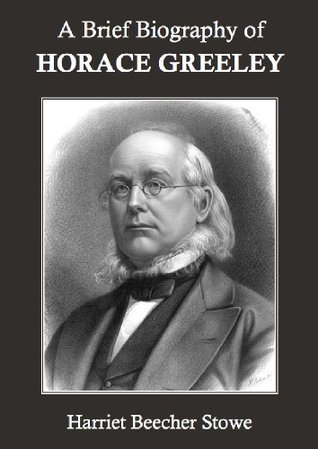
Originally published in 1872 (the year of Horace Greeley’s death) as a portion of Harriet Beecher Stowe’s larger “The Lives and Deeds of Our Self-Made Men,” this Kindle edition, equivalent in length to a physical book of approximately 16 pages, describes the life and career of journalist, abolitionist, and politician Horace Greeley.
Sample passage:
In his calling as a printer, he was most laborious, and quickly became the most valuable hand in the office. He also began here his experience as a writer— if that may be called written which was never set down with a pen. For he used to compose condensations of news paragraphs, and even original paragraphs of his own, framing his sentences in his mind as he stood at the case, and setting them up in type entirely without the intermediate process of setting them down in manuscript. This practice was exactly the way to cultivate economy, clearness, and directness of style; as it was necessary to know accurately what was to be said, or else the letters in the composing stick would have to be distributed and set up again; and it was natural to use the fewest and plainest possible words.
About the author:
Harriet Beecher Stowe (1811–1896) was an American novelist who won fame for here anti-slavery novel “Uncle Tom’s Cabin.”



1811-1896
Harriet Beecher Stowe was an American abolitionist and author. Harriet was born in Litchfield, Connecticut, as the daughter of an outspoken religious leader Lyman Beecher. She was the sister of the educator and author, Catherine Beecher, clergymen Henry Ward Beecher and Charles Beecher.
Her father was a preacher who was greatly effected by the pro-slavery riots that took place in Cincinnati in 1834.
Stowe's novel Uncle Tom's Cabin (1852) depicted life for African-Americans under slavery; it reached millions as a novel and play, and became influential in the U.S. and Britain and made the political issues of the 1850s regarding slavery tangible to millions, energizing anti-slavery forces in the American North, while provoking widespread anger in the South. Upon meeting Stowe, Abraham Lincoln allegedly remarked, "So this is the little old lady who started this new great war!"
... Show more