Included is Grammar Uses Version.
James Rosscup writes that Alford's series on the New Testament "contains much that is valuable in the Greek New Testament… though all of the Greek New Testament words have been changed to English throughout."
John Piper writes "When I’m stumped with a… grammatical or syntactical or logical [question] in Paul, I go to Henry Alford. Henry Alford… comes closer more consistently than any other human commentator to asking my kinds of questions."
Charles Haddon Spurgeon writes that this text "is an invaluable aid to the critical study of the text of the New Testament. You will find in it the ripened results of a matured scholarship, the harvesting of a judgment, generally highly impartial, always worthy of respect, which has gleaned from the most important fields of Biblical research, both modern and ancient, at home and abroad. You will not look here for any spirituality of thought or tenderness of feeling; you will find the learned Dean does not forget to do full justice to his own views, and is quite able to express himself vigorously against his opponents; but for what it professes to be, it is an exceedingly able and successful work. The later issues are by far the most desirable, as the author has considerably revised the work in the fourth edition. What I have said of his Greek Testament applies equally to Alford’s New Testament for English Readers, which is also a standard work."

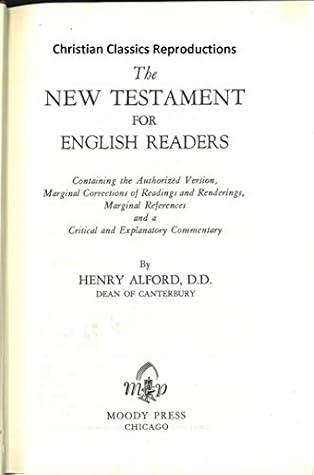


Henry Alford was an English churchman, theologian, textual critic, scholar, poet, hymnodist, and writer.
His chief fame rests on his monumental edition of the New Testament in Greek (4 vols.), which occupied him from 1841 to 1861. In this work he first produced a careful collation of the readings of the chief manuscripts and the researches of the ripest continental scholarship of his day. Philological rather than theological in character, it marked an epochal change from the old homiletic commentary, and though more recent research, patristic and papyral, has largely changed the method of New Testament exegesis, Alford's work is still a quarry where the student can dig with a good deal of profit.
Henry Alford, D.D., Dean of Canterbury, one of the most variously-accomplished churchmen of his day -- poet, preacher, painter, musician, biblical scholar, critic, and philologist -- came of a Somersetshire family, five generations of which, in direct succession, contributed clergymen of some distinction to the English Church. The earliest of these, his great-great-grandfather, Thomas, who died in 1708, was for many years the vicar of Curry Rivell, near Taunton -- a living that passed from one to another of his descendants.
Alford was a talented artist, as his picture-book, The Riviera (1870), shows, and he had abundant musical and mechanical talent. Besides editing the works of John Donne, he published several volumes of his own verse, The School of the Heart (1835), The Abbot of Muchelnaye (1841), The Greek Testament. The Four Gospels (1849), and a number of hymns, the best-known of which are "Forward! be our watchword," "Come, ye thankful people, come," and "Ten thousand times ten thousand."
His chief fame rests on his monumental edition of the New Testament in Greek (4 vols.), which occupied him from 1841 to 1861. In this work he first produced a careful collation of the readings of the chief manuscripts and the researches of the ripest continental scholarship of his day. Philological rather than theological in character, it marked an epochal change from the old homiletic commentary, and though more recent research, patristic and papyral, has largely changed the method of New Testament exegesis, Alford's work is still a quarry where the student can dig with a good deal of profit.
... Show more