Classic Sermons on Evil Speaking by Isaac Barrow D.D. are a collection of messages given in the 1600's
"The sermons here given were first published in 1678, in a volume entitled “Several Sermons against Evil-speaking.” That volume contained ten sermons, of which the publisher said that “the two last, against pragmaticalness and meddling in the affairs of others, do not so properly belong to this subject.” The sermons here given follow continuously, beginning with the second in the series. The text of the first sermon was “If any man offend not in word, he is a perfect man.” The texts to the last three were: “Speak not evil one of another, brethren;” “Judge not;” and “That ye study to be quiet, and to do your own business.”
Contents include:
Introduction by Professor Henry Morley.
Against Foolish Talking and Jesting.
Against Rash and Vain Swearing.
Of Evil-speaking in General.
The Folly of Slander. Part 1.
The Folly of Slander. Part 2.
Illustrated

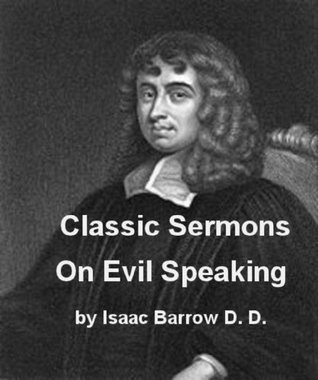


Barrow was born in London. He went to school first at Charterhouse, and subsequently to Felstead. He completed his education at Trinity College, Cambridge, where his uncle and namesake, afterwards Bishop of St Asaph, was a Fellow. He took to hard study, distinguishing himself in classics and mathematics; after taking his degree in 1648, he was elected to a fellowship in 1649; he then resided for a few years in college, and became candidate for the Greek Professorship at Cambridge, but in 1655 he was driven out by the persecution of the Independents. He spent the next four years traveling across France, Italy and even Constantinople, and after many adventures returned to England in 1659.
In 1660, he was ordained and appointed to the Regius Professorship of Greek at Cambridge. In 1662 he was made professor of geometry at Gresham College, and in 1663 was selected as the first occupier of the Lucasian chair at Cambridge.
For the remainder of his life he devoted himself to the study of divinity. He was made a D.D. by royal mandate in 1670, and two years later Master of Trinity College (1672), where he founded the library, and held the post until his death.
... Show more