
- Bible
- Read the Bible
- Bible Versions
- Verse of the Day
- Reading Plans
- Verses by Topic
- Books of the Bible
- Bible Images
- Study
- Commentaries
- Concordances
- Dictionaries
- Encyclopedias
- Sermons
- Bible Atlas & Maps
- BP Wiki
- Devotionals
- Today's Devotionals
- Light of the World
- All Devotionals
- Inspirational Quotes
- More
- Picture Quotes
- Videos
- Inspirational
- Bible Study
- What The Bible Says
- Bible Q&As
- Daily Bread
- Bible by Genre
- Bible Stories
- Random Bible Verse
- Community
- Store
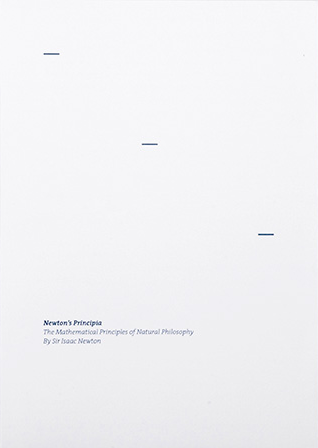
With Isaac Newton’s Principia we took a different approach to the editorial design, than what is typically found in mathematical or physics texts. We created a very detailed design; working with a creative binding technique which allowed us to present the three books as individual art objects.
The translation being used is the 1st American edition, translated by Andrew Motte. Carefully revised and corrected by N. W. Chittenden.
We talk about mathematics, we talk about physics, but we also talk about design, and we have to see, feel, touch and smell this aspect on all sides of the book. The aim was to provide a minimalist aesthetic in juxtaposition to the complexity of the subject. “The cleaner the page, the easier it is to understand and read.” This is the main premise that I have adopted to tackle this new project. But what can be done with all this content that has little rhythm and creates monotony throughout the different pages?
Curious, enigmatic, serious, organised and clean; these are the five aspects that the design of the book Principia responds to.
The graphics of the covers are clean and pure with very little information, leading the reader to think “what is this book hiding?”, reaching a point that is rare and unusual in scientific books. The Greek letters alpha, beta and gamma emphasise this enigmatic aspect of the covers.
To show its serious side, we have gone for an absence of colour, working only with two direct colours, petrol blue and coral orange, which are two very bold colours that complement each other well.
The geometrical graphic grid has been designed based on the three recurring elements in the content: the text, notes in the margin and graphics. These three elements have marked out a flexible, organised and geometrical graphic grid that is adapted to all sections. Wide margins have been given to counter the density of the printed area. The inside covers of each section have a colour background to quickly indicate the beginning of each section, whilst the index pages are found in the middle of each book in a higher weight paper to force it open at this point.
A key aspect of any publication is the choice of typography. For this project we have chosen The Serif, a typeface designed by Lucas de Groot in 1994. It is a Roman serif font with high readability thanks to its well-proportioned forms. It has low contrast, or in other words, the difference between thick and thin strokes is not very pronounced. And thanks to the high x-height, I have been able to work with reduced line spacing.
The Serif family has a wide variety of weights that help us add texture and variety to the content.
The binding is what really sets this book apart. We wanted its “wrapping” to be visually appealing and different. Therefore, we have opted for visible binding that leaves the spine bare, displaying a part of the books that usually remains hidden. This type of binding also helps us when reading the book, as it allows us to open it wider.
Principia consists of three main chapters: the first, The motion of bodies; the second, The movement of bodies through resisting mediums and the third, The system of the world. Due to the large amount of information, we have chosen to divide the three chapters into three books (physically speaking). This option allows the reader to better understand how the book Principia is structured and, in turn, makes it more practical to consult, as each book is easier to handle.
The three main chapters of Principia are bound separately as three individual books, all contained within the main cover.
Paper is related to the sense of touch that is so beloved of book lovers. We have chosen paper designed for offset printing, Munken Polar, where the crisp white tone and its smooth uncoated surface provides an exclusive and natural feel. The inside pages are 100 grams to give the content more body, and the covers are 260 grams.
One last detail is the dry embossing on each of the covers of the three books with the letters alpha, beta and gamma, bringing a touch of elegance. This is how we wanted this book to be valued: it is a collector’s book and, therefore, people will treat it as such, with care and sensitivity.
This new edition of the book Principia is intended to be a point of reference for science books that emphasise good design.
The translation being used is the 1st American edition, translated by Andrew Motte. Carefully revised and corrected by N. W. Chittenden.
We talk about mathematics, we talk about physics, but we also talk about design, and we have to see, feel, touch and smell this aspect on all sides of the book. The aim was to provide a minimalist aesthetic in juxtaposition to the complexity of the subject. “The cleaner the page, the easier it is to understand and read.” This is the main premise that I have adopted to tackle this new project. But what can be done with all this content that has little rhythm and creates monotony throughout the different pages?
Curious, enigmatic, serious, organised and clean; these are the five aspects that the design of the book Principia responds to.
The graphics of the covers are clean and pure with very little information, leading the reader to think “what is this book hiding?”, reaching a point that is rare and unusual in scientific books. The Greek letters alpha, beta and gamma emphasise this enigmatic aspect of the covers.
To show its serious side, we have gone for an absence of colour, working only with two direct colours, petrol blue and coral orange, which are two very bold colours that complement each other well.
The geometrical graphic grid has been designed based on the three recurring elements in the content: the text, notes in the margin and graphics. These three elements have marked out a flexible, organised and geometrical graphic grid that is adapted to all sections. Wide margins have been given to counter the density of the printed area. The inside covers of each section have a colour background to quickly indicate the beginning of each section, whilst the index pages are found in the middle of each book in a higher weight paper to force it open at this point.
A key aspect of any publication is the choice of typography. For this project we have chosen The Serif, a typeface designed by Lucas de Groot in 1994. It is a Roman serif font with high readability thanks to its well-proportioned forms. It has low contrast, or in other words, the difference between thick and thin strokes is not very pronounced. And thanks to the high x-height, I have been able to work with reduced line spacing.
The Serif family has a wide variety of weights that help us add texture and variety to the content.
The binding is what really sets this book apart. We wanted its “wrapping” to be visually appealing and different. Therefore, we have opted for visible binding that leaves the spine bare, displaying a part of the books that usually remains hidden. This type of binding also helps us when reading the book, as it allows us to open it wider.
Principia consists of three main chapters: the first, The motion of bodies; the second, The movement of bodies through resisting mediums and the third, The system of the world. Due to the large amount of information, we have chosen to divide the three chapters into three books (physically speaking). This option allows the reader to better understand how the book Principia is structured and, in turn, makes it more practical to consult, as each book is easier to handle.
The three main chapters of Principia are bound separately as three individual books, all contained within the main cover.
Paper is related to the sense of touch that is so beloved of book lovers. We have chosen paper designed for offset printing, Munken Polar, where the crisp white tone and its smooth uncoated surface provides an exclusive and natural feel. The inside pages are 100 grams to give the content more body, and the covers are 260 grams.
One last detail is the dry embossing on each of the covers of the three books with the letters alpha, beta and gamma, bringing a touch of elegance. This is how we wanted this book to be valued: it is a collector’s book and, therefore, people will treat it as such, with care and sensitivity.
This new edition of the book Principia is intended to be a point of reference for science books that emphasise good design.
BUY NOW
Hardcover
Published 2017 by Kronecker Wallis (first published 1687)
Book Quotes
Subscribe
Get Bible verse every day in your inbox
Read on Mobile


Group of Brands


© 2026 Bibleportal.com All rights reserved.
Sir Isaac Newton was an English physicist, mathematician, astronomer, natural philosopher, alchemist, and theologian who is considered one of the most influential people in human history.
Newton remains influential to scientists, as demonstrated by a 2005 survey of scientists in Britain's Royal Society asking who had the greater effect on the history of science, Newton or Albert Einstein. Newton was deemed the more influential.[8]
Newton also wrote on Judaeo-Christian prophecy, whose decipherment was essential, he thought, to the understanding of God. His book on the subject, which was reprinted well into the Victorian Age, represented lifelong study. Its message was that Christianity went astray in the 4th century AD, when the first Council of Nicaea propounded erroneous doctrines of the nature of Christ. The full extent of Newton's unorthodoxy was recognized only in the present century: but although a critic of accepted Trinitarian dogmas and the Council of Nicaea, he possessed a deep religious sense, venerated the Bible and accepted its account of creation. In late editions of his scientific works he expressed a strong sense of God's providential role in nature.
... Show more