
- Bible
- Read the Bible
- Bible Versions
- Verse of the Day
- Reading Plans
- Verses by Topic
- Books of the Bible
- Bible Images
- Study
- Commentaries
- Concordances
- Dictionaries
- Encyclopedias
- Sermons
- Bible Atlas & Maps
- BP Wiki
- Devotionals
- Today's Devotionals
- Light of the World
- All Devotionals
- Inspirational Quotes
- More
- Picture Quotes
- Videos
- Inspirational
- Bible Study
- What The Bible Says
- Bible Q&As
- Daily Bread
- Bible by Genre
- Bible Stories
- Random Bible Verse
- Community
- Store
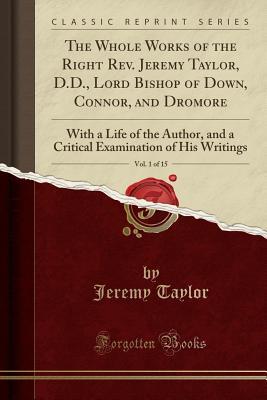
Excerpt from The Whole Works of the Right Rev. Jeremy Taylor, D.D., Lord Bishop of Down, Connor, and Dromore, Vol. 1 of 15: With a Life of the Author, and a Critical Examination of His Writings
After an anxious and unceasing labour Of more than eighteen months, the Editors Of the collected Works Of jeremy taylor have completed their engagement with the public. It only remains, that they should express their gratitude to the many distinguished individuals, whose patronage has ena bled them to bring their undertaking to a close; that they should shortly state the considerations, by which their plan has been regulated and request indulgence for those defects of plan or execution, to which every undertaking Of a similar magnitude is liable.
About the Publisher
Forgotten Books publishes hundreds of thousands of rare and classic books. Find more at www.forgottenbooks.comwww.forgottenbooks.com
This book is a reproduction of an important historical work. Forgotten Books uses state-of-the-art technology to digitally reconstruct the work, preserving the original format whilst repairing imperfections present in the aged copy. In rare cases, an imperfection in the original, such as a blemish or missing page, may be replicated in our edition. We do, however, repair the vast majority of imperfections successfully; any imperfections that remain are intentionally left to preserve the state of such historical works.
After an anxious and unceasing labour Of more than eighteen months, the Editors Of the collected Works Of jeremy taylor have completed their engagement with the public. It only remains, that they should express their gratitude to the many distinguished individuals, whose patronage has ena bled them to bring their undertaking to a close; that they should shortly state the considerations, by which their plan has been regulated and request indulgence for those defects of plan or execution, to which every undertaking Of a similar magnitude is liable.
About the Publisher
Forgotten Books publishes hundreds of thousands of rare and classic books. Find more at www.forgottenbooks.comwww.forgottenbooks.com
This book is a reproduction of an important historical work. Forgotten Books uses state-of-the-art technology to digitally reconstruct the work, preserving the original format whilst repairing imperfections present in the aged copy. In rare cases, an imperfection in the original, such as a blemish or missing page, may be replicated in our edition. We do, however, repair the vast majority of imperfections successfully; any imperfections that remain are intentionally left to preserve the state of such historical works.
BUY NOW
Paperback, 706 pages
Published October 10th 2018 by Forgotten Books
Subscribe
Get Bible verse every day in your inbox
Read on Mobile


Group of Brands


© 2026 Bibleportal.com All rights reserved.
Jeremy Taylor was a clergyman in the Church of England who achieved fame as an author during The Protectorate of Oliver Cromwell. He is sometimes known as the "Shakespeare of Divines" for his poetic style of expression and was often presented as a model of prose writing. He is remembered in the Church of England's calendar of saints with a Lesser Festival on 13 August.
He went on to become chaplain in ordinary to King Charles I as a result of Laud's sponsorship. This made him politically suspect when Laud was tried for treason and executed in 1645 by the Puritan Parliament during the English Civil War. After the Parliamentary victory over the King, he was briefly imprisoned several times.
Eventually, he was allowed to live quietly in Wales, where he became the private chaplain of the Earl of Carbery. At the Restoration, his political star was on the rise, and he was made Bishop of Down and Connor in Ireland. He also became vice-chancellor of the University of Dublin.
Taylor's fame has been maintained by the popularity of his sermons and devotional writings rather than by his influence as a theologian or his importance as an ecclesiastic.
... Show more