
- Bible
- Read the Bible
- Bible Versions
- Verse of the Day
- Reading Plans
- Verses by Topic
- Books of the Bible
- Bible Images
- Study
- Commentaries
- Concordances
- Dictionaries
- Encyclopedias
- Sermons
- Bible Atlas & Maps
- BP Wiki
- Devotionals
- Today's Devotionals
- Light of the World
- All Devotionals
- Inspirational Quotes
- More
- Picture Quotes
- Videos
- Inspirational
- Bible Study
- What The Bible Says
- Bible Q&As
- Daily Bread
- Bible by Genre
- Bible Stories
- Random Bible Verse
- Community
- Store
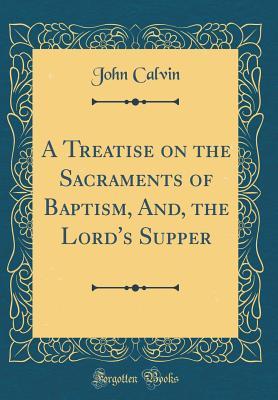
Excerpt from A Treatise on the Sacraments of Baptism, And, the Lord's Supper
Promises, not that they, but we, stood in need afean firmation by such means. - Now, of this definition which we have set, we understand that a sacrament is never without We it, but rather IS a Jome as aeertam addition annexe - (tm it, to this end, that it should confirm and seal the promise itself, and make it more approved unto us, yea, after a certain manner ratified. Tich mean the Lord foreseeth to be needful, first for our ignorance and dulness, and then for our weakness; and yet, to speak properly, not so much to confirm his holy word, as to stablish us in the faith thereof. For the truth of God is by itself sound and certain enough, and cannot, from any other where, receive better confirmation than from itself. But our faith, as it is small and weak, unless it he stayed on every side, and be by all means upholden, is by and by shaken, wavereth, staggereth, yea, and fainteth. And herein, verily, the merciful Lord, according to his great tender kindness, tempereth himself to our capacity; that, whereas we are natural men, who always creeping upon the ground, and sticking fast in the flesh, do not think, nor so much as conceive, any spiritual thing, he vouchsafeth even by these earthly elements to guide us unto himself, and in the flesh itself to set forth a mirror of spiritual good things. For if we were un bodily, as Chrysostome saith, he would have given us the very same things naked and unbodily. (ham. 60. Ad papal.) Now, because we have souls put within bodies, he giveth spiritual things under visible things. Not because there are such gifts planted in the natures of the things which are set forth to us in the sacra ments, but because they were signed by God to this signification. 4. With the Sacraments the Word ofpromise to be joined, not as they join it in the Church of Rome.
About the Publisher
Forgotten Books publishes hundreds of thousands of rare and classic books. Find more at www.forgottenbooks.comwww.forgottenbooks.com
This book is a reproduction of an important historical work. Forgotten Books uses state-of-the-art technology to digitally reconstruct the work, preserving the original format whilst repairing imperfections present in the aged copy. In rare cases, an imperfection in the original, such as a blemish or missing page, may be replicated in our edition. We do, however, repair the vast majority of imperfections successfully; any imperfections that remain are intentionally left to preserve the state of such historical works.
Promises, not that they, but we, stood in need afean firmation by such means. - Now, of this definition which we have set, we understand that a sacrament is never without We it, but rather IS a Jome as aeertam addition annexe - (tm it, to this end, that it should confirm and seal the promise itself, and make it more approved unto us, yea, after a certain manner ratified. Tich mean the Lord foreseeth to be needful, first for our ignorance and dulness, and then for our weakness; and yet, to speak properly, not so much to confirm his holy word, as to stablish us in the faith thereof. For the truth of God is by itself sound and certain enough, and cannot, from any other where, receive better confirmation than from itself. But our faith, as it is small and weak, unless it he stayed on every side, and be by all means upholden, is by and by shaken, wavereth, staggereth, yea, and fainteth. And herein, verily, the merciful Lord, according to his great tender kindness, tempereth himself to our capacity; that, whereas we are natural men, who always creeping upon the ground, and sticking fast in the flesh, do not think, nor so much as conceive, any spiritual thing, he vouchsafeth even by these earthly elements to guide us unto himself, and in the flesh itself to set forth a mirror of spiritual good things. For if we were un bodily, as Chrysostome saith, he would have given us the very same things naked and unbodily. (ham. 60. Ad papal.) Now, because we have souls put within bodies, he giveth spiritual things under visible things. Not because there are such gifts planted in the natures of the things which are set forth to us in the sacra ments, but because they were signed by God to this signification. 4. With the Sacraments the Word ofpromise to be joined, not as they join it in the Church of Rome.
About the Publisher
Forgotten Books publishes hundreds of thousands of rare and classic books. Find more at www.forgottenbooks.comwww.forgottenbooks.com
This book is a reproduction of an important historical work. Forgotten Books uses state-of-the-art technology to digitally reconstruct the work, preserving the original format whilst repairing imperfections present in the aged copy. In rare cases, an imperfection in the original, such as a blemish or missing page, may be replicated in our edition. We do, however, repair the vast majority of imperfections successfully; any imperfections that remain are intentionally left to preserve the state of such historical works.
BUY NOW
Hardcover, 198 pages
Published April 19th 2018 by Forgotten Books
Subscribe
Get Bible verse every day in your inbox
Read on Mobile


Group of Brands


© 2026 Bibleportal.com All rights reserved.
John Calvin (1509 - 1584)
Was an influential French theologian and pastor during the Protestant Reformation. He was a principal figure in the development of the system of Christian theology later called Calvinism. Originally trained as a humanist lawyer, he broke from the Roman Catholic Church around 1530. After religious tensions provoked a violent uprising against Protestants in France, Calvin fled to Basel, Switzerland, where he published the first edition of his seminal work The Institutes of the Christian Religion in 1536.Calvin's writing and preachings provided the seeds for the branch of theology that bears his name. The Reformed, Congregational, and Presbyterian churches, which look to Calvin as the chief expositor of their beliefs, have spread throughout the world.
John Calvin was an influential French theologian and pastor during the Protestant Reformation. He was a principal figure in the development of the system of Christian theology later called Calvinism. Originally trained as a humanist lawyer, he broke from the Roman Catholic Church around 1530. After religious tensions provoked a violent uprising against Protestants in France, Calvin fled to Basel, Switzerland, where in 1536 he published the first edition of his seminal work Institutes of the Christian Religion.
Calvin's writing and preaching provided the seeds for the branch of theology that bears his name. The Presbyterian and other Reformed churches, which look to Calvin as a chief expositor of their beliefs, have spread throughout the world. Calvin's thought exerted considerable influence over major religious figures and entire religious movements, such as Puritanism, and some have argued that his ideas have contributed to the rise of capitalism, individualism, and representative democracy in the West.
Founder of Calvinism. John Calvin, a French scholar who became a leading preacher and dominant force in the Reformation of the 16th Century, studied at the University of Paris and at the University of Orleans. He became dissatisfied with the teachings of the Roman Catholic Church and allied himself with the cause of the Protestant Reformation in 1532.
When the king of France decided to settle the religious question in his country in favor of the Catholics, Calvin fled to Geneva, Switzerland, where his writings and lectures made Geneva the Rome of Protestantism. His institutes of the Christian religion became the basis for the Presbyterian way of thought and church life. Calvinism is the main doctrine of the Presbyterian and Reformed Churches.
... Show more