
- Bible
- Read the Bible
- Bible Versions
- Verse of the Day
- Reading Plans
- Verses by Topic
- Books of the Bible
- Bible Images
- Study
- Commentaries
- Concordances
- Dictionaries
- Encyclopedias
- Sermons
- Bible Atlas & Maps
- BP Wiki
- Devotionals
- Today's Devotionals
- Light of the World
- All Devotionals
- Inspirational Quotes
- More
- Picture Quotes
- Videos
- Inspirational
- Bible Study
- What The Bible Says
- Bible Q&As
- Daily Bread
- Bible by Genre
- Bible Stories
- Random Bible Verse
- Community
- Store
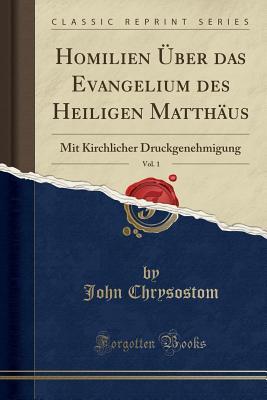
Homilien �ber Das Evangelium Des Heiligen Matth�us, Vol. 1: Mit Kirchlicher Druckgenehmigung (Classic Reprint)
by John Chrysostom
Excerpt from Homilien �ber das Evangelium des Heiligen Matth�us, Vol. 1: Mit Kirchlicher Druckgenehmigung
Der Damaligen 8uft�nde Der C&hriftenheit, 1a fogar Der �ffentlichen (c)1tten und (c)ebr�uche jener Seit, namentlich in gro�en (c)tiidten, noch mehr aber eine reiche Quelle bon %etrachtungen, bon praltifchem 91ugen, ein %orbilb fiir jeden %rediger und %olt�mann aller Seiten. %311hrend in Der (c)chriftertl�rung (shrhfoftomu� fich al� Den n�ch= ternen berft�ndigen @regeten herbortut, Der Darin, in Der fluren a�legnng De� meitan� alle andern S11rchenb�ter �berragt, 5eigt er fich hier in Diefem (c)chlu� teile al� Der 9j1ann Der h�chften %ragi� und De� 8eben�. 03r bereinigt beide %or5uge in fich. Sin Der theoretifchen 2lu�legung ift er un�bertroffen, und in Der brattifchen 9lntnendung ebenfo unbergleichbar. %on felber berfteht e� fich, Da� Der Beier fich nicht mit allen (R)chriftau� legungen De� heiligen @hrtfioftomu� 5u 1dentifi5ieren braucht. �ber jedenfall� merden Die meiften feiner Qlu�legungen Die %robe fiir alle Beiten beftehen. Qba� Den Dogmatifchen 8nhalt betrifft, fo ift 5u bemerfen, Da� Der ber�hmte %rediger bor Den belagianifchen (c)treitigfeiten lebte und Daher noch feine flar beftimmte 8ehre �ber Da� %erh�lt= ni� bon g�ttlicher @nabe und menfchlicher {freiheit befa�. 9ll� ein fehr energifcher (R)eift betont er meiften� fehr ftarf Die %1llen�anftrengungen De� 9j1enfchen und fo t�nnte e� faft erfcheinen, al� lie�e er Die (R)nade 5n fur5 fommen. @benfo lebte er bor Dem @on5il bon @phefu�, welche� 481 ftatt= fand und Die %3111de Der allerfeligften %ungfrau al� "@oite�geb�rerin herborhob. 9j1�ge fich Darum nie= mand Daran fto�en, wenn er fich mehrfach in Den (c)omilien �ber Die 931utter (R)otte� in einer %cife au�fpricht, Die erfennen l��t, Da� er ihr %ehler, menu auch nicht gro�e, 5ufchreibt. die� ift fpe5iell be5iiglich Der 41. Sjomilie Der %all.
About the Publisher
Forgotten Books publishes hundreds of thousands of rare and classic books. Find more at www.forgottenbooks.comwww.forgottenbooks.com
This book is a reproduction of an important historical work. Forgotten Books uses state-of-the-art technology to digitally reconstruct the work, preserving the original format whilst repairing imperfections present in the aged copy. In rare cases, an imperfection in the original, such as a blemish or missing page, may be replicated in our edition. We do, however, repair the vast majority of imperfections successfully; any imperfections that remain are intentionally left to preserve the state of such historical works.
Der Damaligen 8uft�nde Der C&hriftenheit, 1a fogar Der �ffentlichen (c)1tten und (c)ebr�uche jener Seit, namentlich in gro�en (c)tiidten, noch mehr aber eine reiche Quelle bon %etrachtungen, bon praltifchem 91ugen, ein %orbilb fiir jeden %rediger und %olt�mann aller Seiten. %311hrend in Der (c)chriftertl�rung (shrhfoftomu� fich al� Den n�ch= ternen berft�ndigen @regeten herbortut, Der Darin, in Der fluren a�legnng De� meitan� alle andern S11rchenb�ter �berragt, 5eigt er fich hier in Diefem (c)chlu� teile al� Der 9j1ann Der h�chften %ragi� und De� 8eben�. 03r bereinigt beide %or5uge in fich. Sin Der theoretifchen 2lu�legung ift er un�bertroffen, und in Der brattifchen 9lntnendung ebenfo unbergleichbar. %on felber berfteht e� fich, Da� Der Beier fich nicht mit allen (R)chriftau� legungen De� heiligen @hrtfioftomu� 5u 1dentifi5ieren braucht. �ber jedenfall� merden Die meiften feiner Qlu�legungen Die %robe fiir alle Beiten beftehen. Qba� Den Dogmatifchen 8nhalt betrifft, fo ift 5u bemerfen, Da� Der ber�hmte %rediger bor Den belagianifchen (c)treitigfeiten lebte und Daher noch feine flar beftimmte 8ehre �ber Da� %erh�lt= ni� bon g�ttlicher @nabe und menfchlicher {freiheit befa�. 9ll� ein fehr energifcher (R)eift betont er meiften� fehr ftarf Die %1llen�anftrengungen De� 9j1enfchen und fo t�nnte e� faft erfcheinen, al� lie�e er Die (R)nade 5n fur5 fommen. @benfo lebte er bor Dem @on5il bon @phefu�, welche� 481 ftatt= fand und Die %3111de Der allerfeligften %ungfrau al� "@oite�geb�rerin herborhob. 9j1�ge fich Darum nie= mand Daran fto�en, wenn er fich mehrfach in Den (c)omilien �ber Die 931utter (R)otte� in einer %cife au�fpricht, Die erfennen l��t, Da� er ihr %ehler, menu auch nicht gro�e, 5ufchreibt. die� ift fpe5iell be5iiglich Der 41. Sjomilie Der %all.
About the Publisher
Forgotten Books publishes hundreds of thousands of rare and classic books. Find more at www.forgottenbooks.comwww.forgottenbooks.com
This book is a reproduction of an important historical work. Forgotten Books uses state-of-the-art technology to digitally reconstruct the work, preserving the original format whilst repairing imperfections present in the aged copy. In rare cases, an imperfection in the original, such as a blemish or missing page, may be replicated in our edition. We do, however, repair the vast majority of imperfections successfully; any imperfections that remain are intentionally left to preserve the state of such historical works.
BUY NOW
Paperback, 716 pages
Published February 10th 2019 by Forgotten Books
Subscribe
Get Bible verse every day in your inbox
Read on Mobile


Group of Brands


© 2026 Bibleportal.com All rights reserved.
John Chrysostom (349 - 407)
Read freely text sermons and articles by the speaker John Chrysostom in text and pdf format Archbishop of Constantinople, was an important Early Church Father. He is known for his preaching and public speaking, his denunciation of abuse of authority by both ecclesiastical and political leaders, the Divine Liturgy of St. John Chrysostom, and his ascetic sensibilities. The epithet Χρυσόστομος (Chrysostomos, anglicized as Chrysostom) means "golden-mouthed" in Greek and given for his celebrated eloquence.The Eastern Orthodox and Byzantine Catholic churches honor him as a saint and count him among the Three Holy Hierarchs, together with Basil the Great and Gregory Nazianzus. He is recognized by the Eastern Orthodox Church and the Catholic Church as a saint and as a Doctor of the Church. Churches of the Western tradition, including the Roman Catholic Church, some Anglican provinces, and some Lutheran churches, commemorate him on 13 September. Some other Lutheran churches and Anglican provinces commemorate him on the traditional Eastern feast day of 27 January. Chrysostom's extant homiletical works are vast, including many hundreds of exegetical homilies on both the New Testament (especially the works of Saint Paul) and the Old Testament (particularly on Genesis). Among his extant exegetical works are sixty-seven homilies on Genesis, fifty-nine on the Psalms, ninety on the Gospel of Matthew, eighty-eight on the Gospel of John, and fifty-five on the Acts of the Apostles.
John Chrysostom, Archbishop of Constantinople, was an important Early Church Father. He is known for his eloquence in preaching and public speaking, and his denunciation of abuse of authority by both ecclesiastical and political leaders.
Chrysostom is known in Christianity chiefly as a preacher, theologian and liturgist, particularly in the Eastern Orthodox Church.
During a time when city clergy were subject to criticism for their high lifestyle, John was determined to reform his clergy in Constantinople. These efforts were met with resistance and limited success. He was an excellent preacher. As a theologian, he has been and continues to be very important in Eastern Christianity, and is generally considered the most prominent doctor of the Greek Church, but has been less important to Western Christianity.
His writings have survived to the present day more so than any of the other Greek Fathers. He rejected the contemporary trend for allegory, instead speaking plainly and applying Bible passages and lessons to everyday life.
... Show more