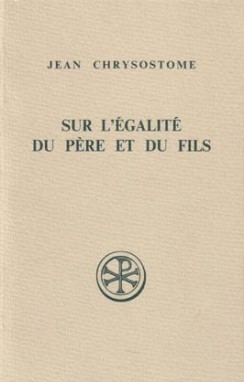
Les six homélies éditées dans ce volume : « Sur l'égalité du Père et du Fils » ont, malgré la différence du titre, un lien étroit avec les homélies « Sur l'incompréhensibilité de Dieu » (SC n° 28 bis). Ce sont deux aspects complémentaires du mystère chrétien. L'incompréhensibilité de Dieu s'impose en même temps que son existence. Mais l'Incarnation de Dieu en ce monde est un défi à la raison humaine, et c'est pourquoi les hommes ont tant de peine à accepter, la divinité de Jésus. Dans l'évangile (Matthieu 11, 4 et 12, 8), le Christ donne comme preuve de sa divinité les miracles accomplis au cours de sa vie publique. À son tour, Jean Chrysostome voit dans ces miracles, la meilleure réfutation de l'hérésie et les met en valeur avec toutes les ressources de son éloquence, tantôt fidèle aux règles de la rhétorique, tantôt se laissant aller à une parole spontanée. C'est Montfaucon qui a réuni ces textes pour la première fois. Les sources manuscrites variant avec chaque homélie, l'éditeur actuel a été amené à consulter quarante-huit manuscrits. Il ne prétend pas pour autant, avoir retrouvé le texte original. L'ensemble que forment ces homélies avec celles qui sont contenues dans le n° 28 bis offre une catéchèse où se trouve exposé l'essentiel de la foi chrétienne. Selon le vœu de Jean Chrysostome (Cat. II, 1, « au peuple d'Antioche », PG 49, 231), puissent-elles résonner longtemps dans les âmes.



John Chrysostom (349 - 407)
Read freely text sermons and articles by the speaker John Chrysostom in text and pdf format Archbishop of Constantinople, was an important Early Church Father. He is known for his preaching and public speaking, his denunciation of abuse of authority by both ecclesiastical and political leaders, the Divine Liturgy of St. John Chrysostom, and his ascetic sensibilities. The epithet Χρυσόστομος (Chrysostomos, anglicized as Chrysostom) means "golden-mouthed" in Greek and given for his celebrated eloquence.The Eastern Orthodox and Byzantine Catholic churches honor him as a saint and count him among the Three Holy Hierarchs, together with Basil the Great and Gregory Nazianzus. He is recognized by the Eastern Orthodox Church and the Catholic Church as a saint and as a Doctor of the Church. Churches of the Western tradition, including the Roman Catholic Church, some Anglican provinces, and some Lutheran churches, commemorate him on 13 September. Some other Lutheran churches and Anglican provinces commemorate him on the traditional Eastern feast day of 27 January. Chrysostom's extant homiletical works are vast, including many hundreds of exegetical homilies on both the New Testament (especially the works of Saint Paul) and the Old Testament (particularly on Genesis). Among his extant exegetical works are sixty-seven homilies on Genesis, fifty-nine on the Psalms, ninety on the Gospel of Matthew, eighty-eight on the Gospel of John, and fifty-five on the Acts of the Apostles.
John Chrysostom, Archbishop of Constantinople, was an important Early Church Father. He is known for his eloquence in preaching and public speaking, and his denunciation of abuse of authority by both ecclesiastical and political leaders.
Chrysostom is known in Christianity chiefly as a preacher, theologian and liturgist, particularly in the Eastern Orthodox Church.
During a time when city clergy were subject to criticism for their high lifestyle, John was determined to reform his clergy in Constantinople. These efforts were met with resistance and limited success. He was an excellent preacher. As a theologian, he has been and continues to be very important in Eastern Christianity, and is generally considered the most prominent doctor of the Greek Church, but has been less important to Western Christianity.
His writings have survived to the present day more so than any of the other Greek Fathers. He rejected the contemporary trend for allegory, instead speaking plainly and applying Bible passages and lessons to everyday life.
... Show more