
- Bible
- Read the Bible
- Bible Versions
- Verse of the Day
- Reading Plans
- Verses by Topic
- Books of the Bible
- Bible Images
- Study
- Commentaries
- Concordances
- Dictionaries
- Encyclopedias
- Sermons
- Bible Atlas & Maps
- BP Wiki
- Devotionals
- Today's Devotionals
- All Devotionals
- Inspirational Quotes
- More
- Picture Quotes
- Videos
- Inspirational
- Bible Study
- What The Bible Says
- Bible Q&As
- Daily Bread
- Bible by Genre
- Bible Stories
- Random Bible Verse
- Community
- Store
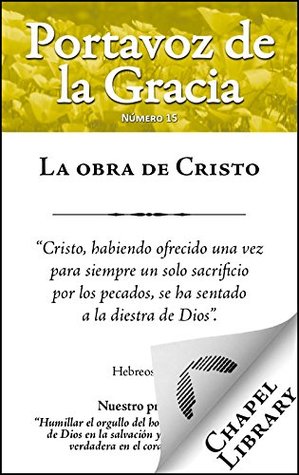
La obra de Cristo (Portavoz de la Gracia nº 15)
by John Flavel
La inspirada Epístola a los Hebreos dice: “Pero Cristo, habiendo ofrecido una vez para siempre un solo sacrificio por los pecados, se ha sentado a la diestra de Dios” (Heb. 10:12). ¡Esta es una declaración sensacional! No podemos leer estas veintidós palabras bajo la iluminación del Espíritu Santo, el estudio diligente y la meditación sin que nuestro corazón se conmueva ni nuestra alma ansíe adorar al Señor. ¡Señor, perdona nuestra falta de entusiasmo! Aquí, en veintidós palabras tenemos el resumen de la obra de Jesucristo, el propósito eterno de Dios manifestado en el Hijo eterno de Dios. Aquí frente a nosotros están las glorias de este hombre Cristo: Cristo el Hijo, Cristo el Mediador, Cristo el Profeta, Cristo el Sacerdote, Cristo el Rey. Aquí está el perdón de los pecados logrado para siempre con “un solo sacrificio”. ¡Aquí está todo lo infinitamente necesario para salvar y preservar al pueblo de Dios por toda la eternidad! ¡Todo! Designado en la eternidad antes de la Creación, enviado al mundo, encarnado por la concepción milagrosa en el vientre de la Virgen, obediente a la Ley, crucificado, resucitado, ascendido al cielo y sentado en glorioso esplendor. Cristo cumplió con su muerte la obra que su Padre decretó antes de la fundación del mundo. Aquí está el Garante, aquí está el Sustituto que vino a morir en una agonía horrorosa en la cruenta cruz del Calvario. Aquí está el que resucitó el tercer día con gran poder y gloria, venciendo a la muerte, al infierno, al mundo y a Satanás. Cada aspecto y cada detalle de todo lo que su Santo Padre le dio para hacer a fin de salvar a su pueblo de la pena, el poder, el placer y la presencia del pecado —todo— Jesús lo logró todo. La Persona y la obra de Cristo son la razón de la historia, el enfoque de la Biblia, el objeto de la fe salvadora y la única esperanza de vida eterna y del futuro. Jesucristo es la realidad más sorprendente y magnífica en el universo.
BUY NOW
Kindle Edition, 81 pages
Published January 18th 2016 by Chapel Library (first published 2015)
Subscribe
Get Bible verse every day in your inbox
Read on Mobile


Group of Brands


© 2026 Bibleportal.com All rights reserved.
John Flavel (1628 - 1691)
Was an English Presbyterian clergyman, puritan, and author. Flavel, the eldest son of the Rev. Richard Flavel, described as ‘a painful and eminent minister,’ who was incumbent successively of Bromsgrove, Worcestershire, Hasler and Willersey, Gloucestershire (from which last living he was ejected in 1662), was born in or about 1630 at Bromsgrove.He was ejected from his living by the passing of the Act of Uniformity in 1662, but continued to preach and administer the sacraments privately till the Five Mile Act of 1665, when he retired to Slapton, 5 miles away. He then lived for a time in London, but returned to Dartmouth, where he labored till his death in 1691. He was married four times. He was a vigorous and voluminous writer, and not without a play of fine fancy. His principal works are his Navigation Spiritualized (1671); The Fountain of Life, in forty-two Sermons (1672); The Method of Grace (1680); Pneumatologia, a Treatise on the Soul of Man (1698); A Token for Mourners; Husbandry Spiritualized (1699).
John Flavel was an English Presbyterian clergyman. Flavel was born at Bromsgrove, Worcestershire and studied at Oxford. A Presbyterian, held livings at Diptford (in Devon) and Dartmouth. He was ejected from the latter as a result of the Great Ejection of 1662; however, he continued to preach there secretly. After the Declaration of Indulgence 1687, became a minister of a Nonconformist Church there.
He was a prolific and popular author. Among his works are The Mystery of Providence (1678), Husbandry Spiritualised (1669) and Navigation Spiritualised (1671), The Seamon's Companion (1676), titles which suggest some of his characteristics as a writer.
He died at Exeter, Devonshire, on 26 June 1691. Flavel is commemorated in the name of Flavel Road on Bromsgrove's Charford Estate.
John Flavel (or Flavell) was born in 1628 in Bromsgrove, Worcestershire. He was the son of Richard Flavel, a minister who died of the plague in 1665 while in prison for nonconformity. John Flavel was educated by his father in the ways of religion, then "plied his studies hard" as a commoner at University College, Oxford. In 1650, he was ordained by the presbytery at Salisbury. He settled in Diptford, where he honed his numerous gifts.
He married Joan Randall, a godly woman, who died while giving birth to their first child in 1655. The baby died as well. After a year of mourning, Flavel married Elizabeth Stapell and was again blessed with a close, God-fearing marriage, as well as children.
In 1656, Flavel accepted a call to be minister in the thriving seaport of Dartmouth. He earned a smaller income there, but his work was more profitable; many were converted. One of his parishioners wrote of Flavel, "I could say much, though not enough of the excellency of his preaching; of his seasonable, suitable, and spiritual matter; of his plain expositions of Scripture; his talking method, his genuine and natural deductions, his convincing arguments, his clear and powerful demonstrations, his heart-searching applications, and his comfortable supports to those that were afflicted in conscience. In short, that person must have a very soft head, or a very hard heart, or both, that could sit under his ministry unaffected."
... Show more