
- Bible
- Read the Bible
- Bible Versions
- Verse of the Day
- Reading Plans
- Verses by Topic
- Books of the Bible
- Bible Images
- Study
- Commentaries
- Concordances
- Dictionaries
- Encyclopedias
- Sermons
- Bible Atlas & Maps
- BP Wiki
- Devotionals
- Today's Devotionals
- All Devotionals
- Inspirational Quotes
- More
- Picture Quotes
- Videos
- Inspirational
- Bible Study
- What The Bible Says
- Bible Q&As
- Daily Bread
- Bible by Genre
- Bible Stories
- Random Bible Verse
- Community
- Store
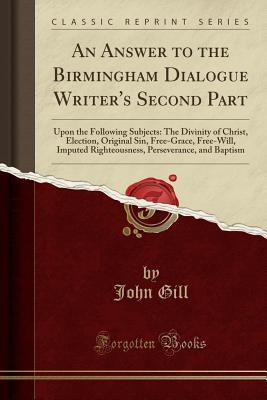
Excerpt from An Answer to the Birmingham Dialogue Writer's Second Part: Upon the Following Subjects: The Divinity of Christ, Election, Original Sin, Free-Grace, Free-Will, Imputed Righteousness, Perseverance, and Baptism
Oi. This writer having afferted in his Pirji Part that Chril't is God, or a God, becaufe the Father hath given him divine perfeftions, the following argument was formed in anfwer to it: If the Father has given to Chrifizdivine perfections, for which reafon he is God, or a God, he has either given him only, fome divine perfeetions, or all divine perfections; if he has only given him fome divine perfeetions, then he is imperfeetly God, or an imperfect one; if he has given him all divine perfeetions, then he mui't be equal to him. Now this was argumentum aa' bo minem, an argument formed on his own principles, and not mine, as any one who has the leaf't {hare of common fenfe and underi'tanding will eafily obferve; and yet this man, either ignorantly or wilfully, re prefents it as an argument proceeding upon my own principles; whereas it is he, and not I, that fays, the Father has given to Chrift divine perfee'tions. I af firm, that all that the Father hath are his; he pof felfes and enjoys all divine perfections, not ey gift.
About the Publisher
Forgotten Books publishes hundreds of thousands of rare and classic books. Find more at www.forgottenbooks.comwww.forgottenbooks.com
This book is a reproduction of an important historical work. Forgotten Books uses state-of-the-art technology to digitally reconstruct the work, preserving the original format whilst repairing imperfections present in the aged copy. In rare cases, an imperfection in the original, such as a blemish or missing page, may be replicated in our edition. We do, however, repair the vast majority of imperfections successfully; any imperfections that remain are intentionally left to preserve the state of such historical works.
Oi. This writer having afferted in his Pirji Part that Chril't is God, or a God, becaufe the Father hath given him divine perfeftions, the following argument was formed in anfwer to it: If the Father has given to Chrifizdivine perfections, for which reafon he is God, or a God, he has either given him only, fome divine perfeetions, or all divine perfections; if he has only given him fome divine perfeetions, then he is imperfeetly God, or an imperfect one; if he has given him all divine perfeetions, then he mui't be equal to him. Now this was argumentum aa' bo minem, an argument formed on his own principles, and not mine, as any one who has the leaf't {hare of common fenfe and underi'tanding will eafily obferve; and yet this man, either ignorantly or wilfully, re prefents it as an argument proceeding upon my own principles; whereas it is he, and not I, that fays, the Father has given to Chrift divine perfee'tions. I af firm, that all that the Father hath are his; he pof felfes and enjoys all divine perfections, not ey gift.
About the Publisher
Forgotten Books publishes hundreds of thousands of rare and classic books. Find more at www.forgottenbooks.comwww.forgottenbooks.com
This book is a reproduction of an important historical work. Forgotten Books uses state-of-the-art technology to digitally reconstruct the work, preserving the original format whilst repairing imperfections present in the aged copy. In rare cases, an imperfection in the original, such as a blemish or missing page, may be replicated in our edition. We do, however, repair the vast majority of imperfections successfully; any imperfections that remain are intentionally left to preserve the state of such historical works.
BUY NOW
Paperback, 58 pages
Published January 24th 2019 by Forgotten Books


Group of Brands


© 2026 Bibleportal.com All rights reserved.
John Gill (1697 - 1771)
Was an English Baptist pastor, biblical scholar, and theologian who held to a firm Calvinistic soteriology. Born in Kettering, Northamptonshire, he attended Kettering Grammar School where he mastered the Latin classics and learned Greek by age 11. He continued self-study in everything from logic to Hebrew, his love for the latter remaining throughout his life.His first pastoral work was as an intern assisting John Davis at Higham Ferrers in 1718 at age 21. He became pastor at the Strict Baptist church at Goat Yard Chapel, Horsleydown, Southwark in 1719. His pastorate lasted 51 years. In 1757 his congregation needed larger premises and moved to a Carter Lane, St. Olave's Street, Southwark. This Baptist church was once pastored by Benjamin Keach and would later become the New Park Street Chapel and then the Metropolitan Tabernacle pastored by Charles Spurgeon. During Gill's ministry, the church strongly supported the preaching of George Whitefield at nearby Kennington Common.
John Gill was an English Baptist, biblical scholar, "Jehovist", and held to a staunch Calvinistic Soteriology. Born in Kettering, Northamptonshire, he attended Kettering Grammar School where he mastered the Latin classics and learned Greek by age 11. He continued self-study in everything from logic to Hebrew, his love for the latter remaining throughout his life.
At the age of about 12, Gill heard a sermon from his pastor, William Wallis, on the text, "And the Lord called unto Adam, and said unto him, where art thou?" (Genesis 3:9). The message stayed with Gill and eventually led to his conversion. It was not until seven years later that he made a public profession when he was 18.
His first pastoral work was as an intern assisting John Davis at Higham Ferrers in 1718 at age 21. He became pastor at the Strict Baptist church at Goat Yard Chapel, Horsleydown, Southwark in 1719. His pastorate lasted 51 years. In 1757 his congregation needed larger premises and moved to a Carter Lane, St. Olave’s Street, Southwark. This Baptist church was once pastored by Benjamin Keach and would later become the New Park Street Chapel and then the Metropolitan Tabernacle pastored by Charles Spurgeon.
In 1748, Gill was awarded the honorary degree of Doctor of Divinity by the University of Aberdeen. He was a profound scholar and a prolific author, publishing many works.
... Show more