
- Bible
- Read the Bible
- Bible Versions
- Verse of the Day
- Reading Plans
- Verses by Topic
- Books of the Bible
- Bible Images
- Study
- Commentaries
- Concordances
- Dictionaries
- Encyclopedias
- Sermons
- Bible Atlas & Maps
- BP Wiki
- Devotionals
- Today's Devotionals
- Light of the World
- All Devotionals
- Inspirational Quotes
- More
- Picture Quotes
- Videos
- Inspirational
- Bible Study
- What The Bible Says
- Bible Q&As
- Daily Bread
- Bible by Genre
- Bible Stories
- Random Bible Verse
- Community
- Store
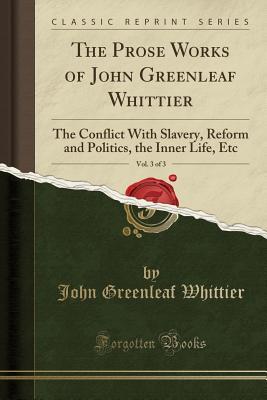
The Prose Works of John Greenleaf Whittier, Vol. 3 of 3: The Conflict with Slavery, Reform and Politics, the Inner Life, Etc (Classic Reprint)
by John Greenleaf Whittier
Excerpt from The Prose Works of John Greenleaf Whittier, Vol. 3 of 3: The Conflict With Slavery, Reform and Politics, the Inner Life, Etc
There is a law above all the enactments of human codes, the same throughout the world, the same in all time, - such as it was before the daring genius of Columbus pierced the night of ages, and Opened to one world the sources of wealth and power and knowledge, to another all unutterable woes; such as it is at this day: it is the law written by the finger of God upon the heart of man; and by that law, unchangeable and eternal while men despise fraud, and loathe rapine, and abhor blood, they shall reject with indignation the wild and guilty fantasy that man can hold property in man. Lord brougham.
About the Publisher
Forgotten Books publishes hundreds of thousands of rare and classic books. Find more at www.forgottenbooks.comwww.forgottenbooks.com
This book is a reproduction of an important historical work. Forgotten Books uses state-of-the-art technology to digitally reconstruct the work, preserving the original format whilst repairing imperfections present in the aged copy. In rare cases, an imperfection in the original, such as a blemish or missing page, may be replicated in our edition. We do, however, repair the vast majority of imperfections successfully; any imperfections that remain are intentionally left to preserve the state of such historical works.
There is a law above all the enactments of human codes, the same throughout the world, the same in all time, - such as it was before the daring genius of Columbus pierced the night of ages, and Opened to one world the sources of wealth and power and knowledge, to another all unutterable woes; such as it is at this day: it is the law written by the finger of God upon the heart of man; and by that law, unchangeable and eternal while men despise fraud, and loathe rapine, and abhor blood, they shall reject with indignation the wild and guilty fantasy that man can hold property in man. Lord brougham.
About the Publisher
Forgotten Books publishes hundreds of thousands of rare and classic books. Find more at www.forgottenbooks.comwww.forgottenbooks.com
This book is a reproduction of an important historical work. Forgotten Books uses state-of-the-art technology to digitally reconstruct the work, preserving the original format whilst repairing imperfections present in the aged copy. In rare cases, an imperfection in the original, such as a blemish or missing page, may be replicated in our edition. We do, however, repair the vast majority of imperfections successfully; any imperfections that remain are intentionally left to preserve the state of such historical works.
BUY NOW
Paperback, 408 pages
Published October 15th 2018 by Forgotten Books
Subscribe
Get Bible verse every day in your inbox
Read on Mobile


Group of Brands


© 2026 Bibleportal.com All rights reserved.
1807-1892
John Greenleaf Whittier was an influential American Quaker poet and ardent advocate of the abolition of slavery in the United States.
Although he received little formal education, he was an avid reader who studied his father's six books on Quakerism until their teachings became the foundation of his ideology. Whittier was heavily influenced by the doctrines of his religion, particularly its stress on humanitarianism, compassion, and social responsibility.
Whittier produced two collections of antislavery poetry: Poems Written during the Progress of the Abolition Question in the United States, between 1830 and 1838 and Voices of Freedom (1846). He was an elector in the presidential election of 1860 and of 1864, voting for Abraham Lincoln both times.
The passage of the Thirteenth Amendment in 1865 ended both slavery and his public cause, so Whittier turned to other forms of poetry for the remainder of his life.
... Show more