
- Bible
- Read the Bible
- Bible Versions
- Verse of the Day
- Reading Plans
- Verses by Topic
- Books of the Bible
- Bible Images
- Study
- Commentaries
- Concordances
- Dictionaries
- Encyclopedias
- Sermons
- Bible Atlas & Maps
- BP Wiki
- Devotionals
- Today's Devotionals
- Light of the World
- All Devotionals
- Inspirational Quotes
- More
- Picture Quotes
- Videos
- Inspirational
- Bible Study
- What The Bible Says
- Bible Q&As
- Daily Bread
- Bible by Genre
- Bible Stories
- Random Bible Verse
- Community
- Store
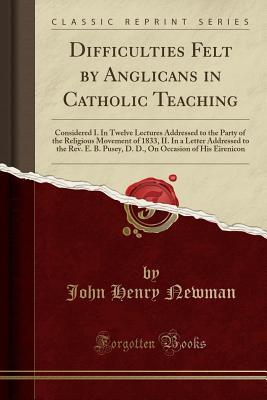
Excerpt from Difficulties Felt by Anglicans in Catholic Teaching: Considered I. In Twelve Lectures Addressed to the Party of the Religious Movement of 1833, II. In a Letter Addressed to the Rev. E. B. Pusey, D. D., On Occasion of His Eirenicon
Those surely who are advancing towards the Church, would not have advanced so far as they have, had they not had sufficient arguments to bring them still further. What retards their progress is not any weakness in those arguments, but the force Of Opposite considera tions, speculative or practical, which are urged, some times against the Church, sometimes against their own submitting to her authority. They would have no doubt about their duty, but for the charges brought against her, or the remonstrances addressed to themselves; charges and remonstrances which, whatever their logical cogency, are abundantly sufficient for their purpose, in a case where there are so many inducements, whether from wrong feeling, or infirmity, or even error of con science, to listen to them. Such persons, then, have a claim on us to be fortified in their right perceptions.
About the Publisher
Forgotten Books publishes hundreds of thousands of rare and classic books. Find more at www.forgottenbooks.comwww.forgottenbooks.com
This book is a reproduction of an important historical work. Forgotten Books uses state-of-the-art technology to digitally reconstruct the work, preserving the original format whilst repairing imperfections present in the aged copy. In rare cases, an imperfection in the original, such as a blemish or missing page, may be replicated in our edition. We do, however, repair the vast majority of imperfections successfully; any imperfections that remain are intentionally left to preserve the state of such historical works.
Those surely who are advancing towards the Church, would not have advanced so far as they have, had they not had sufficient arguments to bring them still further. What retards their progress is not any weakness in those arguments, but the force Of Opposite considera tions, speculative or practical, which are urged, some times against the Church, sometimes against their own submitting to her authority. They would have no doubt about their duty, but for the charges brought against her, or the remonstrances addressed to themselves; charges and remonstrances which, whatever their logical cogency, are abundantly sufficient for their purpose, in a case where there are so many inducements, whether from wrong feeling, or infirmity, or even error of con science, to listen to them. Such persons, then, have a claim on us to be fortified in their right perceptions.
About the Publisher
Forgotten Books publishes hundreds of thousands of rare and classic books. Find more at www.forgottenbooks.comwww.forgottenbooks.com
This book is a reproduction of an important historical work. Forgotten Books uses state-of-the-art technology to digitally reconstruct the work, preserving the original format whilst repairing imperfections present in the aged copy. In rare cases, an imperfection in the original, such as a blemish or missing page, may be replicated in our edition. We do, however, repair the vast majority of imperfections successfully; any imperfections that remain are intentionally left to preserve the state of such historical works.
Paperback, 422 pages
Published July 30th 2018 by Forgotten Books (first published September 27th 2015)
Subscribe
Get Bible verse every day in your inbox
Read on Mobile


Group of Brands


© 2026 Bibleportal.com All rights reserved.
John Henry Newman was a Roman Catholic priest and cardinal who converted to Roman Catholicism from Anglicanism in October 1845. In early life, he was a major figure in the Oxford Movement to bring the Church of England back to its Catholic roots.
Eventually his studies in history persuaded him to become a Roman Catholic. Both before and after becoming a Roman Catholic, he wrote a number of influential books.
... Show more