
- Bible
- Read the Bible
- Bible Versions
- Verse of the Day
- Reading Plans
- Verses by Topic
- Books of the Bible
- Bible Images
- Study
- Commentaries
- Concordances
- Dictionaries
- Encyclopedias
- Sermons
- Bible Atlas & Maps
- BP Wiki
- Devotionals
- Today's Devotionals
- Light of the World
- All Devotionals
- Inspirational Quotes
- More
- Picture Quotes
- Videos
- Inspirational
- Bible Study
- What The Bible Says
- Bible Q&As
- Daily Bread
- Bible by Genre
- Bible Stories
- Random Bible Verse
- Community
- Store
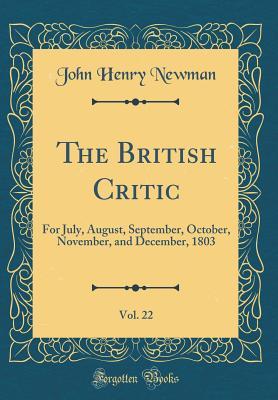
The British Critic, Vol. 22: For July, August, September, October, November, and December, 1803 (Classic Reprint)
by John Henry Newman
Excerpt from The British Critic, Vol. 22: For July, August, September, October, November, and December, 1803
No file for books, is daily declared, with much folemnity, by thofe who feel a momentary intereli in having it believed; by thol'e who with to difcourage the hopes of an author, or lower the price of his labours: yet Reviewers of all defcriptions flill find it diflicult to keep pace with the works that iflite from the prefs; and have no defence for their omif. Fions, but that neceflity which they all experiencea That we are not more deficient in this ref than our neighbours, we have fearon feel a ured; ye: our half yearly (election genera y works which certainly belong n0t firifily to period. It is our own half year, act that of e chronology, from which we make our choice. A little time, however, places all on an equality, and they who have been noticed early, and they Whom accident has caul'ed to wait, are alike recorded in our progrellive regifier. We begin at prefent, as we have mvariably done, with that which we regard as M.
About the Publisher
Forgotten Books publishes hundreds of thousands of rare and classic books. Find more at www.forgottenbooks.comwww.forgottenbooks.com
This book is a reproduction of an important historical work. Forgotten Books uses state-of-the-art technology to digitally reconstruct the work, preserving the original format whilst repairing imperfections present in the aged copy. In rare cases, an imperfection in the original, such as a blemish or missing page, may be replicated in our edition. We do, however, repair the vast majority of imperfections successfully; any imperfections that remain are intentionally left to preserve the state of such historical works.
No file for books, is daily declared, with much folemnity, by thofe who feel a momentary intereli in having it believed; by thol'e who with to difcourage the hopes of an author, or lower the price of his labours: yet Reviewers of all defcriptions flill find it diflicult to keep pace with the works that iflite from the prefs; and have no defence for their omif. Fions, but that neceflity which they all experiencea That we are not more deficient in this ref than our neighbours, we have fearon feel a ured; ye: our half yearly (election genera y works which certainly belong n0t firifily to period. It is our own half year, act that of e chronology, from which we make our choice. A little time, however, places all on an equality, and they who have been noticed early, and they Whom accident has caul'ed to wait, are alike recorded in our progrellive regifier. We begin at prefent, as we have mvariably done, with that which we regard as M.
About the Publisher
Forgotten Books publishes hundreds of thousands of rare and classic books. Find more at www.forgottenbooks.comwww.forgottenbooks.com
This book is a reproduction of an important historical work. Forgotten Books uses state-of-the-art technology to digitally reconstruct the work, preserving the original format whilst repairing imperfections present in the aged copy. In rare cases, an imperfection in the original, such as a blemish or missing page, may be replicated in our edition. We do, however, repair the vast majority of imperfections successfully; any imperfections that remain are intentionally left to preserve the state of such historical works.
BUY NOW
Hardcover, 742 pages
Published November 30th 2018 by Forgotten Books
Subscribe
Get Bible verse every day in your inbox
Read on Mobile


Group of Brands


© 2026 Bibleportal.com All rights reserved.
John Henry Newman was a Roman Catholic priest and cardinal who converted to Roman Catholicism from Anglicanism in October 1845. In early life, he was a major figure in the Oxford Movement to bring the Church of England back to its Catholic roots.
Eventually his studies in history persuaded him to become a Roman Catholic. Both before and after becoming a Roman Catholic, he wrote a number of influential books.
... Show more