
- Bible
- Read the Bible
- Bible Versions
- Verse of the Day
- Reading Plans
- Verses by Topic
- Books of the Bible
- Bible Images
- Study
- Commentaries
- Concordances
- Dictionaries
- Encyclopedias
- Sermons
- Bible Atlas & Maps
- BP Wiki
- Devotionals
- Today's Devotionals
- All Devotionals
- Inspirational Quotes
- More
- Picture Quotes
- Videos
- Inspirational
- Bible Study
- What The Bible Says
- Bible Q&As
- Daily Bread
- Bible by Genre
- Bible Stories
- Random Bible Verse
- Community
- Store
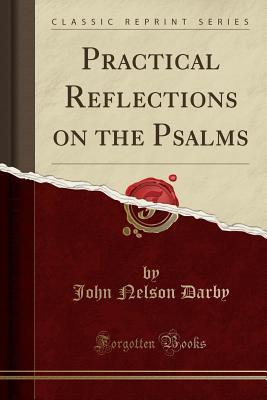
Practical Reflections on the Psalms (Classic Reprint)
by John Nelson Darby
Excerpt from Practical Reflections on the Psalms
Synopsis of the Books of the Bible. Vol. Ii. Morrish London.
When at peace with God, the heart turns back from the Epistles where the work of Christ is unfolded, and all needed to set the soul at rest and peace with God is made known; it turns back to the Gospels to learn the ways, and thoughts and actions of Him who loved us and gave Himself for us. It truns back still - when rightly informed as to the true meaning of the Psalms, - te them, and learns the heart of Christ, and how His sympathies enter into, and give a voice to the exercises of His people's hearts. He learned all this when in divine grace, He entered into that order of suffering, especially at the close of His life on earth, in order to be able to speak a word in season to him who is weary. It learns too the plaint of His own heart, at moments when no human heart could ever fathom the deep waters of anguish His holy soul passed through.
About the Publisher
Forgotten Books publishes hundreds of thousands of rare and classic books. Find more at www.forgottenbooks.comwww.forgottenbooks.com
This book is a reproduction of an important historical work. Forgotten Books uses state-of-the-art technology to digitally reconstruct the work, preserving the original format whilst repairing imperfections present in the aged copy. In rare cases, an imperfection in the original, such as a blemish or missing page, may be replicated in our edition. We do, however, repair the vast majority of imperfections successfully; any imperfections that remain are intentionally left to preserve the state of such historical works.
Synopsis of the Books of the Bible. Vol. Ii. Morrish London.
When at peace with God, the heart turns back from the Epistles where the work of Christ is unfolded, and all needed to set the soul at rest and peace with God is made known; it turns back to the Gospels to learn the ways, and thoughts and actions of Him who loved us and gave Himself for us. It truns back still - when rightly informed as to the true meaning of the Psalms, - te them, and learns the heart of Christ, and how His sympathies enter into, and give a voice to the exercises of His people's hearts. He learned all this when in divine grace, He entered into that order of suffering, especially at the close of His life on earth, in order to be able to speak a word in season to him who is weary. It learns too the plaint of His own heart, at moments when no human heart could ever fathom the deep waters of anguish His holy soul passed through.
About the Publisher
Forgotten Books publishes hundreds of thousands of rare and classic books. Find more at www.forgottenbooks.comwww.forgottenbooks.com
This book is a reproduction of an important historical work. Forgotten Books uses state-of-the-art technology to digitally reconstruct the work, preserving the original format whilst repairing imperfections present in the aged copy. In rare cases, an imperfection in the original, such as a blemish or missing page, may be replicated in our edition. We do, however, repair the vast majority of imperfections successfully; any imperfections that remain are intentionally left to preserve the state of such historical works.
BUY NOW
Paperback, 358 pages
Published November 9th 2018 by Forgotten Books
Subscribe
Get Bible verse every day in your inbox
Read on Mobile


Group of Brands


© 2026 Bibleportal.com All rights reserved.
John Nelson Darby (1800 - 1882)
was an Anglo-Irish Bible teacher, one of the influential figures among the original Plymouth Brethren and the founder of the Exclusive Brethren. He is considered to be the father of modern Dispensationalism and Futurism ("the Rapture" in the English vernacular). Pre-tribulation rapture theology was popularized extensively in the 1830s by John Nelson Darby and the Plymouth Brethren, and further popularized in the United States in the early 20th century by the wide circulation of the Scofield Reference Bible.He produced a translation of the Bible based on the Hebrew and Greek texts called The Holy Scriptures: A New Translation from the Original Languages by J. N. Darby. Darby traveled widely in Europe and Britain in the 1830s and 1840s, and established many Brethren assemblies. He gave 11 significant lectures in Geneva in 1840 on the hope of the church (L'attente actuelle de l'église). These established his reputation as a leading interpreter of biblical prophecy.
John Nelson Darby was an Anglo-Irish evangelist, and an influential figure among the original Plymouth Brethren. He is considered to be the father of modern Dispensationalism. He produced a translation of the Bible based on the Hebrew and Greek texts called The Holy Scriptures: A New Translation from the Original Languages by J. N. Darby.
John Nelson Darby graduated Trinity College, Dublin, in 1819 and was called to the Irish bar about 1825; but soon gave up law practice, took orders, and served a curacy in Wicklow until, in 1827, doubts as to the Scriptural authority for church establishments led him to leave the institutional church altogether and meet with a company of like-minded persons in Dublin.
Darby traveled widely in Europe and Britain in the 1830s and 1840s, and established many Brethren assemblies. These established his reputation as a leading interpreter of biblical prophecy. He was also a Bible Commentator. He declined however to contribute to the compilation of the Revised Version of the King James Bible.
... Show more