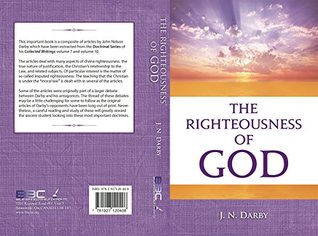
This important book is a composite of articles by John Nelson
Darby which have been extracted from the Doctrinal Series of
his Collected Writings volume 7 and volume 10.
The articles deal with many aspects of divine righteousness : the
true nature of justif ication, the Christian’s relationship to the
Law, and related subjects. Of particular interest is the matter of
so called imputed righteousness. The teaching that the Christian
is under the “moral law” is dealt with in several of the articles.
Some of the articles were originally part of a larger debate
between Darby and his antagonists. The thread of these debates
may be a little challenging for some to follow as the original
articles of Darby’s opponents have been long out of print. Nevertheless,
a careful reading and study of these will greatly reward
the sincere student looking into these most important doctrines.



John Nelson Darby (1800 - 1882)
was an Anglo-Irish Bible teacher, one of the influential figures among the original Plymouth Brethren and the founder of the Exclusive Brethren. He is considered to be the father of modern Dispensationalism and Futurism ("the Rapture" in the English vernacular). Pre-tribulation rapture theology was popularized extensively in the 1830s by John Nelson Darby and the Plymouth Brethren, and further popularized in the United States in the early 20th century by the wide circulation of the Scofield Reference Bible.He produced a translation of the Bible based on the Hebrew and Greek texts called The Holy Scriptures: A New Translation from the Original Languages by J. N. Darby. Darby traveled widely in Europe and Britain in the 1830s and 1840s, and established many Brethren assemblies. He gave 11 significant lectures in Geneva in 1840 on the hope of the church (L'attente actuelle de l'église). These established his reputation as a leading interpreter of biblical prophecy.
John Nelson Darby was an Anglo-Irish evangelist, and an influential figure among the original Plymouth Brethren. He is considered to be the father of modern Dispensationalism. He produced a translation of the Bible based on the Hebrew and Greek texts called The Holy Scriptures: A New Translation from the Original Languages by J. N. Darby.
John Nelson Darby graduated Trinity College, Dublin, in 1819 and was called to the Irish bar about 1825; but soon gave up law practice, took orders, and served a curacy in Wicklow until, in 1827, doubts as to the Scriptural authority for church establishments led him to leave the institutional church altogether and meet with a company of like-minded persons in Dublin.
Darby traveled widely in Europe and Britain in the 1830s and 1840s, and established many Brethren assemblies. These established his reputation as a leading interpreter of biblical prophecy. He was also a Bible Commentator. He declined however to contribute to the compilation of the Revised Version of the King James Bible.
... Show more