
- Bible
- Read the Bible
- Bible Versions
- Verse of the Day
- Reading Plans
- Verses by Topic
- Books of the Bible
- Bible Images
- Study
- Commentaries
- Concordances
- Dictionaries
- Encyclopedias
- Sermons
- Bible Atlas & Maps
- BP Wiki
- Devotionals
- Today's Devotionals
- All Devotionals
- Inspirational Quotes
- More
- Picture Quotes
- Videos
- Inspirational
- Bible Study
- What The Bible Says
- Bible Q&As
- Daily Bread
- Bible by Genre
- Bible Stories
- Random Bible Verse
- Community
- Store
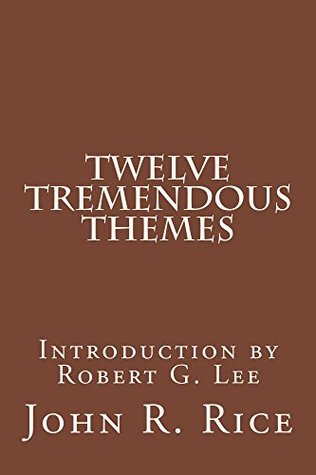
Twelve Tremendous Themes
by John R. Rice
Without claiming full agreement as to every iota of every statement, yet without taking issue with the author at any point, and with gratitude for the book with its alluring and alliterative title—“Twelve Tremendous Themes”—I commend it as a worthy book which will be profitable for all to possess and propagate. I have read the manuscript with delight and with profit and with prayer that it will have a wide circulation. Such a book is needed and will, when read and preached, do unmeasurable good in this day of invertebrate theology, jelly-fish morality, India-rubber convictions, see-saw philosophy, scientific conceit—when some speak with breath strong with conjectural onions and foul with the garlic of critical contempt for Scriptural certainties.
This book is truth simply and pungently phrased. It sets forth conclusions clearly and concisely expressed. It is declaration saturated and foundationed with the Scriptures. It makes appeal wooingly and earnestly uttered. This book is real bread and meat for the strengthening of Christians, real milk for nourishing the Christian, honey for sweetening the Christian, fire for warming the Christian. Those who read it and lay hold of its truths will know that it is stimulation for the sluggard, stirring for the complacent, anchorage for the unstable, courage for the timid, insistence for the undecided.
This book honors God, honors the Christ who is God, honors the Holy Spirit, honors the church, honors the Gospel, warns the wicked, invites the sinner to accept Christ—and comforts all who believe the Bible to be the inspired, infallible, inerrant Word of God.
Robert G. Lee, D.D., LL.D., Litt.D.
Pastor, Bellevue Baptist Church
Memphis, Tennessee
This book is truth simply and pungently phrased. It sets forth conclusions clearly and concisely expressed. It is declaration saturated and foundationed with the Scriptures. It makes appeal wooingly and earnestly uttered. This book is real bread and meat for the strengthening of Christians, real milk for nourishing the Christian, honey for sweetening the Christian, fire for warming the Christian. Those who read it and lay hold of its truths will know that it is stimulation for the sluggard, stirring for the complacent, anchorage for the unstable, courage for the timid, insistence for the undecided.
This book honors God, honors the Christ who is God, honors the Holy Spirit, honors the church, honors the Gospel, warns the wicked, invites the sinner to accept Christ—and comforts all who believe the Bible to be the inspired, infallible, inerrant Word of God.
Robert G. Lee, D.D., LL.D., Litt.D.
Pastor, Bellevue Baptist Church
Memphis, Tennessee
BUY NOW
Kindle Edition, 222 pages
Published April 13th 2015 by SolidChristianBooks.com (first published November 1943)
Subscribe
Get Bible verse every day in your inbox
Read on Mobile


Group of Brands


© 2026 Bibleportal.com All rights reserved.
John R. Rice (1895 - 1980)
Was a Baptist evangelist and pastor and the founding editor of The Sword of the Lord, an influential fundamentalist newspaper. Rice believed that the mission of churches was "not to take care of Christians" but to "win souls," a notion his mostly lower-middle-class church members did not wholeheartedly endorse. When Rice spent more time away from his pulpit to hold revivals elsewhere, a supply pastor and his supporters staged a coup. Rice decided to reenter evangelism. Yet before he did so, he encouraged the church to change its name from Fundamentalist Baptist Tabernacle to Galilean Baptist Church, thus distinguishing his ministry and that of the church from J. Frank Norris.In 1934, Rice founded The Sword of the Lord, a bi-weekly publication that grew into an influential fundamentalist Baptist newspaper. At first it was simply the publication of his Dallas church, handed out on the street and delivered door-to-door by Rice's daughters and other Sunday School children. The Sword's circulation grew dramatically. It was thirty thousand in 1940, fifty thousand in 1946, and ninety thousand in 1953, surpassing the circulation of the venerable Moody Monthly. Rice regularly published reports from evangelistic campaigns that became valuable publicity tools for approved revivalists. In 1946, he and other prominent evangelists adopted a code of ethics and a statement of faith to prevent "evangelists from being unduly criticized for commercialism and unethical practices." The same year Bob Jones College conferred on him an honorary Litt. D. degree.
John Richard Rice was born in Cooke County, Texas, on December 11, 1895, the son of William H. and Sallie Elizabeth LaPrade Rice. Educated at Decatur Baptist College and Baylor University, he did graduate work at the Southwestern Baptist Theological Seminary and the University of Chicago.
Although Dr. Rice served as pastor of Baptist churches in Dallas and Shamrock, Texas, in addition to starting about a dozen others from his successful independent crusades, his primary work was as an evangelist. He had been a friend and peer of Billy and Ma Sunday, Bob Jones Sr., W.B. Riley, Homer Rodeheaver, H.A. Ironside, Robert G. Lee, Harry Rimmer, and other leaders of that era. He himself held huge citywide crusades in Chicago, Cleveland, Buffalo, Seattle, and numerous other key metropolitan centers.
Dr. Rice authored more than 200 books and booklets, circulating in excess of 60,000,000 copies before his death--about a dozen of which were translated into at least 35 foreign languages. His sermon booklet, What Must I Do to Be Saved?, had been distributed in over 32,000,000 copies in English alone--8,500,000 in Japanese, and nearly 2,000,000 in Spanish.
In 1934 he launched The Sword of the Lord, which, by the time of his death, had become the largest independent religious weekly in the world, with subscribers in every state of the union, and more than 100 foreign countries. Thousands of preachers read it regularly, and it undoubtedly had the greatest impact on the fundamentalist movement of any publication in the 20th century.
Rice was a Baptist evangelist and pastor and the founding editor of The Sword of the Lord, an influential fundamentalist newspaper.
Rice was born in Cooke County, Texas in 1895, the son of William H. and Sallie Elizabeth La Prade Rice, and the oldest of three brothers. The death of John R. Rice's mother when he was was six years old left a lasting mark on the man.
Rice did not complete his seminary course but in 1923, took a position as the assistant pastor of a Southern Baptist church in Plainview, Texas. The following year he became senior pastor in Shamrock, Texas, an oil boomtown; but in 1926 he left the pastorate for evanglism. Settling in Fort Worth, he became an unofficial associate of the flamboyant and authoritarian fundamentalist J. Frank Norris, pastor of First Baptist Church, who was preparing to leave the Southern Baptist Convention. Rice himself broke with the Southern Baptists in 1927.
During the next few years, Rice held a series of successful revivals in Texas that were promoted by Norris. Rice made converts during his campaigns and then organized the new Christians into at least a half-dozen churches with the name "Fundamentalist Baptist."
In July 1932, Rice held an open-air evangelistic campaign in the Oak Cliff section of Dallas and hundreds made professions of faith. There Rice organized the Fundamentalist Baptist Tabernacle of Dallas; but instead of moving on, he pastored the church for more than seven years.
Rice believed that the mission of churches was "not to take care of Christians" but to "win souls."
... Show more