Expérience, connaissance, qu'est-ce qui importe ?
Le chrétien, éclairé et conduit par le Saint-Esprit, a-t-il besoin de faire aussi appel à son intelligence ?
Dans quelle mesure l'annonce de l'Evangile est-elle aussi une interpellation à la raison humaine ?
Trop souvent les chrétiens laissent leur tête de côté. Ce qui compte pour eux, c'est l'expérience, l'ambiance, le vécu. Ils oublient que Dieu a créé l'homme avec une intelligence qui doit aussi avoir sa part dans la vie de tout disciplie du Christ.
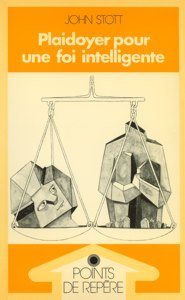
Tout en insistant sur le rôle de l'intelligence pour le chrétien, John Stott dénonce un christianisme docte et sans vie et plaide pour une foi vivante et vraie.



John Robert Walmsley Stott is a British Christian leader and Anglican clergyman who is noted as a leader of the worldwide evangelical movement. He is famous as one of the principal authors of the Lausanne Covenant in 1974.
Stott was ordained in 1945 and went on to become a curate at All Souls Church, Langham Place (1945-1950) then rector (1950-75). This was the church in which he had grown up, and in which he has spent almost all of his life, aside from a few years spent in Cambridge.
Stott played a central role at two landmark events in the history of British evangelicalism. He was chairing the National Assembly of Evangelicals in 1966, a convention organised by the Evangelical Alliance, when Martyn Lloyd-Jones made an unexpected call for evangelicals to unite together as evangelicals and no longer within their 'mixed' denominations.
... Show more