
- Bible
- Read the Bible
- Bible Versions
- Verse of the Day
- Reading Plans
- Verses by Topic
- Books of the Bible
- Bible Images
- Study
- Commentaries
- Concordances
- Dictionaries
- Encyclopedias
- Sermons
- Bible Atlas & Maps
- BP Wiki
- Devotionals
- Today's Devotionals
- Light of the World
- All Devotionals
- Inspirational Quotes
- More
- Picture Quotes
- Videos
- Inspirational
- Bible Study
- What The Bible Says
- Bible Q&As
- Daily Bread
- Bible by Genre
- Bible Stories
- Random Bible Verse
- Community
- Store
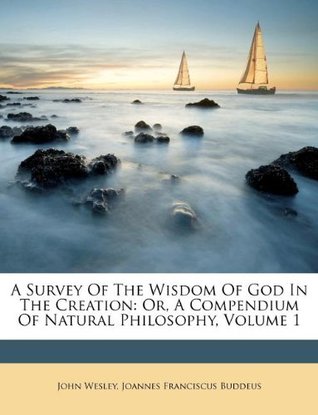
A Survey of the Wisdom of God in the Creation: Or, a Compendium of Natural Philosophy, Volume 1
by John Wesley
This historic book may have numerous typos and missing text. Purchasers can usually download a free scanned copy of the original book (without typos) from the publisher. Not indexed. Not illustrated. 1842 edition. Excerpt: ... and goodness which made and which governs the whole. When we contemplate the creatures in nature, we ought to hear in mind that the Almighty is both the shepherd of the whole flock, and the lord of the whole pasture; and that, therefore, we may be prepared to expect that the one part will throw light on the whole, and our prospect will brighten and broaden, till, to our grateful and delighted mind, " the earth" shall appear " full of the glory of the Lord." CHAPTER IV. ORDEnS OF MAMMALIA. 1. Names and Distinctions of Orders.--2. Four-handed Animals.--3. Carnassiers.--Cheiroptera; Inseetivora; Carnivora (plantigrade) (digitigrade) (amphibious).--4. Rodentia.--5. Edentata.--6. Pachydermata.--7. Ruminantia. --8. Cetacea.--9. Marsupialia. 1. Chiefly upon the characters which we noticed in the section immediately preceding, but with occasional reference to others, as may be necessary, the mammalia are arranged into orders, and. those orders into smaller divisions and genera, according to their structure, and their habits as intimately connected with that structure; and, by taking this method, we are enabled to gain as much knowledge of the whole as may .answer for all ordinary purposes, and that with even less labour and time than would be required for fully understanding only a few species, if we took the other method and went to the details without knowledge of the principles. Order 1. -- Bimana, two-handed. The only species which this order contains is man; and, for the reasons which have been already given, man does not properly, as man, in the most exalted and best sense of the term, belong to this division of the philosophy of nature. But let man learn of the other animals: let him go to the beasts of the field, and they will give...
Paperback, 494 pages
Published July 19th 2011 by Nabu Press
Subscribe
Get Bible verse every day in your inbox
Read on Mobile


Group of Brands


© 2026 Bibleportal.com All rights reserved.
John Wesley (1703 - 1791)
Was an Anglican cleric and Christian theologian. Wesley is largely credited, along with his brother Charles Wesley, as founding the Methodist movement which began when he took to open-air preaching in a similar manner to George Whitefield. In contrast to Whitefield's Calvinism, Wesley embraced the Arminian doctrines that were dominant in the 18th-century Church of England. Methodism in both forms became a highly successful evangelical movement in Britain, which encouraged people to experience Jesus Christ personally.Wesley helped to organise and form societies of Christians throughout Great Britain, North America and Ireland as small groups that developed intensive, personal accountability, discipleship and religious instruction among members. His great contribution was to appoint itinerant, unordained preachers who travelled widely to evangelise and care for people in the societies. Under Wesley's direction, Methodists became leaders in many social issues of the day, including the prison reform and abolitionism movements.
John Wesley was an Anglican cleric and Christian theologian. Wesley is largely credited, along with his brother Charles Wesley, with founding the Methodist movement which began when he took to open-air preaching in a similar manner to George Whitefield. In contrast to George Whitefield's Calvinism (which later led to the forming of the Calvinistic Methodists), Wesley embraced Arminianism. Methodism in both forms was a highly successful evangelical movement in the United Kingdom, which encouraged people to experience Christ personally.
Wesley believed that this doctrine should be constantly preached, especially among the people called Methodists. In fact, he contended that the purpose of the Methodist movement was to "spread scriptural holiness across England."
Throughout his life, Wesley remained within the Church of England and insisted that his movement was well within the bounds of the Anglican tradition. His maverick use of church policy put him at odds with many within the Church of England, though toward the end of his life he was widely respected.
John Wesley was the founder of the Methodist movement which grew from the 'Holy Club' of his Oxford friends into a great religious revival. An indefatigable traveller, preacher and writer, Wesley averaged 8,000 miles a year on horseback and gave 15 sermons a week. The reluctance of the Anglican clergy to lend him their pulpits led him to give some of his sermons in the open air, a decision which enabled him to reach those among the poorer sections of society who were not accustomed to going to church.
... Show more