
- Bible
- Read the Bible
- Bible Versions
- Verse of the Day
- Reading Plans
- Verses by Topic
- Books of the Bible
- Bible Images
- Study
- Commentaries
- Concordances
- Dictionaries
- Encyclopedias
- Sermons
- Bible Atlas & Maps
- BP Wiki
- Devotionals
- Today's Devotionals
- Light of the World
- All Devotionals
- Inspirational Quotes
- More
- Picture Quotes
- Videos
- Inspirational
- Bible Study
- What The Bible Says
- Bible Q&As
- Daily Bread
- Bible by Genre
- Bible Stories
- Random Bible Verse
- Community
- Store
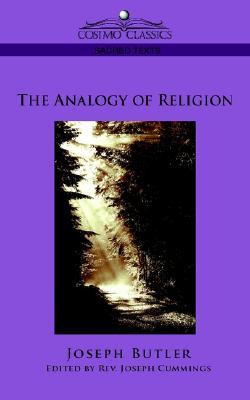
The Analogy of Religion
by Joseph Butler
I express myself with caution, lest I should be mistaken to vilify reason; which is indeed the only faculty we have wherewith to judge concerning anything. -from The Analogy of Religion Elegantly written and forceful in its arguments, this rebuttal to pre-Darwinistic Deism, first published in England in 1736, is a compelling defense of Christianity bursting with humanity and compassion, from the perspective of the era's limited understanding of biology, geology, cosmology, and other advanced sciences we take for granted today. This annotated edition, prepared in 1875 by an American theologian, is a must-read for anyone hoping to understand the foundations of the war contemporary fundamentalist Christians have taken to the modern scientific community. It serves as a reminder that, as Butler notes: "Language is, in its very nature, inadequate, ambiguous, liable to infinite abuse, even from negligence; and so liable to it from design, that every man can deceive and betray by it." British theologian JOSEPH BUTLER (1692-1752) was educated at Oxford University and appointed bishop of Dunham in 1750, a position he held until his death. American educator and theologian Joseph Cummings (b. 1817) was educated at Wesleyan University, where he later served as the institution's president, from 1857 to 1875; in 1881 he was appointed president of Northwestern University.
Paperback
Published November 25th 2005 by Cosimo Classics
Subscribe
Get Bible verse every day in your inbox
Read on Mobile


Group of Brands


© 2026 Bibleportal.com All rights reserved.
Joseph Butler was an English bishop, theologian, apologist, and philosopher. He was born in Wantage, Berkshire, England.
He is most famous for his "Fifteen Sermons on Human Nature" (1726) and "Analogy of Religion, Natural and Revealed" (1736). The Analogy is an important work of Christian apologetics in the history of the controversies over Deism. Butler’s apologetic concentrated on discerning analogies to the death and resurrection of Christ in the natural world (such as the caterpillar turning into a butterfly). Butler’s arguments combined a cumulative case for faith using probabilistic reasoning to persuade Deists and others to reconsider orthodox faith. Aspects of his apologetic reasoning are reflected in the writings of twentieth century Christian apologists such as C. S. Lewis and John Warwick Montgomery.
The "Sermons on Human Nature" is commonly studied as an answer to Hobbes’ philosophy of ethical egoism. These two books are considered by his proponents to be among the most powerful and original contributions to ethics, apologetics and theology which have ever been made. They depend for their effect entirely upon the force of their reasoning, for they have no graces of style.
Butler died in 1752 in Bath, Somerset. His admirers praise him as an excellent man, and a diligent and conscientious churchman. Though indifferent to general literature, he had some taste in the fine arts, especially architecture.
In the calendars of the Anglican communion his feast day is June 16.
... Show more