
- Bible
- Read the Bible
- Bible Versions
- Verse of the Day
- Reading Plans
- Verses by Topic
- Books of the Bible
- Bible Images
- Study
- Commentaries
- Concordances
- Dictionaries
- Encyclopedias
- Sermons
- Bible Atlas & Maps
- BP Wiki
- Devotionals
- Today's Devotionals
- Light of the World
- All Devotionals
- Inspirational Quotes
- More
- Picture Quotes
- Videos
- Inspirational
- Bible Study
- What The Bible Says
- Bible Q&As
- Daily Bread
- Bible by Genre
- Bible Stories
- Random Bible Verse
- Community
- Store
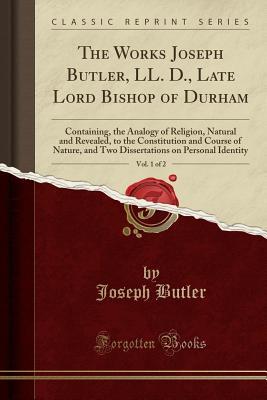
Excerpt from The Works Joseph Butler, LL. D., Late Lord Bishop of Durham, Vol. 1 of 2: Containing, the Analogy of Religion, Natural and Revealed, to the Constitution and Course of Nature, and Two Dissertations on Personal Identity
And the mind may concur in rendering our religious ser vices acceptable to God, and at the some time useful to ourselves. And what way can-this be, but precisely that which is recommended in the Charge; such a cultivation of outward as well as inward religion, that from both may result, what is the point chiefly to he laboured, and at all events to be secured, a correspondent temper and behaviour; or, in other words, such on application of the forms of godliness, as may be subservient in promoting the power and spirit of it? No man, who believes the Scriptures of the Old and New Testament, and under stands what he believes, but must know, that external religion is as much enjoined, and constitutes as real it part of revelation, as that which is internal. The many ceremonies in use among the. Jews, in consequence of a divine commend; the baptism of water, as an emblem of moral purity; the. Eating and drinking of bread and wine, as symbols and representations of the body and bloodof Christ, required of Christians, are proofs of this. On comparing these two parts of religion together, one, it is immediately seen, is of much greater importance than the other; and, whenever they happen to interfere, is always to be preferred: But does it follow from hence, that therefore that other is of little or no importance, and, ia' cases where there is no competition, may entirely be neglected? Or rather, is not the legitimate conclusion directly the reverse, that nothing is to be looked upon as of little importance, which is of any use at all in preserv ing upon our minds a sense of the Divine authority, which recalls to our remembrance the obligations we are under, and helps to keep us, as the Scripture expresses it, in the fear of the Lord all the day long {t} to adopt the instance mentioned in the Charge, the. Sight of a church should remind a man of some sentiment ofo.
About the Publisher
Forgotten Books publishes hundreds of thousands of rare and classic books. Find more at www.forgottenbooks.comwww.forgottenbooks.com
This book is a reproduction of an important historical work. Forgotten Books uses state-of-the-art technology to digitally reconstruct the work, preserving the original format whilst repairing imperfections present in the aged copy. In rare cases, an imperfection in the original, such as a blemish or missing page, may be replicated in our edition. We do, however, repair the vast majority of imperfections successfully; any imperfections that remain are intentionally left to preserve the state of such historical works.
And the mind may concur in rendering our religious ser vices acceptable to God, and at the some time useful to ourselves. And what way can-this be, but precisely that which is recommended in the Charge; such a cultivation of outward as well as inward religion, that from both may result, what is the point chiefly to he laboured, and at all events to be secured, a correspondent temper and behaviour; or, in other words, such on application of the forms of godliness, as may be subservient in promoting the power and spirit of it? No man, who believes the Scriptures of the Old and New Testament, and under stands what he believes, but must know, that external religion is as much enjoined, and constitutes as real it part of revelation, as that which is internal. The many ceremonies in use among the. Jews, in consequence of a divine commend; the baptism of water, as an emblem of moral purity; the. Eating and drinking of bread and wine, as symbols and representations of the body and bloodof Christ, required of Christians, are proofs of this. On comparing these two parts of religion together, one, it is immediately seen, is of much greater importance than the other; and, whenever they happen to interfere, is always to be preferred: But does it follow from hence, that therefore that other is of little or no importance, and, ia' cases where there is no competition, may entirely be neglected? Or rather, is not the legitimate conclusion directly the reverse, that nothing is to be looked upon as of little importance, which is of any use at all in preserv ing upon our minds a sense of the Divine authority, which recalls to our remembrance the obligations we are under, and helps to keep us, as the Scripture expresses it, in the fear of the Lord all the day long {t} to adopt the instance mentioned in the Charge, the. Sight of a church should remind a man of some sentiment ofo.
About the Publisher
Forgotten Books publishes hundreds of thousands of rare and classic books. Find more at www.forgottenbooks.comwww.forgottenbooks.com
This book is a reproduction of an important historical work. Forgotten Books uses state-of-the-art technology to digitally reconstruct the work, preserving the original format whilst repairing imperfections present in the aged copy. In rare cases, an imperfection in the original, such as a blemish or missing page, may be replicated in our edition. We do, however, repair the vast majority of imperfections successfully; any imperfections that remain are intentionally left to preserve the state of such historical works.
Paperback, 468 pages
Published April 24th 2018 by Forgotten Books
Subscribe
Get Bible verse every day in your inbox
Read on Mobile


Group of Brands


© 2026 Bibleportal.com All rights reserved.
Joseph Butler was an English bishop, theologian, apologist, and philosopher. He was born in Wantage, Berkshire, England.
He is most famous for his "Fifteen Sermons on Human Nature" (1726) and "Analogy of Religion, Natural and Revealed" (1736). The Analogy is an important work of Christian apologetics in the history of the controversies over Deism. Butler’s apologetic concentrated on discerning analogies to the death and resurrection of Christ in the natural world (such as the caterpillar turning into a butterfly). Butler’s arguments combined a cumulative case for faith using probabilistic reasoning to persuade Deists and others to reconsider orthodox faith. Aspects of his apologetic reasoning are reflected in the writings of twentieth century Christian apologists such as C. S. Lewis and John Warwick Montgomery.
The "Sermons on Human Nature" is commonly studied as an answer to Hobbes’ philosophy of ethical egoism. These two books are considered by his proponents to be among the most powerful and original contributions to ethics, apologetics and theology which have ever been made. They depend for their effect entirely upon the force of their reasoning, for they have no graces of style.
Butler died in 1752 in Bath, Somerset. His admirers praise him as an excellent man, and a diligent and conscientious churchman. Though indifferent to general literature, he had some taste in the fine arts, especially architecture.
In the calendars of the Anglican communion his feast day is June 16.
... Show more