
- Bible
- Read the Bible
- Bible Versions
- Verse of the Day
- Reading Plans
- Verses by Topic
- Books of the Bible
- Bible Images
- Study
- Commentaries
- Concordances
- Dictionaries
- Encyclopedias
- Sermons
- Bible Atlas & Maps
- BP Wiki
- Devotionals
- Today's Devotionals
- Light of the World
- All Devotionals
- Inspirational Quotes
- More
- Picture Quotes
- Videos
- Inspirational
- Bible Study
- What The Bible Says
- Bible Q&As
- Daily Bread
- Bible by Genre
- Bible Stories
- Random Bible Verse
- Community
- Store
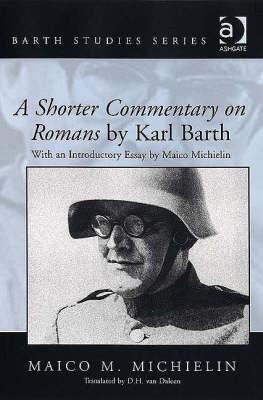
A Shorter Commentary on Romans by Karl Barth: With an Introductory Essay by Maico Michielin
by Karl Barth
First published in 1959, Karl Barth's A Shorter Commentary on Romans originated as the manuscript for a course of extra-mural lectures held in Basle during the winter of 1940-41. During this time, Barth continued to resist the Nazi regime and its influence on the Reformed Church as he did when he was in Bonn. This reissue of Barth's A Shorter Commentary on Romans links to the renewed interest today in a 'theological' interpretation of Scripture. In response to the modern preoccupation with what lies behind the text (the author's context), and to a postmodern preoccupation with what lies in front of the text (the reader's context), both theologians and biblical scholars are asking the following questions: 'What is the relationship between the biblical text, interpreter and God?' 'Can the Bible be read both as an historical document and as a text that speaks to us today, and if so, how can it do so?' Barth's commentarial practice as exemplified in A Shorter Commentary on Romans answers these questions. This book is presented in two parts: first, an introduction by Maico Michielin helping readers understand Barth's theological exegetical approach to interpreting Scripture and showing readers how to let Scripture address theological and ethical concerns for today; the main body of the book then follows - the republication of the original English translation by D.H. van Daalen of Barth's A Shorter Commentary on Romans.
Hardcover, 146 pages
Published September 28th 2007 by Routledge (first published 1933)
Subscribe
Get Bible verse every day in your inbox
Read on Mobile


Group of Brands


© 2026 Bibleportal.com All rights reserved.
Karl Barth was a Swiss Reformed theologian whom critics hold to be among the most important Christian thinkers of the 20th century.
Beginning with his experience as a pastor, he rejected his training in the predominant liberal theology typical of 19th-century Protestantism. Instead he embarked on a new theological path initially called dialectical theology, due to its stress on the paradoxical nature of divine truth (e.g., God's relationship to humanity embodies both grace and judgment). Other critics have referred to Barth as the father of neo-orthodoxy -- a term emphatically rejected by Barth himself. The most accurate description of his work might be "a theology of the Word." Barth's theological thought emphasized the sovereignty of God, particularly through his innovative doctrine of election.
Barth tries to recover the Doctrine of the Trinity in theology from its putative loss in liberalism. His argument follows from the idea that God is the object of God's own self-knowledge, and revelation in the Bible means the self-unveiling to humanity of the God who cannot be discovered by humanity simply through its own efforts.
... Show more