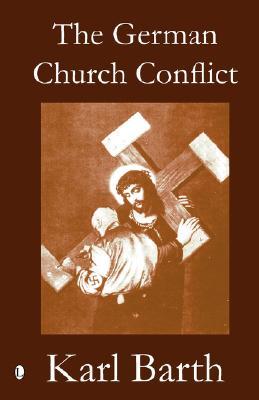
As Hitler became ever more influential among the German people, so religion became a factor which Hitler could use to the advantage of National Socialism. Hitler won over the neutrality and acceptance of the Roman Catholic Church for his government, but the more divided Protestant faith presented greater problems. Hitler's suggestion of the founding of a German-Christian Church seemed to accommodate the need for unity within the German Protestant faith. Whilst some Protestants were overjoyed at the idea that a national 'Christian' Church could be founded, others were highly critical. A conflict between Church and State soon arose. Karl Barth vigourously rejected the German-Christian movement; this work presents critical reflection from Barth's point of view upon the historical, social and political background to the transformation of the German churches. The first essay examines the nature of conflict in the Church, whilst the second focuses on the Church's opposition. The third investigates the significant year of 1933-34 for the German-Christian movement and it is in the fourth and fifth essays that the German Confessing Church's history of the period is analysed. The war on the Evangelical Church in Germany and the German Confessing Church of 1936-1939 form the central theme of the last six essays.



Karl Barth was a Swiss Reformed theologian whom critics hold to be among the most important Christian thinkers of the 20th century.
Beginning with his experience as a pastor, he rejected his training in the predominant liberal theology typical of 19th-century Protestantism. Instead he embarked on a new theological path initially called dialectical theology, due to its stress on the paradoxical nature of divine truth (e.g., God's relationship to humanity embodies both grace and judgment). Other critics have referred to Barth as the father of neo-orthodoxy -- a term emphatically rejected by Barth himself. The most accurate description of his work might be "a theology of the Word." Barth's theological thought emphasized the sovereignty of God, particularly through his innovative doctrine of election.
Barth tries to recover the Doctrine of the Trinity in theology from its putative loss in liberalism. His argument follows from the idea that God is the object of God's own self-knowledge, and revelation in the Bible means the self-unveiling to humanity of the God who cannot be discovered by humanity simply through its own efforts.
... Show more