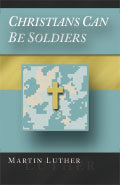
It generally is not difficult to understand how a Christian can serve in the military compulsorily during a conflict in which life, family, property and even a nation itself is at stake; when right and wrong are easy to determine, when an enemy combatant is easily identifiable and a desired outcome clearly desirable and achievable. In such a situation the specific acts of individual soldiers, although troubling, and in any other context, unacceptable, are accepted and indeed, understood as necessary. But what about when the greater contours of war are not as clear? When military service is not compulsory, but voluntary? When combatants are difficult to identify? When the validity of individual acts of soldiers is routinely questioned by those outside of the military? Can a Christian serve in such a situation? Martin Luther answers this question with a sure and confident "Yes!" How? By explaining what a soldier actually is in the eyes of God and what therefore a soldier is to do. Luther even includes a prayer written specifically for soldiers before they enter combat.
Formatted into 15 simple chapters along with study questions, this 128 page book is perfect for personal devotion or Bible study.



Martin Luther changed the course of Western civilization by initiating the Protestant Reformation. As a priest and theology professor, he confronted indulgence salesmen with his 95 Theses in 1517. Luther strongly disputed their claim that freedom from God's punishment of sin could be purchased with money. His refusal to retract all of his writings at the demand of Pope Leo X in 1520 and the Holy Roman Emperor Charles V at the Diet of Worms meeting in 1521 resulted in his excommunication by the pope and condemnation as an outlaw by the emperor.
Luther taught that salvation is a free gift of God and received only by grace through faith in Jesus as redeemer from sin, not from good works. His theology challenged the authority of the pope of the Roman Catholic Church by teaching that the Bible is the only source of divinely revealed knowledge and opposed sacerdotalism by considering all baptized Christians to be a holy priesthood.
His translation of the Bible into the language of the people (instead of Latin) made it more accessible, causing a tremendous impact on the church and on German culture. It fostered the development of a standard version of the German language, added several principles to the art of translation, and influenced the translation into English of the King James Bible. His hymns inspired the development of singing in churches. His marriage to Katharina von Bora set a model for the practice of clerical marriage, allowing Protestant priests to marry.
... Show more