"Un tout petit livre si l'on considère le papier, mais qui contient la somme entière de la vie chrétienne si l'on en comprend le sens" : ainsi Luther présente-t-il en 1520 son traité De la liberté du chrétien. Ce texte appelle à une libération politique et religieuse célébrée depuis comme l'essence de la Réforme. Il constitue une "somme", qui réorganise toute la théologie autour de la question de la liberté - la somme théologique de Martin Luther. Mais qu'est-ce que cette liberté, qui rend à la fois seigneur et serviteur ? Comment peut-on être libre sans libre arbitre? La réponse est à chercher selon Luther dans une enquête sur la foi et sur la Parole de Dieu qui nourrit cette foi.
Le rôle crucial dévolu à la Parole de Dieu montre à quel point l'entreprise du réformateur est solidaire d'une réflexion sur la langue. De la liberté du chrétien trouve ainsi son complément, à partir de 1522, dans les Préfaces à la traduction de la Bible, minutieuses explications de la Parole de Dieu, de son vocabulaire et de son style. Or le Luther traducteur de la Bible est aussi l'inventeur de l'allemand moderne. De la liberté du chrétien, premier traité de philosophie en langue allemande, constitue l'une des matrices de la philosophie moderne.

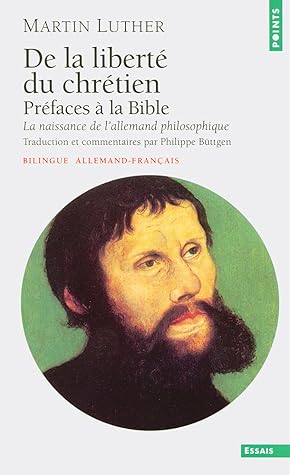


Martin Luther changed the course of Western civilization by initiating the Protestant Reformation. As a priest and theology professor, he confronted indulgence salesmen with his 95 Theses in 1517. Luther strongly disputed their claim that freedom from God's punishment of sin could be purchased with money. His refusal to retract all of his writings at the demand of Pope Leo X in 1520 and the Holy Roman Emperor Charles V at the Diet of Worms meeting in 1521 resulted in his excommunication by the pope and condemnation as an outlaw by the emperor.
Luther taught that salvation is a free gift of God and received only by grace through faith in Jesus as redeemer from sin, not from good works. His theology challenged the authority of the pope of the Roman Catholic Church by teaching that the Bible is the only source of divinely revealed knowledge and opposed sacerdotalism by considering all baptized Christians to be a holy priesthood.
His translation of the Bible into the language of the people (instead of Latin) made it more accessible, causing a tremendous impact on the church and on German culture. It fostered the development of a standard version of the German language, added several principles to the art of translation, and influenced the translation into English of the King James Bible. His hymns inspired the development of singing in churches. His marriage to Katharina von Bora set a model for the practice of clerical marriage, allowing Protestant priests to marry.
... Show more