
- Bible
- Read the Bible
- Bible Versions
- Verse of the Day
- Reading Plans
- Verses by Topic
- Books of the Bible
- Bible Images
- Study
- Commentaries
- Concordances
- Dictionaries
- Encyclopedias
- Sermons
- Bible Atlas & Maps
- BP Wiki
- Devotionals
- Today's Devotionals
- Light of the World
- All Devotionals
- Inspirational Quotes
- More
- Picture Quotes
- Videos
- Inspirational
- Bible Study
- What The Bible Says
- Bible Q&As
- Daily Bread
- Bible by Genre
- Bible Stories
- Random Bible Verse
- Community
- Store
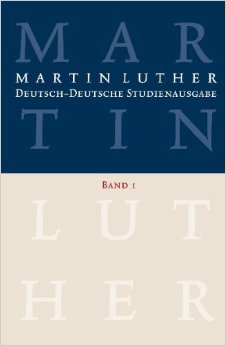
Glaube und Leben (Deutsch-Deutsche Studienausgabe: Band 1)
by Martin Luther
English summary: Martin Luther molded not only the theology of the Reformation, he also left his stamp on the German language. Today the powerful, rhetorically intense Early New High German of Luther's original texts is not easy to understand, however. Therefore, not only linguistic peculiarities tend to be forgotten, but the specific style of Luther's theology is lost as well in the necessary adaptations to modern German. This thematically structured three-volume edition intends to remedy this dual deficiency by publishing the Early-New-High-German original texts in easy-to-read Antiqua font side by side with a modern text edition. The original texts follow the first editions; concordances with the comprehensive critical Weimar Edition (WA) allow the reader easily to trace the texts in this standard reference work and assure that users of this textbook edition can follow and actively participate in the scholarly discussion without any problems. The translations have been provided by established scholars from a variety of theological fields. The first volume contains 17 texts from the years 1518 to 1539, which take a variety of approaches to the central topic of reformational theology, i.e. the relationship of faith, doctrine, and life. The volume contains the sermons on indulgence and penance (1519), -On the Liberty of a Christian Man- (1520), the explication of the Magnificat (1521), and the Small Catechism (1529). German description: Martin Luther hat nicht nur die reformatorische Theologie, sondern auch die deutsche Sprache gepragt. Allerdings sind die originalen Texte Luthers in ihrer kraftvollen, rhetorisch eindringlichen fruehneuhochdeutschen Sprache heute nur noch schwer zuganglich. Damit fallen nicht nur sprachliche Eigenheiten dem Vergessen anheim, auch der Stil der Theologie Luthers wird in den notwendigen Ubertragungen in moderne Sprache nivelliert. Die auf drei Bande berechnete, thematisch gegliederte Ausgabe will diesem doppelten Mangel abhelfen, indem sie die fruehneuhochdeutschen Originale in lesbarer Antiqua-Schrift neben Textfassungen in gegenwartigem Deutsch stellt. Die Originaltexte folgen den Erstdrucken; Konkordanzen mit der grossen kritischen Weimarer Ausgabe (WA) ermoglichen ein mueheloses Auffinden der Texte in dieser Referenzausgabe und stellen sicher, dass anhand der Deutsch-Deutschen Studienausgabe die Diskussion in der wissenschaftlichen Literatur verfolgt und fortgefuehrt werden kann. Die Ubertragungen wurden von namhaften Gelehrten aus verschiedenen theologischen Disziplinen vorgenommen. Der erste Band enthalt 17 Schriften aus den Jahren 1518-1539, die das Kernthema der reformatorischen Theologie variieren, namlich das Verheltnis von Glaube, Lehre und Leben. Dazu zahlen unter anderem die Sermone zu Ablass und Busse (1519), die Schrift -Von der Freiheit eines Christenmenschen- (1520), die Auslegung des Magnificat (1521) sowie der Kleine Katechismus (1529).
BUY NOW
Hardcover
Published (first published April 15th 2012)
Subscribe
Get Bible verse every day in your inbox
Read on Mobile


Group of Brands


© 2026 Bibleportal.com All rights reserved.
Martin Luther changed the course of Western civilization by initiating the Protestant Reformation. As a priest and theology professor, he confronted indulgence salesmen with his 95 Theses in 1517. Luther strongly disputed their claim that freedom from God's punishment of sin could be purchased with money. His refusal to retract all of his writings at the demand of Pope Leo X in 1520 and the Holy Roman Emperor Charles V at the Diet of Worms meeting in 1521 resulted in his excommunication by the pope and condemnation as an outlaw by the emperor.
Luther taught that salvation is a free gift of God and received only by grace through faith in Jesus as redeemer from sin, not from good works. His theology challenged the authority of the pope of the Roman Catholic Church by teaching that the Bible is the only source of divinely revealed knowledge and opposed sacerdotalism by considering all baptized Christians to be a holy priesthood.
His translation of the Bible into the language of the people (instead of Latin) made it more accessible, causing a tremendous impact on the church and on German culture. It fostered the development of a standard version of the German language, added several principles to the art of translation, and influenced the translation into English of the King James Bible. His hymns inspired the development of singing in churches. His marriage to Katharina von Bora set a model for the practice of clerical marriage, allowing Protestant priests to marry.
... Show more