
- Bible
- Read the Bible
- Bible Versions
- Verse of the Day
- Reading Plans
- Verses by Topic
- Books of the Bible
- Bible Images
- Study
- Commentaries
- Concordances
- Dictionaries
- Encyclopedias
- Sermons
- Bible Atlas & Maps
- BP Wiki
- Devotionals
- Today's Devotionals
- Light of the World
- All Devotionals
- Inspirational Quotes
- More
- Picture Quotes
- Videos
- Inspirational
- Bible Study
- What The Bible Says
- Bible Q&As
- Daily Bread
- Bible by Genre
- Bible Stories
- Random Bible Verse
- Community
- Store
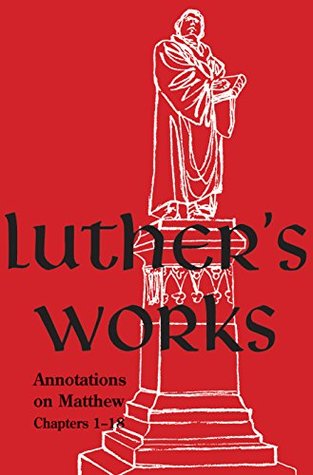
Luther's Works: Volume 67 (Annotations on Matthew: Chapters 1-18) (Luther's Works (Concordia))
by Martin Luther
About the Volume
In December 1533, a new cycle of preaching on Matthew began in the Wittenberg Castle Church. Luther himself inaugurated the series with three sermons on Matthew 1. Then the preaching on Matthew was assigned to the Wittenberg doctoral student Hieronymus Weller (1499–1572). Behind Weller’s sermons, however, stood Luther, who prepared notes to help his student preach. The notes touched both on the interpretation of the scriptural passages and on homiletical strategies for preaching them.
In annotating Matthew’s text for another doctor of theology, Luther grappled with questions of the exegesis of the Synoptic Gospels at a high level of technical detail. Luther drew especially on the discipline of rhetoric—the use of language to persuade and move human beings—to interpret Matthew’s narrative and Jesus’ speech presented there and to identify strategies for the effective homiletical presentation of those texts to Weller’s contemporary audience.
As a modern reader, you will want to explore Luther’s treatment of the application of rhetoric to the tasks of exegesis and preaching, as well as for its exegesis of controverted passages. For Luther, trained as a Nominalist and later embracing humanist studies, a rhetorical understanding of Christ’s speech—and the rhetorical application of His Word in the present—is vitally important for Christians.
The crucial knowledge about God is not philosophical knowledge about the divine nature in relation to the creation, which could be obtained by reason or meditation or observation. Rather, it is the knowledge of God’s “counsel and will,” which must be revealed in Christ’s Word and proclaimed through the continuing ministry preached by His disciples. This was the task Luther sought to model for his timid student in the Annotations on Matthew.
About the Series
The 28 planned new volumes are intended to reflect both modern and sixteenth-century interests and to expand the coverage of genres underrepresented in the existing volumes, such as Luther's sermons and disputations. The primary basis for the translation is the comprehensive Weimar edition.
About the VolumeIn December 1533, a new cycle of preaching on Matthew began in the Wittenberg Castle Church. Luther himself inaugurated the series with three sermons on Matthew 1. Then the preaching on Matthew was assigned to the Wittenberg doctoral student Hieronymus Weller (1499–1572). Behind Weller’s sermons, however, stood Luther, who prepared notes to help his student preach. The notes touched both on the interpretation of the scriptural passages and on homiletical strategies for preaching them.
In annotating Matthew’s text for another doctor of theology, Luther grappled with questions of the exegesis of the Synoptic Gospels at a high level of technical detail. Luther drew especially on the discipline of rhetoric—the use of language to persuade and move human beings—to interpret Matthew’s narrative and Jesus’ speech presented there and to identify strategies for the effective homiletical presentation of those texts to Weller’s contemporary audience.
As a modern reader, you will want to explore Luther’s treatment of the application of rhetoric to the tasks of exegesis and preaching, as well as for its exegesis of controverted passages. For Luther, trained as a Nominalist and later embracing humanist studies, a rhetorical understanding of Christ’s speech—and the rhetorical application of His Word in the present—is vitally important for Christians.
The crucial knowledge about God is not philosophical knowledge about the divine nature in relation to the creation, which could be obtained by reason or meditation or observation. Rather, it is the knowledge of God’s “counsel and will,” which must be revealed in Christ’s Word and proclaimed through the continuing ministry preached by His disciples. This was the task Luther sought to model for his timid student in the Annotations on Matthew.
About the Series
The 28 planned new volumes are intended to reflect both modern and sixteenth-century interests and to expand the coverage of genres underrepresented in the existing volumes, such as Luther's sermons and disputations. The primary basis for the translation is the comprehensive Weimar edition.
In December 1533, a new cycle of preaching on Matthew began in the Wittenberg Castle Church. Luther himself inaugurated the series with three sermons on Matthew 1. Then the preaching on Matthew was assigned to the Wittenberg doctoral student Hieronymus Weller (1499–1572). Behind Weller’s sermons, however, stood Luther, who prepared notes to help his student preach. The notes touched both on the interpretation of the scriptural passages and on homiletical strategies for preaching them.
In annotating Matthew’s text for another doctor of theology, Luther grappled with questions of the exegesis of the Synoptic Gospels at a high level of technical detail. Luther drew especially on the discipline of rhetoric—the use of language to persuade and move human beings—to interpret Matthew’s narrative and Jesus’ speech presented there and to identify strategies for the effective homiletical presentation of those texts to Weller’s contemporary audience.
As a modern reader, you will want to explore Luther’s treatment of the application of rhetoric to the tasks of exegesis and preaching, as well as for its exegesis of controverted passages. For Luther, trained as a Nominalist and later embracing humanist studies, a rhetorical understanding of Christ’s speech—and the rhetorical application of His Word in the present—is vitally important for Christians.
The crucial knowledge about God is not philosophical knowledge about the divine nature in relation to the creation, which could be obtained by reason or meditation or observation. Rather, it is the knowledge of God’s “counsel and will,” which must be revealed in Christ’s Word and proclaimed through the continuing ministry preached by His disciples. This was the task Luther sought to model for his timid student in the Annotations on MatthewAnnotations on Matthew.
About the Series
The 28 planned new volumes are intended to reflect both modern and sixteenth-century interests and to expand the coverage of genres underrepresented in the existing volumes, such as Luther's sermons and disputations. The primary basis for the translation is the comprehensive Weimar edition.
BUY NOW
Kindle Edition, 450 pages
Published July 14th 2015 by Concordia Publishing House
Subscribe
Get Bible verse every day in your inbox
Read on Mobile


Group of Brands


© 2026 Bibleportal.com All rights reserved.
Martin Luther changed the course of Western civilization by initiating the Protestant Reformation. As a priest and theology professor, he confronted indulgence salesmen with his 95 Theses in 1517. Luther strongly disputed their claim that freedom from God's punishment of sin could be purchased with money. His refusal to retract all of his writings at the demand of Pope Leo X in 1520 and the Holy Roman Emperor Charles V at the Diet of Worms meeting in 1521 resulted in his excommunication by the pope and condemnation as an outlaw by the emperor.
Luther taught that salvation is a free gift of God and received only by grace through faith in Jesus as redeemer from sin, not from good works. His theology challenged the authority of the pope of the Roman Catholic Church by teaching that the Bible is the only source of divinely revealed knowledge and opposed sacerdotalism by considering all baptized Christians to be a holy priesthood.
His translation of the Bible into the language of the people (instead of Latin) made it more accessible, causing a tremendous impact on the church and on German culture. It fostered the development of a standard version of the German language, added several principles to the art of translation, and influenced the translation into English of the King James Bible. His hymns inspired the development of singing in churches. His marriage to Katharina von Bora set a model for the practice of clerical marriage, allowing Protestant priests to marry.
... Show more