Against the backdrop of today's renewed uncertainty over the present economic system, this timely volume presents Martin Luther's contribution to the modern economic sciences, providing a detailed introduction and revised translation of his major pamphlet on economic matters, On Commerce and Usury (Von Kauffshandlung und Wucher, 1524). In his teachings on indulgences Luther picked up on the question of hoarding money, and was among the earliest voices in early modern Europe calling for an ethical economics. Luther's work prefigured many later contributions to modern economic theory, from the mercantilists and cameralists to the German Historical School.
Luther was, apparently, quite near to what the British economist J. M. Keynes developed as a general theory in 1936, relating the power of spendthrift and a pro-active state which made people consume and invest in the economy. And Luther was always very clear about the basic fact that in order for the economy to work well and society to flourish markets need rules. Luther s prescience and enduring relevance are brought to the fore in Philipp Robinson Rossner's authoritative introduction and notes.

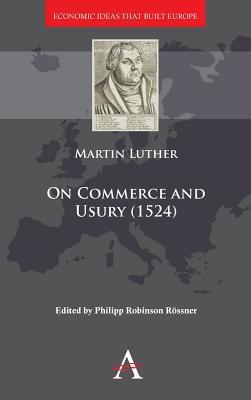


Martin Luther changed the course of Western civilization by initiating the Protestant Reformation. As a priest and theology professor, he confronted indulgence salesmen with his 95 Theses in 1517. Luther strongly disputed their claim that freedom from God's punishment of sin could be purchased with money. His refusal to retract all of his writings at the demand of Pope Leo X in 1520 and the Holy Roman Emperor Charles V at the Diet of Worms meeting in 1521 resulted in his excommunication by the pope and condemnation as an outlaw by the emperor.
Luther taught that salvation is a free gift of God and received only by grace through faith in Jesus as redeemer from sin, not from good works. His theology challenged the authority of the pope of the Roman Catholic Church by teaching that the Bible is the only source of divinely revealed knowledge and opposed sacerdotalism by considering all baptized Christians to be a holy priesthood.
His translation of the Bible into the language of the people (instead of Latin) made it more accessible, causing a tremendous impact on the church and on German culture. It fostered the development of a standard version of the German language, added several principles to the art of translation, and influenced the translation into English of the King James Bible. His hymns inspired the development of singing in churches. His marriage to Katharina von Bora set a model for the practice of clerical marriage, allowing Protestant priests to marry.
... Show more