
- Bible
- Read the Bible
- Bible Versions
- Verse of the Day
- Reading Plans
- Verses by Topic
- Books of the Bible
- Bible Images
- Study
- Commentaries
- Concordances
- Dictionaries
- Encyclopedias
- Sermons
- Bible Atlas & Maps
- BP Wiki
- Devotionals
- Today's Devotionals
- Light of the World
- All Devotionals
- Inspirational Quotes
- More
- Picture Quotes
- Videos
- Inspirational
- Bible Study
- What The Bible Says
- Bible Q&As
- Daily Bread
- Bible by Genre
- Bible Stories
- Random Bible Verse
- Community
- Store
The Bible, as we hold it today, is esteemed by many religious institutions and especially Conservative Christians to be the inspired, inerrant Word of God. This doctrinal position affirms that the Bible is unlike all other books or collections of works in that it is free of error due to having been "given by inspiration of God, and is profitable for doctrine, for reproof, for correction, for instruction in righteousness: that the man of God may be perfect, thoroughly furnished unto all good works" (2 Tim. 3:16, 17).
While no other text can claim this same unique authority, these select works by key Protestant Reformers reflect the theology and actions of those churchmen and statesmen who placed their careers, works, and actions in jeopardy in order to crystallize the Protestant Reformation of the sixteenth century. These select sermons and works are frequently used or assigned as supplemental works within academic settings to help students and scholars discover or better understand how Lutheranism, Anglicanism, Calvinism, and Arminianism gave birth to modern Western Christian denominations commonly known today as evangelical and Protestant churches.
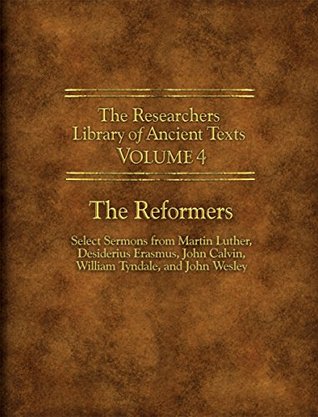
The Researchers Library of Ancient Texts - Volume 4 is intended to be a supplemental resource for assisting serious researchers and students in the study of the Bible and the Church age.
Contained in this volume: The select works of Martin Luther, Desiderius Erasmus, John Calvin, William Tyndale, and John Wesley
While no other text can claim this same unique authority, these select works by key Protestant Reformers reflect the theology and actions of those churchmen and statesmen who placed their careers, works, and actions in jeopardy in order to crystallize the Protestant Reformation of the sixteenth century. These select sermons and works are frequently used or assigned as supplemental works within academic settings to help students and scholars discover or better understand how Lutheranism, Anglicanism, Calvinism, and Arminianism gave birth to modern Western Christian denominations commonly known today as evangelical and Protestant churches.
The Researchers Library of Ancient Texts - Volume 4 is intended to be a supplemental resource for assisting serious researchers and students in the study of the Bible and the Church age.
Contained in this volume: The select works of Martin Luther, Desiderius Erasmus, John Calvin, William Tyndale, and John Wesley
BUY NOW
Kindle Edition
Published September 22nd 2014 (first published August 15th 2014)
Subscribe
Get Bible verse every day in your inbox
Read on Mobile


Group of Brands


© 2026 Bibleportal.com All rights reserved.
Martin Luther changed the course of Western civilization by initiating the Protestant Reformation. As a priest and theology professor, he confronted indulgence salesmen with his 95 Theses in 1517. Luther strongly disputed their claim that freedom from God's punishment of sin could be purchased with money. His refusal to retract all of his writings at the demand of Pope Leo X in 1520 and the Holy Roman Emperor Charles V at the Diet of Worms meeting in 1521 resulted in his excommunication by the pope and condemnation as an outlaw by the emperor.
Luther taught that salvation is a free gift of God and received only by grace through faith in Jesus as redeemer from sin, not from good works. His theology challenged the authority of the pope of the Roman Catholic Church by teaching that the Bible is the only source of divinely revealed knowledge and opposed sacerdotalism by considering all baptized Christians to be a holy priesthood.
His translation of the Bible into the language of the people (instead of Latin) made it more accessible, causing a tremendous impact on the church and on German culture. It fostered the development of a standard version of the German language, added several principles to the art of translation, and influenced the translation into English of the King James Bible. His hymns inspired the development of singing in churches. His marriage to Katharina von Bora set a model for the practice of clerical marriage, allowing Protestant priests to marry.
... Show more