
- Bible
- Read the Bible
- Bible Versions
- Verse of the Day
- Reading Plans
- Verses by Topic
- Books of the Bible
- Bible Images
- Study
- Commentaries
- Concordances
- Dictionaries
- Encyclopedias
- Sermons
- Bible Atlas & Maps
- BP Wiki
- Devotionals
- Today's Devotionals
- Light of the World
- All Devotionals
- Inspirational Quotes
- More
- Picture Quotes
- Videos
- Inspirational
- Bible Study
- What The Bible Says
- Bible Q&As
- Daily Bread
- Bible by Genre
- Bible Stories
- Random Bible Verse
- Community
- Store
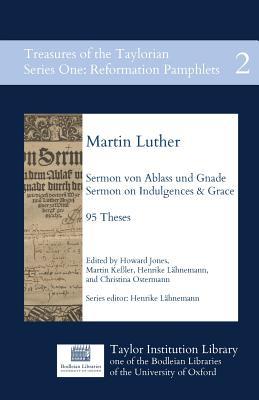
The Sermon von Ablass und GnadeSermon von Ablass und Gnade (Sermon on Indulgences and GraceSermon on Indulgences and Grace) is a seminal text for the Reformation: it is the first vernacular statement of Luther's views on the question which led to his break with Rome; the first printed work of his to reach a mass audience; and the first example of the direct, arresting style which became the hallmark of his German writings. The work hit the market 500 years ago, in the second half of March 1518, five months after the posting of the 95 Theses, and within three years at least 24 editions had been printed in various parts of Germany and Switzerland. The volume is based on two of these editions, copies of which are held in the Taylor Institution Library: Arch. 8� G. 1518 (5), printed by Pamphilus Gengenbach in Basel, and Arch. 8� G. 1518 (6), printed by Valentin Schumann in Leipzig. It presents a guide to the theological, historical, material, linguistic, and stylistic importance of this work.
The Sermon rejects scholastic teaching about indulgences and proposes instead a theology of grace. Luther meant the Sermon as an accessible summary of his views, and for the modern reader it is still the most succinct account of Luther's side in the indulgence controversy, serving as an introduction to the more technical 95 Theses95 Theses which are also included in Latin, a new English translation by Howard Jones, and explanatory footnotes in this edition. The theological and historical context of the SermonSermon and 95 Theses95 Theses is complex and dates back centuries before the actual texts. Martin Ke�ler explains this background and provides an evaluation of both works in 'Theological and Historical Background'.
This volume includes a side-by-side facsimile of the two Taylorian copies on facing pages which is complemented by a digital reconstruction of the broadsides from which they were printed, available with all content of the book on editions.mml.ox.ac.uk, prepared by Emma Huber. The printed text is based on the Leipzig edition and a new translation into modern English by Howard Jones. Henrike L�hnemann offers a detailed guide to the book-history in 'The Taylorian Copies' (including an analysis of the woodcuts in the Basel edition and the marginalia added to the Taylorian copy of the Leipzig edition), a preview to the follow-up pamphlets in the debate, and an account of the acquisition history by Christina Ostermann.
The Sermon rejects scholastic teaching about indulgences and proposes instead a theology of grace. Luther meant the Sermon as an accessible summary of his views, and for the modern reader it is still the most succinct account of Luther's side in the indulgence controversy, serving as an introduction to the more technical 95 Theses95 Theses which are also included in Latin, a new English translation by Howard Jones, and explanatory footnotes in this edition. The theological and historical context of the SermonSermon and 95 Theses95 Theses is complex and dates back centuries before the actual texts. Martin Ke�ler explains this background and provides an evaluation of both works in 'Theological and Historical Background'.
This volume includes a side-by-side facsimile of the two Taylorian copies on facing pages which is complemented by a digital reconstruction of the broadsides from which they were printed, available with all content of the book on editions.mml.ox.ac.uk, prepared by Emma Huber. The printed text is based on the Leipzig edition and a new translation into modern English by Howard Jones. Henrike L�hnemann offers a detailed guide to the book-history in 'The Taylorian Copies' (including an analysis of the woodcuts in the Basel edition and the marginalia added to the Taylorian copy of the Leipzig edition), a preview to the follow-up pamphlets in the debate, and an account of the acquisition history by Christina Ostermann.
BUY NOW
Paperback, 146 pages
Published April 19th 2018 by Taylor Institution Library
Subscribe
Get Bible verse every day in your inbox
Read on Mobile


Group of Brands


© 2026 Bibleportal.com All rights reserved.
Martin Luther changed the course of Western civilization by initiating the Protestant Reformation. As a priest and theology professor, he confronted indulgence salesmen with his 95 Theses in 1517. Luther strongly disputed their claim that freedom from God's punishment of sin could be purchased with money. His refusal to retract all of his writings at the demand of Pope Leo X in 1520 and the Holy Roman Emperor Charles V at the Diet of Worms meeting in 1521 resulted in his excommunication by the pope and condemnation as an outlaw by the emperor.
Luther taught that salvation is a free gift of God and received only by grace through faith in Jesus as redeemer from sin, not from good works. His theology challenged the authority of the pope of the Roman Catholic Church by teaching that the Bible is the only source of divinely revealed knowledge and opposed sacerdotalism by considering all baptized Christians to be a holy priesthood.
His translation of the Bible into the language of the people (instead of Latin) made it more accessible, causing a tremendous impact on the church and on German culture. It fostered the development of a standard version of the German language, added several principles to the art of translation, and influenced the translation into English of the King James Bible. His hymns inspired the development of singing in churches. His marriage to Katharina von Bora set a model for the practice of clerical marriage, allowing Protestant priests to marry.
... Show more