
- Bible
- Read the Bible
- Bible Versions
- Verse of the Day
- Reading Plans
- Verses by Topic
- Books of the Bible
- Bible Images
- Study
- Commentaries
- Concordances
- Dictionaries
- Encyclopedias
- Sermons
- Bible Atlas & Maps
- BP Wiki
- Devotionals
- Today's Devotionals
- Light of the World
- All Devotionals
- Inspirational Quotes
- More
- Picture Quotes
- Videos
- Inspirational
- Bible Study
- What The Bible Says
- Bible Q&As
- Daily Bread
- Bible by Genre
- Bible Stories
- Random Bible Verse
- Community
- Store
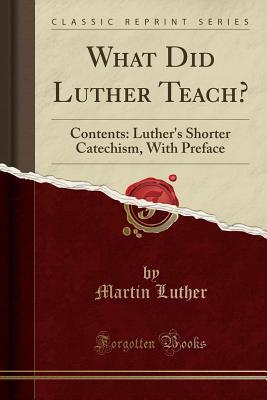
What Did Luther Teach?: Contents: Luther's Shorter Catechism, with Preface (Classic Reprint)
by Martin Luther
Excerpt from What Did Luther Teach?: Contents: Luther's Shorter Catechism, With Preface
Preachers, grace, mercy, and peace in Christ Jesus our Lord.
The miserable sights which met my eyes in my late round of visitation have induced me to put forth this short and simple Catechism. God help us, what calamity saw I everywhere! The people, especially the dwellers in the country, yea, many of the Clergy, are so utterly ignorant of all Christian doctrine, that I am even ashamed to speak of it. And yet they are all called by that Holy Name of Christ, they all use the same Sacraments with us, though they not only do not understand the Creed, the Lord's Prayer, and the ten Commandments, but cannot even repeat the words. To put it briefly, they are no way difl'ercut from the beasts. But now that the Gospel is taught everywhere, they enjoy their Christian liberty to the uttermost. How will ye answer to Christ in this, 0 yo Bishops, to whom this charge has been divinely committed P For ye are they to whom, and to whom alone, this calamity of the Christian religion is owing. Ye have permitted these men thus vilely to err; yours is the fault, ye who have cared for anything rather than for this which was your bounden duty. I would not here call down any evil on your heads. Yet is it not the height of impiety, joined with the utmost shamelessness, that ye are fighting for Com munion in one kind, and for your own traditions; utterly careless meanwhile, whether the flock committed to your trust and keeping know the Lord's Prayer, the Apostles' Creed, and the ten Commandments or not! Woe, woe unto you i In the Name of God, therefore, I entreat and charge you all ye Clergy and Preachers, seriously to discharge your ofice, and to attend to the souls commit tedtcyoubythelord. Andthisyewillhestdo, ifwith us, ye tesehthis Catechism to your people, especially to the young. But if any of you are so unlesrned as to have no knowledge at all of these things, be not ashamed to read over word by word to your hearers the form which we prescribe, and alter this manner.
About the Publisher
Forgotten Books publishes hundreds of thousands of rare and classic books. Find more at www.forgottenbooks.comwww.forgottenbooks.com
This book is a reproduction of an important historical work. Forgotten Books uses state-of-the-art technology to digitally reconstruct the work, preserving the original format whilst repairing imperfections present in the aged copy. In rare cases, an imperfection in the original, such as a blemish or missing page, may be replicated in our edition. We do, however, repair the vast majority of imperfections successfully; any imperfections that remain are intentionally left to preserve the state of such historical works.
Preachers, grace, mercy, and peace in Christ Jesus our Lord.
The miserable sights which met my eyes in my late round of visitation have induced me to put forth this short and simple Catechism. God help us, what calamity saw I everywhere! The people, especially the dwellers in the country, yea, many of the Clergy, are so utterly ignorant of all Christian doctrine, that I am even ashamed to speak of it. And yet they are all called by that Holy Name of Christ, they all use the same Sacraments with us, though they not only do not understand the Creed, the Lord's Prayer, and the ten Commandments, but cannot even repeat the words. To put it briefly, they are no way difl'ercut from the beasts. But now that the Gospel is taught everywhere, they enjoy their Christian liberty to the uttermost. How will ye answer to Christ in this, 0 yo Bishops, to whom this charge has been divinely committed P For ye are they to whom, and to whom alone, this calamity of the Christian religion is owing. Ye have permitted these men thus vilely to err; yours is the fault, ye who have cared for anything rather than for this which was your bounden duty. I would not here call down any evil on your heads. Yet is it not the height of impiety, joined with the utmost shamelessness, that ye are fighting for Com munion in one kind, and for your own traditions; utterly careless meanwhile, whether the flock committed to your trust and keeping know the Lord's Prayer, the Apostles' Creed, and the ten Commandments or not! Woe, woe unto you i In the Name of God, therefore, I entreat and charge you all ye Clergy and Preachers, seriously to discharge your ofice, and to attend to the souls commit tedtcyoubythelord. Andthisyewillhestdo, ifwith us, ye tesehthis Catechism to your people, especially to the young. But if any of you are so unlesrned as to have no knowledge at all of these things, be not ashamed to read over word by word to your hearers the form which we prescribe, and alter this manner.
About the Publisher
Forgotten Books publishes hundreds of thousands of rare and classic books. Find more at www.forgottenbooks.comwww.forgottenbooks.com
This book is a reproduction of an important historical work. Forgotten Books uses state-of-the-art technology to digitally reconstruct the work, preserving the original format whilst repairing imperfections present in the aged copy. In rare cases, an imperfection in the original, such as a blemish or missing page, may be replicated in our edition. We do, however, repair the vast majority of imperfections successfully; any imperfections that remain are intentionally left to preserve the state of such historical works.
BUY NOW
Paperback, 38 pages
Published April 29th 2018 by Forgotten Books (first published September 27th 2015)
Subscribe
Get Bible verse every day in your inbox
Read on Mobile


Group of Brands


© 2026 Bibleportal.com All rights reserved.
Martin Luther changed the course of Western civilization by initiating the Protestant Reformation. As a priest and theology professor, he confronted indulgence salesmen with his 95 Theses in 1517. Luther strongly disputed their claim that freedom from God's punishment of sin could be purchased with money. His refusal to retract all of his writings at the demand of Pope Leo X in 1520 and the Holy Roman Emperor Charles V at the Diet of Worms meeting in 1521 resulted in his excommunication by the pope and condemnation as an outlaw by the emperor.
Luther taught that salvation is a free gift of God and received only by grace through faith in Jesus as redeemer from sin, not from good works. His theology challenged the authority of the pope of the Roman Catholic Church by teaching that the Bible is the only source of divinely revealed knowledge and opposed sacerdotalism by considering all baptized Christians to be a holy priesthood.
His translation of the Bible into the language of the people (instead of Latin) made it more accessible, causing a tremendous impact on the church and on German culture. It fostered the development of a standard version of the German language, added several principles to the art of translation, and influenced the translation into English of the King James Bible. His hymns inspired the development of singing in churches. His marriage to Katharina von Bora set a model for the practice of clerical marriage, allowing Protestant priests to marry.
... Show more