
- Bible
- Read the Bible
- Bible Versions
- Verse of the Day
- Reading Plans
- Verses by Topic
- Books of the Bible
- Bible Images
- Study
- Commentaries
- Concordances
- Dictionaries
- Encyclopedias
- Sermons
- Bible Atlas & Maps
- BP Wiki
- Devotionals
- Today's Devotionals
- Light of the World
- All Devotionals
- Inspirational Quotes
- More
- Picture Quotes
- Videos
- Inspirational
- Bible Study
- What The Bible Says
- Bible Q&As
- Daily Bread
- Bible by Genre
- Bible Stories
- Random Bible Verse
- Community
- Store
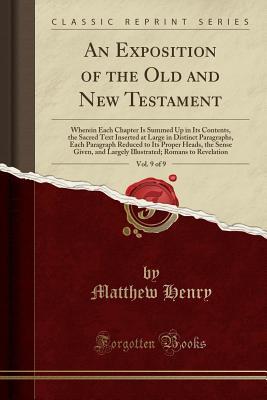
Excerpt from An Exposition of the Old and New Testament, Vol. 9 of 9: Wherein Each Chapter Is Summed Up in Its Contents, the Sacred Text Inserted at Large in Distinct Paragraphs, Each Paragraph Reduced to Its Proper Heads, the Sense Given, and Largely Illustrated; Romans to Revelation
Paul here enters upon a large discourse of justification, in the latter part of this chapter laying down his thesis, and, in order to the proof of it, describing the de lorable con dition of the Gentile world. Is transition is very handsome, and like an orator: bewas ready to preach the gospel at Rome, though a place where the gospel was run down by those that called themselves the wits for, saith he, I am not ashamed of it, v. 16. There is a great deal in the gospel which such a man as Paul might be tempted to be as amed of, especially that he whose ospel it is was a man hanged upon a tree, t at the doctrine of it was lain, had little in it to set it ofl among scholars, the professors of it were mean and despised, and every where Spoken against; yet Paul was not ashamed to own it. I reckon him a Christian indeed that is neither ashamed of the gospel nor a shame to it. The reason of this bold profession taken from the nature and excellency of the gospel. Introduces his dissertation.
About the Publisher
Forgotten Books publishes hundreds of thousands of rare and classic books. Find more at www.forgottenbooks.comwww.forgottenbooks.com
This book is a reproduction of an important historical work. Forgotten Books uses state-of-the-art technology to digitally reconstruct the work, preserving the original format whilst repairing imperfections present in the aged copy. In rare cases, an imperfection in the original, such as a blemish or missing page, may be replicated in our edition. We do, however, repair the vast majority of imperfections successfully; any imperfections that remain are intentionally left to preserve the state of such historical works.
Paul here enters upon a large discourse of justification, in the latter part of this chapter laying down his thesis, and, in order to the proof of it, describing the de lorable con dition of the Gentile world. Is transition is very handsome, and like an orator: bewas ready to preach the gospel at Rome, though a place where the gospel was run down by those that called themselves the wits for, saith he, I am not ashamed of it, v. 16. There is a great deal in the gospel which such a man as Paul might be tempted to be as amed of, especially that he whose ospel it is was a man hanged upon a tree, t at the doctrine of it was lain, had little in it to set it ofl among scholars, the professors of it were mean and despised, and every where Spoken against; yet Paul was not ashamed to own it. I reckon him a Christian indeed that is neither ashamed of the gospel nor a shame to it. The reason of this bold profession taken from the nature and excellency of the gospel. Introduces his dissertation.
About the Publisher
Forgotten Books publishes hundreds of thousands of rare and classic books. Find more at www.forgottenbooks.comwww.forgottenbooks.com
This book is a reproduction of an important historical work. Forgotten Books uses state-of-the-art technology to digitally reconstruct the work, preserving the original format whilst repairing imperfections present in the aged copy. In rare cases, an imperfection in the original, such as a blemish or missing page, may be replicated in our edition. We do, however, repair the vast majority of imperfections successfully; any imperfections that remain are intentionally left to preserve the state of such historical works.
BUY NOW
Paperback, 834 pages
Published August 6th 2018 by Forgotten Books
Subscribe
Get Bible verse every day in your inbox
Read on Mobile


Group of Brands


© 2026 Bibleportal.com All rights reserved.
Henry's well-known Exposition of the Old and New Testaments (1708-1710) is a commentary of a practical and devotional rather than of a critical kind, covering the whole of the Old Testament, and the Gospels and Acts in the New Testament. After the author's death, the work was finished by a number of ministers, and edited by George Burder and John Hughes in 1811. Not a work of textual criticism, its attempt at good sense, discrimination, its high moral tone and simple piety with practical application, combined with the well-sustained flow of its English style, made it one of the most popular works of its type. Matthew Henry's six volume Complete Commentary, originally published in 1706, provides an exhaustive verse by verse study of the Bible. His commentaries are still in use to this day.
... Show more