
- Bible
- Read the Bible
- Bible Versions
- Verse of the Day
- Reading Plans
- Verses by Topic
- Books of the Bible
- Bible Images
- Study
- Commentaries
- Concordances
- Dictionaries
- Encyclopedias
- Sermons
- Bible Atlas & Maps
- BP Wiki
- Devotionals
- Today's Devotionals
- Light of the World
- All Devotionals
- Inspirational Quotes
- More
- Picture Quotes
- Videos
- Inspirational
- Bible Study
- What The Bible Says
- Bible Q&As
- Daily Bread
- Bible by Genre
- Bible Stories
- Random Bible Verse
- Community
- Store
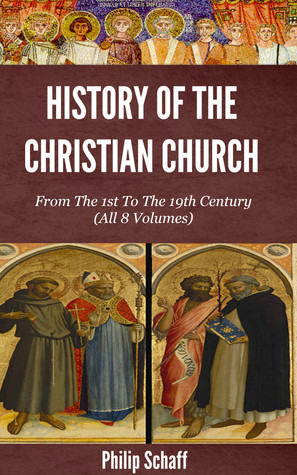
The Christian Church from the 1st-20th Century
by Philip Schaff
Philip Schaff almost needs no introduction. He wrote one of the finest histories of the church. His work, the History of the Christian Church, has become a benchmark on the subject. In his eight volume set he covers just about every issue concerning the church from the time of the Apostles through the Reformation. He incorporates discussion of ideas and principles throughout the history of the church. In this eBook all eight volumes are present and there is also a linked table of contents for every section. We have also labeled every section and chapter so that it will be easier to navigate through the volumes. This material has been carefully compared, corrected¸ and amended, according to the 1910 edition of Charles Scribner's Sons.
Here are the general titles of each of the volumes:
Volume One
THE FIRST PERIOD
APOSTLIC CHRISTIANITY
A.D. 1–100.
Volume II
SECOND PERIOD
ANTE-NICENE CHRISTIANITY
A.D. 100–311 (325).
Volume III
THIRD PERIOD
THE CHURCH IN UNION WITH THE ROMAN EMPIRE
FROM CONSTANTINE THE GREAT TO GREGORY THE GREAT. A.D. 311–590.
Volume IV
MEDIAEVAL CHRISTIANITY
From Gregory I to Gregory VII
A.D. 590–1073
Volume V
FROM GREGORY VII. TO BONIFACE VIII. A. D. 1049–1294.
Volume VI
FROM BONIFACE VIII. TO MARTIN LUTHER. A.D. 1294–1517.
THE SIXTH PERIOD OF CHURCH HISTORY.
Volume VII
HISTORY OF THE REFORMATION.
1517 – 1648.
Volume VIII
SECOND BOOK.
THE SWISS REFORMATION.
THIRD BOOK.
THE REFORMATION IN FRENCH SWITZERLAND, OR THE CALVINISTIC MOVEMENT.
Here are the general titles of each of the volumes:
Volume One
THE FIRST PERIOD
APOSTLIC CHRISTIANITY
A.D. 1–100.
Volume II
SECOND PERIOD
ANTE-NICENE CHRISTIANITY
A.D. 100–311 (325).
Volume III
THIRD PERIOD
THE CHURCH IN UNION WITH THE ROMAN EMPIRE
FROM CONSTANTINE THE GREAT TO GREGORY THE GREAT. A.D. 311–590.
Volume IV
MEDIAEVAL CHRISTIANITY
From Gregory I to Gregory VII
A.D. 590–1073
Volume V
FROM GREGORY VII. TO BONIFACE VIII. A. D. 1049–1294.
Volume VI
FROM BONIFACE VIII. TO MARTIN LUTHER. A.D. 1294–1517.
THE SIXTH PERIOD OF CHURCH HISTORY.
Volume VII
HISTORY OF THE REFORMATION.
1517 – 1648.
Volume VIII
SECOND BOOK.
THE SWISS REFORMATION.
THIRD BOOK.
THE REFORMATION IN FRENCH SWITZERLAND, OR THE CALVINISTIC MOVEMENT.
BUY NOW
Kindle Edition
Published January 12th 2014 by www.DelmarvaPublications.com
Subscribe
Get Bible verse every day in your inbox
Read on Mobile


Group of Brands


© 2026 Bibleportal.com All rights reserved.
On his journey he stayed in England and met Edward Pusey and other Tractarians. His inaugural address on The Principle of Protestantism, delivered in German at Reading, Pennsylvania, in 1844, and published in German with an English version by John Williamson Nevin was a pioneer work in English in the field of symbolics (that is, the authoritative ecclesiastical formulations of religious doctrines in creeds or confessions). This address and the "Mercersburg Theology" which he taught seemed too pro-Catholic to some, and he was charged with heresy. But, at the synod at York in 1845, he was unanimously acquitted.
Schaff's broad views strongly influenced the German Reformed Church, through his teaching at Mercersburg, through his championship of English in German Reformed churches and schools in America, through his hymnal (1859), through his labours as chairman of the committee which prepared a new liturgy, and by his edition (1863) of the Heidelberg Catechism. His History of the Apostolic Church (in German, 1851; in English, 1853) and his History of the Christian Church (7 vols., 1858-1890), opened a new period in American study of ecclesiastical history.
In 1854, he visited Europe, representing the American German churches at the ecclesiastical diet at Frankfort and at the Swiss pastoral conference at Basel. He lectured in Germany on America, and received the degree of D.D. from Berlin.
In consequence of the ravages of the American Civil War the theological seminary at Mercersburg was closed for a while and so in 1863 Dr. Schaff became secretary of the Sabbath Committee (which fought the “continental Sunday”) in New York City, and held the position till 1870. In 1865 he founded the first German Sunday School in Stuttgart. In 1862-1867 he lectured on church history at Andover.
Schaff was a member of the Leipzig Historical Society, the Netherland Historical Society, and other historical and literary societies in Europe and America. He was one of the founders, and honorary secretary, of the American branch of the Evangelical Alliance, and was sent to Europe in 1869, 1872, and 1873 to arrange for the general conference of the Alliance, which, after two postponements on account of the Franco-Prussian War, was held in New York in October 1873. Schaff was also, in 1871, one of the Alliance delegates to the emperor of Russia to plead for the religious liberty of his subjects in the Baltic provinces.
He became a professor at Union Theological Seminary, New York City in 1870 holding first the chair of theological encyclopedia and Christian symbolism till 1873, of Hebrew and the cognate languages till 1874, of sacred literature till 1887, and finally of church history, till his death. He also served as president of the committee that translated the American Standard Version of the Bible, though he died before it was published in 1901.
His History of the Christian Church resembled Neander's work, though less biographical, and was pictorial rather than philosophical. He also wrote biographies, catechisms and hymnals for children, manuals of religious verse, lectures and essays on Dante, etc. He translated Johann Jakob Herzog's Real-Encyklopädie für protestantische Theologie und Kirche into English.
... Show more