
- Bible
- Read the Bible
- Bible Versions
- Verse of the Day
- Reading Plans
- Verses by Topic
- Books of the Bible
- Bible Images
- Study
- Commentaries
- Concordances
- Dictionaries
- Encyclopedias
- Sermons
- Bible Atlas & Maps
- BP Wiki
- Devotionals
- Today's Devotionals
- Light of the World
- All Devotionals
- Inspirational Quotes
- More
- Picture Quotes
- Videos
- Inspirational
- Bible Study
- What The Bible Says
- Bible Q&As
- Daily Bread
- Bible by Genre
- Bible Stories
- Random Bible Verse
- Community
- Store
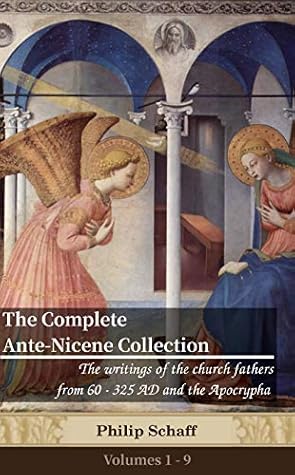
The Complete Ante-Nicene Fathers Collection: with linked footnotes
by Philip Schaff
The Ante-Nicene Period (literally meaning "before Nicaea") in the history of early Christianity was the era following the Apostolic Age of the first century until the First Council of Nicaea in 325. During this period the orthodoxy (right belief) of the faith developed. These key authors of the faith are known as the church fathers. They not only defined the faith but wrote against various heresies.
Some of the unorthodox beliefs were:
Gnosticism (2nd to 4th centuries) – reliance on revealed knowledge from an unknowable God, a distinct divinity from the Demiurge who created and oversees the material world.
Marcionism (2nd century) – the God of Jesus was a different God from the God of the Old Testament.
Montanism (2nd century) – relied on prophetic revelations from the Holy Spirit.
Adoptionism (2nd century) – Jesus was not born the Son of God, but was adopted at his baptism, resurrection or ascension.
Docetism (2nd to 3rd century) – Jesus was pure spirit and his physical form an illusion.
Sabellianism (3rd century) – the Father, Son, and Holy Spirit are three modes of the one God and not the three separate persons of the Trinity.
Arianism (3rd to 4th century) – Jesus, as the Son, was subordinate to God the Father.
In this collected work the following volumes are presented under the editorship of Philip Schaff:
Volume I - The Apostolic Fathers with Justin Martyr and Irenaeus
Volume II - Fathers of the Second Century
Volume III - Latin Christianity: Its Founder, Tertullian
Volume IV - The Fathers of the Third Century
Volume V - The Fathers of the Third Century
Volume VI - The Fathers of the Third Century
Volume VII - The Fathers of the Third and Fourth Centuries
Volume VIII - The Fathers of the Third and Fourth Centuries
Volume IX - Recently Discovered Additions to Early Christian Literature; Commentaries of Origen
All the works presented here have in-line footnotes linked to the appropriate note at the back of the work.
Some of the unorthodox beliefs were:
Gnosticism (2nd to 4th centuries) – reliance on revealed knowledge from an unknowable God, a distinct divinity from the Demiurge who created and oversees the material world.
Marcionism (2nd century) – the God of Jesus was a different God from the God of the Old Testament.
Montanism (2nd century) – relied on prophetic revelations from the Holy Spirit.
Adoptionism (2nd century) – Jesus was not born the Son of God, but was adopted at his baptism, resurrection or ascension.
Docetism (2nd to 3rd century) – Jesus was pure spirit and his physical form an illusion.
Sabellianism (3rd century) – the Father, Son, and Holy Spirit are three modes of the one God and not the three separate persons of the Trinity.
Arianism (3rd to 4th century) – Jesus, as the Son, was subordinate to God the Father.
In this collected work the following volumes are presented under the editorship of Philip Schaff:
Volume I - The Apostolic Fathers with Justin Martyr and Irenaeus
Volume II - Fathers of the Second Century
Volume III - Latin Christianity: Its Founder, Tertullian
Volume IV - The Fathers of the Third Century
Volume V - The Fathers of the Third Century
Volume VI - The Fathers of the Third Century
Volume VII - The Fathers of the Third and Fourth Centuries
Volume VIII - The Fathers of the Third and Fourth Centuries
Volume IX - Recently Discovered Additions to Early Christian Literature; Commentaries of Origen
All the works presented here have in-line footnotes linked to the appropriate note at the back of the work.
BUY NOW
Kindle Edition, 19263 pages
Published July 2nd 2019
Subscribe
Get Bible verse every day in your inbox
Read on Mobile


Group of Brands


© 2026 Bibleportal.com All rights reserved.
On his journey he stayed in England and met Edward Pusey and other Tractarians. His inaugural address on The Principle of Protestantism, delivered in German at Reading, Pennsylvania, in 1844, and published in German with an English version by John Williamson Nevin was a pioneer work in English in the field of symbolics (that is, the authoritative ecclesiastical formulations of religious doctrines in creeds or confessions). This address and the "Mercersburg Theology" which he taught seemed too pro-Catholic to some, and he was charged with heresy. But, at the synod at York in 1845, he was unanimously acquitted.
Schaff's broad views strongly influenced the German Reformed Church, through his teaching at Mercersburg, through his championship of English in German Reformed churches and schools in America, through his hymnal (1859), through his labours as chairman of the committee which prepared a new liturgy, and by his edition (1863) of the Heidelberg Catechism. His History of the Apostolic Church (in German, 1851; in English, 1853) and his History of the Christian Church (7 vols., 1858-1890), opened a new period in American study of ecclesiastical history.
In 1854, he visited Europe, representing the American German churches at the ecclesiastical diet at Frankfort and at the Swiss pastoral conference at Basel. He lectured in Germany on America, and received the degree of D.D. from Berlin.
In consequence of the ravages of the American Civil War the theological seminary at Mercersburg was closed for a while and so in 1863 Dr. Schaff became secretary of the Sabbath Committee (which fought the “continental Sunday”) in New York City, and held the position till 1870. In 1865 he founded the first German Sunday School in Stuttgart. In 1862-1867 he lectured on church history at Andover.
Schaff was a member of the Leipzig Historical Society, the Netherland Historical Society, and other historical and literary societies in Europe and America. He was one of the founders, and honorary secretary, of the American branch of the Evangelical Alliance, and was sent to Europe in 1869, 1872, and 1873 to arrange for the general conference of the Alliance, which, after two postponements on account of the Franco-Prussian War, was held in New York in October 1873. Schaff was also, in 1871, one of the Alliance delegates to the emperor of Russia to plead for the religious liberty of his subjects in the Baltic provinces.
He became a professor at Union Theological Seminary, New York City in 1870 holding first the chair of theological encyclopedia and Christian symbolism till 1873, of Hebrew and the cognate languages till 1874, of sacred literature till 1887, and finally of church history, till his death. He also served as president of the committee that translated the American Standard Version of the Bible, though he died before it was published in 1901.
His History of the Christian Church resembled Neander's work, though less biographical, and was pictorial rather than philosophical. He also wrote biographies, catechisms and hymnals for children, manuals of religious verse, lectures and essays on Dante, etc. He translated Johann Jakob Herzog's Real-Encyklopädie für protestantische Theologie und Kirche into English.
... Show more