
- Bible
- Read the Bible
- Bible Versions
- Verse of the Day
- Reading Plans
- Verses by Topic
- Books of the Bible
- Bible Images
- Study
- Commentaries
- Concordances
- Dictionaries
- Encyclopedias
- Sermons
- Bible Atlas & Maps
- BP Wiki
- Devotionals
- Today's Devotionals
- All Devotionals
- Inspirational Quotes
- More
- Picture Quotes
- Videos
- Inspirational
- Bible Study
- What The Bible Says
- Bible Q&As
- Daily Bread
- Bible by Genre
- Bible Stories
- Random Bible Verse
- Community
- Store
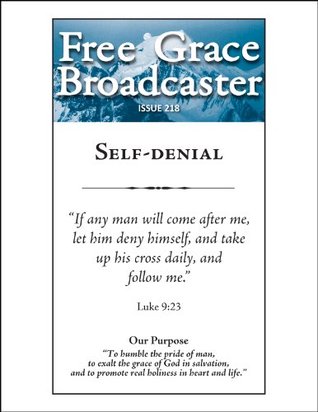
Self-denial (Free Grace Broadcaster - Puritan Collection #218)
by Richard Baxter
A quality eBook from Chapel Library (Active Table of Contents and footnotes)
The Free Grace Broadcaster is a digest of Christ-centered sermons and articles from prior centuries. Each issue focuses on a different theme. The FGB is useful for personal study, discipleship, family worship, and sermon preparation.
Wilhelmus à Brakel (1635-1711): "Self-denial Defined" – one cannot truly under-stand a life of self-denial unless that crucial concept is biblically defined.
J. C. Ryle (1816-1900): "What It Costs to Be a Christian" – one cannot fully enter into a life of self-denial unless he or she counts the cost of following Christ.
A. W. Pink (1886-1952): "Cross-bearing" – the Christian life consists of denying self and taking up the cross; however, many misunderstand what the “cross” is in a believer’s daily life.
Richard Baxter (1615-1691): "Selfishness and Self-denial" – a detailed study of how human beings became selfish and how sanctification and self-denial are the only cure for this destructive condition of man.
Charles H. Spurgeon (1834-1892): "Learning Self-denial from Christ" – the only way a sinful human being can learn self-denial is by knowing Christ, studying His extraordinary sacrifice, and walking with Him.
John Calvin (1509-1564): "Christ’s Cross and Ours" – everything about Christ’s life was to promote the great glory of God; the believer’s life should be committed to the same pursuit.
Charles H. Spurgeon (1834-1892): "Family or Christ?" – Jesus said that unless we hate father, mother, wife, children, brothers, sisters and ourselves, we cannot be His disciple: how are believers to understand and apply this?
Thomas Manton (1620-1677): "Reasons for Self-denial" – a list of biblical reasons to help the believer count the cost and conform his life to Christ’s holy example.
George Whitefield (1714-1770): "Motives to Self-denial" – a thoughtful exhortation to meditate on Christ’s life, to think upon the lives of godly Christians, to consider hell, and to meditate on heaven.
The Free Grace Broadcaster is a digest of Christ-centered sermons and articles from prior centuries. Each issue focuses on a different theme. The FGB is useful for personal study, discipleship, family worship, and sermon preparation.
Wilhelmus à Brakel (1635-1711): "Self-denial Defined" – one cannot truly under-stand a life of self-denial unless that crucial concept is biblically defined.
J. C. Ryle (1816-1900): "What It Costs to Be a Christian" – one cannot fully enter into a life of self-denial unless he or she counts the cost of following Christ.
A. W. Pink (1886-1952): "Cross-bearing" – the Christian life consists of denying self and taking up the cross; however, many misunderstand what the “cross” is in a believer’s daily life.
Richard Baxter (1615-1691): "Selfishness and Self-denial" – a detailed study of how human beings became selfish and how sanctification and self-denial are the only cure for this destructive condition of man.
Charles H. Spurgeon (1834-1892): "Learning Self-denial from Christ" – the only way a sinful human being can learn self-denial is by knowing Christ, studying His extraordinary sacrifice, and walking with Him.
John Calvin (1509-1564): "Christ’s Cross and Ours" – everything about Christ’s life was to promote the great glory of God; the believer’s life should be committed to the same pursuit.
Charles H. Spurgeon (1834-1892): "Family or Christ?" – Jesus said that unless we hate father, mother, wife, children, brothers, sisters and ourselves, we cannot be His disciple: how are believers to understand and apply this?
Thomas Manton (1620-1677): "Reasons for Self-denial" – a list of biblical reasons to help the believer count the cost and conform his life to Christ’s holy example.
George Whitefield (1714-1770): "Motives to Self-denial" – a thoughtful exhortation to meditate on Christ’s life, to think upon the lives of godly Christians, to consider hell, and to meditate on heaven.
BUY NOW
Kindle Edition, 63 pages
Published May 2nd 2012 by Chapel Library
Subscribe
Get Bible verse every day in your inbox
Read on Mobile


Group of Brands


© 2026 Bibleportal.com All rights reserved.
He wrote 168 or so separate works -- such treatises as the Christian Directory, the Methodus Theologiae Christianae, and the Catholic Theology, might each have represented the life's work of an ordinary man. His Breviate of the Life of Mrs Margaret Baxter records the virtues of his wife, and reveals Baxter's tenderness of nature. Without doubt, however, his most famous and enduring contribution to Christian literature was a devotional work published in 1658 under the title Call to the Unconverted to Turn and Live. This slim volume was credited with the conversion of thousands and formed one of the core extra-biblical texts of evangelicalism until at least the middle of the nineteenth century.
Richard Baxter was ordained into the Church of England, 1638, but in two years allied with Puritans opposed to the episcopacy of his church. At Kidderminster (1641-60) he made the church a model parish. The church was enlarged to hold the crowds. Pastoral counseling was as important as preaching, and his program for his parish was a pattern for many other ministers. Baxter played an ameliorative role during the English Civil Wars.
He was a chaplain in the parliamentary army but then helped to restore the king (1660). After the establishment of the monarchy, he fought for toleration of moderate dissent in the Church of England. Persecuted for more than 20 years and was imprisoned (1685) for 18 months, the Revolution of 1688, replacing James II with William and Mary, brought about an Act of Toleration that freed Baxter to express his opinions.
... Show more