
- Bible
- Read the Bible
- Bible Versions
- Verse of the Day
- Reading Plans
- Verses by Topic
- Books of the Bible
- Bible Images
- Study
- Commentaries
- Concordances
- Dictionaries
- Encyclopedias
- Sermons
- Bible Atlas & Maps
- BP Wiki
- Devotionals
- Today's Devotionals
- Light of the World
- All Devotionals
- Inspirational Quotes
- More
- Picture Quotes
- Videos
- Inspirational
- Bible Study
- What The Bible Says
- Bible Q&As
- Daily Bread
- Bible by Genre
- Bible Stories
- Random Bible Verse
- Community
- Store
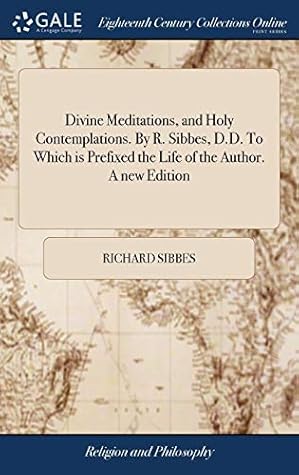
Divine Meditations, and Holy Contemplations. By R. Sibbes, D.D. To Which is Prefixed the Life of the Author. A new Edition
by Richard Sibbes
The 18th century was a wealth of knowledge, exploration and rapidly growing technology and expanding record-keeping made possible by advances in the printing press. In its determination to preserve the century of revolution, Gale initiated a revolution of its own: digitization of epic proportions to preserve these invaluable works in the largest archive of its kind. Now for the first time these high-quality digital copies of original 18th century manuscripts are available in print, making them highly accessible to libraries, undergraduate students, and independent scholars.
The Age of Enlightenment profoundly enriched religious and philosophical understanding and continues to influence present-day thinking. Works collected here include masterpieces by David Hume, Immanuel Kant, and Jean-Jacques Rousseau, as well as religious sermons and moral debates on the issues of the day, such as the slave trade. The Age of Reason saw conflict between Protestantism and Catholicism transformed into one between faith and logic -- a debate that continues in the twenty-first century.
++++
The below data was compiled from various identification fields in the bibliographic record of this title. This data is provided as an additional tool in helping to insure edition identification:
++++
British Library
T105215
With a recommendation by George Burder.
Newport (Shropshire): printed by H.P. Silvester; sold by B. Crosby and Co. and J. Walker, London; Mozely, Gainsborough; and Wilson and Co. York, (1800?). 180p., plate: port.; 18�
The Age of Enlightenment profoundly enriched religious and philosophical understanding and continues to influence present-day thinking. Works collected here include masterpieces by David Hume, Immanuel Kant, and Jean-Jacques Rousseau, as well as religious sermons and moral debates on the issues of the day, such as the slave trade. The Age of Reason saw conflict between Protestantism and Catholicism transformed into one between faith and logic -- a debate that continues in the twenty-first century.
++++
The below data was compiled from various identification fields in the bibliographic record of this title. This data is provided as an additional tool in helping to insure edition identification:
++++
British Library
T105215
With a recommendation by George Burder.
Newport (Shropshire): printed by H.P. Silvester; sold by B. Crosby and Co. and J. Walker, London; Mozely, Gainsborough; and Wilson and Co. York, (1800?). 180p., plate: port.; 18�
BUY NOW
Hardcover, 186 pages
Published April 18th 2018 by Gale Ecco, Print Editions
Subscribe
Get Bible verse every day in your inbox
Read on Mobile


Group of Brands


© 2026 Bibleportal.com All rights reserved.
Richard Sibbes was an English theologian. He is known as a Biblical exegete, and as a representative, with William Perkins and John Preston, of what has been called "main-line" Puritanism.
He attended St John's College, Cambridge from 1595. He was lecturer at Holy Trinity Church, Cambridge, from 1610 or 1611 to 1615 or 1616. It is erroneously held by 18th and 19th century scholars that Sibbes was deprived of his various academic posts on account of his Puritanism. In fact he was never deprived of any of his posts, due to his ingenuity of the system.
He was then preacher at Gray's Inn, London, from 1617, returning to Cambridge as Master of Catherine Hall in 1626, without giving up the London position.
He was the author of several devotional works expressing intense religious feeling -- The Saint's Cordial (1629), The Bruised Reed and Smoking Flax (1631, exegesis of Isaiah 42:3), The Soules Conflict (1635), etc.
... Show more