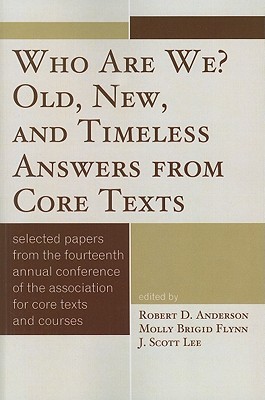
In this volume, the Association for Core Texts and Courses has gathered essays of literary and philosophical accounts that explain who we are simply as persons. Further, essays are included that highlight the person as entwined with other persons and examine who we are in light of communal ties. The essays reflect both the Western experience of democracy and how community informs who we are more generally. Our historical position in a modern or post-modern, urbanized or disenchanted world is explored by yet other papers. And, finally, ACTC educators model the intellectual life for students and colleagues by showing how to read texts carefully and with sophistication -- as an example of who we can be.



Sir Robert Anderson was born in Dublin, Ireland and was of Scottish descent. His father was an elder in the Irish Presbyterian Church and he was raised in a religious home. Anderson's conversion took place after listening to a sermon delivered by John Hall.
Sir Robert Anderson graduated from Trinity College, Dublin, in 1862 and was called to the Irish Bar in 1863. He later became Assistant Commissioner of the Metropolitan Police and Chief of the Criminal Investigation Department at Scotland Yard. When he retired in 1901, he was made Knight Commander of the the Order of the Bath. W. H. Smith, on the floor of the House of Commons, said Sir Robert "had discharged his duties with great ability and perfect faithfulness to the public."
Sir Robert Anderson was the chief inspector for Scotland Yard. He was greatly respected for his skill as an investigator. When Anderson wasn't writing on subjects related to crime, he wrote books on Christian prophecy. He helped establish the fact that 69 of Daniel's 70 weeks have now transpired, and that the tribulation will be the 70th week. Sir Robert Anderson's book, The Coming Prince, has become a foundational resource for all dispensationalists.
... Show more