
- Bible
- Read the Bible
- Bible Versions
- Verse of the Day
- Reading Plans
- Verses by Topic
- Books of the Bible
- Bible Images
- Study
- Commentaries
- Concordances
- Dictionaries
- Encyclopedias
- Sermons
- Bible Atlas & Maps
- BP Wiki
- Devotionals
- Today's Devotionals
- Light of the World
- All Devotionals
- Inspirational Quotes
- More
- Picture Quotes
- Videos
- Inspirational
- Bible Study
- What The Bible Says
- Bible Q&As
- Daily Bread
- Bible by Genre
- Bible Stories
- Random Bible Verse
- Community
- Store
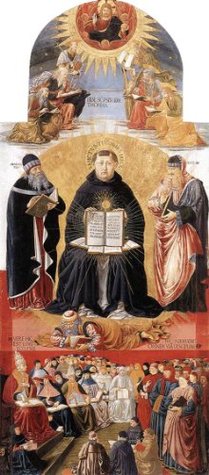
Aquinas Ethicus
by Thomas Aquinas
The Sovereign Pontiff, Leo XIII., in his Encyclical on Scholastic Philosophy, writes as follows: “Let the teachers whom you shall discreetly choose make it their aim to instil the doctrine of Thomas Aquinas into the minds of their scholars, and to set in a clear light his solidity and excellence above other authors. . . . But lest supposititious utterances be taken for true, or adulterate for genuine, see to it that the wisdom of Thomas be drunk in from his own streams.”
Nevertheless, experience shows that it is difficult even in the training of young ecclesiastics to get them to read St. Thomas continuously. Indeed it may be feared that St. Thomas is not yet read by them quite as much as Leo XIII. would have wished. And by laymen in English-speaking countries he is read scarcely at all.
1 Several years of teaching Moral Philosophy in a Catholic Seminary induced the Translator to gather numerous references to St. Thomas, which he pressed upon the perusal of his auditors. Most of these passages are here translated, with additions. The translation is not continuous. Phrases, Articles, and whole Questions are omitted, some because they deal with Theology rather than with Ethics, some on account of their difficulty, and some for brevity’s sake. But the original numbering of Question, Article, and Argument has been preserved throughout, marking omissions and affording convenience of reference.
This is a translation, not a paraphrase. The words are the words of St. Thomas. The Translator has added notes, which may sometimes serve to guard against dangerous misinterpretation. Anything in the way of continuous commentary must be sought, so far as he can supply it, in Ethics and Natural Law (Manuals of Catholic Philosophy, Stonyhurst Series), to which this volume may be regarded as a companion.
If it be said: “This is not a translation, but a mutilation:” the reply is forthcoming, that the Angelic Doctor still reposes whole and entire in his own original Latin, to which fair original it is hoped that this abbreviated version may help to introduce new readers.
Nevertheless, experience shows that it is difficult even in the training of young ecclesiastics to get them to read St. Thomas continuously. Indeed it may be feared that St. Thomas is not yet read by them quite as much as Leo XIII. would have wished. And by laymen in English-speaking countries he is read scarcely at all.
1 Several years of teaching Moral Philosophy in a Catholic Seminary induced the Translator to gather numerous references to St. Thomas, which he pressed upon the perusal of his auditors. Most of these passages are here translated, with additions. The translation is not continuous. Phrases, Articles, and whole Questions are omitted, some because they deal with Theology rather than with Ethics, some on account of their difficulty, and some for brevity’s sake. But the original numbering of Question, Article, and Argument has been preserved throughout, marking omissions and affording convenience of reference.
This is a translation, not a paraphrase. The words are the words of St. Thomas. The Translator has added notes, which may sometimes serve to guard against dangerous misinterpretation. Anything in the way of continuous commentary must be sought, so far as he can supply it, in Ethics and Natural Law (Manuals of Catholic Philosophy, Stonyhurst Series), to which this volume may be regarded as a companion.
If it be said: “This is not a translation, but a mutilation:” the reply is forthcoming, that the Angelic Doctor still reposes whole and entire in his own original Latin, to which fair original it is hoped that this abbreviated version may help to introduce new readers.
BUY NOW
Kindle Edition, 644 pages
Published July 11th 2012 by Veritatis Splendor Publications (first published January 28th 2010)
Subscribe
Get Bible verse every day in your inbox
Read on Mobile


Group of Brands


© 2026 Bibleportal.com All rights reserved.
Thomas Aquinas was an immensely influential philosopher and theologian in the tradition of scholasticism, known as Doctor Angelicus and Doctor Communis.
He was the foremost classical proponent of natural theology, and the father of the Thomistic school of philosophy and theology. His influence on Western thought is considerable, and much of modern philosophy was conceived as a reaction against, or as an agreement with, his ideas, particularly in the areas of ethics, natural law and political theory.
The philosophy of Aquinas has exerted enormous influence on subsequent Christian theology, especially that of the Roman Catholic Church, extending to Western philosophy in general, where he stands as a vehicle and modifier of Aristotelianism, which he fused with the thought of Augustine.
... Show more