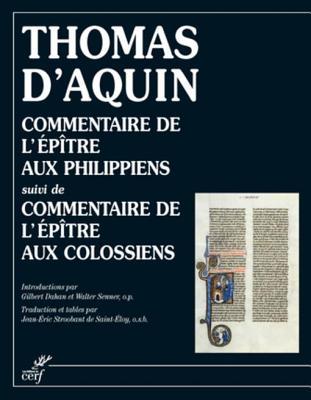
Entre 1263 et 1265, a Orvieto, Thomas d'Aquin donne son premier enseignement magistral sur l'ensemble des epitres de Paul. C'est dans ce cadre qu'il commente, verset apres verset, l'epitre aux Philippiens. Et c'est au cours d'un sejour a Rome, dans les annees 1260, qu'il dispense ses lecons sur l'epitre aux Colossiens. Comme dans tous ses commentaires de l'Ecriture sainte, Thomas se revele a la fois comme un exegete rigoureux et soucieux de toujours respecter la lettre du texte sacre, mais aussi comme un grand spirituel, desireux de degager du texte de l'Apotre un enseignement pour la vie chretienne. Un ouvrage fondamental, classique et toujours vivant.



Thomas Aquinas was an immensely influential philosopher and theologian in the tradition of scholasticism, known as Doctor Angelicus and Doctor Communis.
He was the foremost classical proponent of natural theology, and the father of the Thomistic school of philosophy and theology. His influence on Western thought is considerable, and much of modern philosophy was conceived as a reaction against, or as an agreement with, his ideas, particularly in the areas of ethics, natural law and political theory.
The philosophy of Aquinas has exerted enormous influence on subsequent Christian theology, especially that of the Roman Catholic Church, extending to Western philosophy in general, where he stands as a vehicle and modifier of Aristotelianism, which he fused with the thought of Augustine.
... Show more