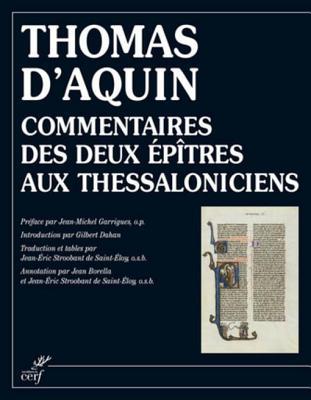
C'est entre 1263 et 1273 que Thomas d'Aquin livrera un commentaire complet des lettres pauliniennes qu'il a pense comme un tout organique. Saint Thomas confere a ces epitres, en elles-memes tres disparates, une unite et une structure doctrinale. L'objet principal de ce commentaire porte sur la defense de l'unite de l'Eglise contre les persecutions. Dans la premiere epitre, il est question des persecutions de l'epoque, que l'Aquinate decrit et resume en recourant a l'image de l'arche de Noe tanguant au milieu des eaux tumultueuses, et qui symbolise la resistance de l'Eglise en proie aux tribulations. Dans la seconde epitre, Thomas traite en particulier des persecutions futures contre l'Eglise, au temps de l'Antichrist, que de nombreux auteurs ont tente de decrypter en l'assimilant a tel ou tel tyran, mais qui en realite doit encore se reveler avec toute sa malice a la fin des temps. Un ouvrage fondamental, classique et toujours vivant.



Thomas Aquinas was an immensely influential philosopher and theologian in the tradition of scholasticism, known as Doctor Angelicus and Doctor Communis.
He was the foremost classical proponent of natural theology, and the father of the Thomistic school of philosophy and theology. His influence on Western thought is considerable, and much of modern philosophy was conceived as a reaction against, or as an agreement with, his ideas, particularly in the areas of ethics, natural law and political theory.
The philosophy of Aquinas has exerted enormous influence on subsequent Christian theology, especially that of the Roman Catholic Church, extending to Western philosophy in general, where he stands as a vehicle and modifier of Aristotelianism, which he fused with the thought of Augustine.
... Show more