
- Bible
- Read the Bible
- Bible Versions
- Verse of the Day
- Reading Plans
- Verses by Topic
- Books of the Bible
- Bible Images
- Study
- Commentaries
- Concordances
- Dictionaries
- Encyclopedias
- Sermons
- Bible Atlas & Maps
- BP Wiki
- Devotionals
- Today's Devotionals
- Light of the World
- All Devotionals
- Inspirational Quotes
- More
- Picture Quotes
- Videos
- Inspirational
- Bible Study
- What The Bible Says
- Bible Q&As
- Daily Bread
- Bible by Genre
- Bible Stories
- Random Bible Verse
- Community
- Store
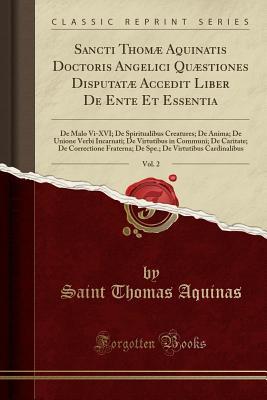
Excerpt from Sancti Thom� Aquinatis Doctoris Angelici Qu�stiones Disputat� Accedit Liber De Ente Et Essentia, Vol. 2: De Malo Vi-XVI; De Spiritualibus Creatures; De Anima; De Unione Verbi Incarnati; De Virtutibus in Communi; De Caritate; De Correctione Fraterna; De Spe.; De Virtutibus Cardinalibus
Quaestio est de electione humana etunum quaeritur hic, utrum homo haheat liberam eleotionem snorum actuum, aut ex necessitate eligat. Et videtur quod non libere, sedex necessitate eligat. Dicitur enim Hierem., X, 23 Non est hominis eia ejus, nec viri est ut ambulet et dirigat gressus suos. Sed illud respectu cujus homo habet libertatem, ejus est, quasi in ipsius dominio constitutum. Ergo videtur quod homo snarum viarum et suorum actuum liberam electionem non habeat.
About the Publisher
Forgotten Books publishes hundreds of thousands of rare and classic books. Find more at www.forgottenbooks.comwww.forgottenbooks.com
This book is a reproduction of an important historical work. Forgotten Books uses state-of-the-art technology to digitally reconstruct the work, preserving the original format whilst repairing imperfections present in the aged copy. In rare cases, an imperfection in the original, such as a blemish or missing page, may be replicated in our edition. We do, however, repair the vast majority of imperfections successfully; any imperfections that remain are intentionally left to preserve the state of such historical works.
Quaestio est de electione humana etunum quaeritur hic, utrum homo haheat liberam eleotionem snorum actuum, aut ex necessitate eligat. Et videtur quod non libere, sedex necessitate eligat. Dicitur enim Hierem., X, 23 Non est hominis eia ejus, nec viri est ut ambulet et dirigat gressus suos. Sed illud respectu cujus homo habet libertatem, ejus est, quasi in ipsius dominio constitutum. Ergo videtur quod homo snarum viarum et suorum actuum liberam electionem non habeat.
About the Publisher
Forgotten Books publishes hundreds of thousands of rare and classic books. Find more at www.forgottenbooks.comwww.forgottenbooks.com
This book is a reproduction of an important historical work. Forgotten Books uses state-of-the-art technology to digitally reconstruct the work, preserving the original format whilst repairing imperfections present in the aged copy. In rare cases, an imperfection in the original, such as a blemish or missing page, may be replicated in our edition. We do, however, repair the vast majority of imperfections successfully; any imperfections that remain are intentionally left to preserve the state of such historical works.
BUY NOW
Paperback, 802 pages
Published April 23rd 2018 by Forgotten Books
Subscribe
Get Bible verse every day in your inbox
Read on Mobile


Group of Brands


© 2026 Bibleportal.com All rights reserved.
Thomas Aquinas was an immensely influential philosopher and theologian in the tradition of scholasticism, known as Doctor Angelicus and Doctor Communis.
He was the foremost classical proponent of natural theology, and the father of the Thomistic school of philosophy and theology. His influence on Western thought is considerable, and much of modern philosophy was conceived as a reaction against, or as an agreement with, his ideas, particularly in the areas of ethics, natural law and political theory.
The philosophy of Aquinas has exerted enormous influence on subsequent Christian theology, especially that of the Roman Catholic Church, extending to Western philosophy in general, where he stands as a vehicle and modifier of Aristotelianism, which he fused with the thought of Augustine.
... Show more