
- Bible
- Read the Bible
- Bible Versions
- Verse of the Day
- Reading Plans
- Verses by Topic
- Books of the Bible
- Bible Images
- Study
- Commentaries
- Concordances
- Dictionaries
- Encyclopedias
- Sermons
- Bible Atlas & Maps
- BP Wiki
- Devotionals
- Today's Devotionals
- Light of the World
- All Devotionals
- Inspirational Quotes
- More
- Picture Quotes
- Videos
- Inspirational
- Bible Study
- What The Bible Says
- Bible Q&As
- Daily Bread
- Bible by Genre
- Bible Stories
- Random Bible Verse
- Community
- Store
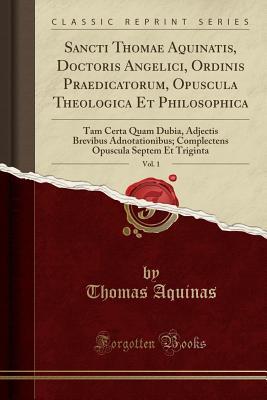
Excerpt from Sancti Thomae Aquinatis, Doctoris Angelici, Ordinis Praedicatorum, Opuscula Theologica Et Philosophica, Vol. 1: Tam Certa Quam Dubia, Adjectis Brevibus Adnotationibus; Complectens Opuscula Septem Et Triginta
Per hoc autem ostenditur, quod Deam esse sit necessaria.... Omne enim quod possibile est esse et non esse, est mutabile. Sed Deus est omnine immutabilis, ut ostensam est. Ergo Deum non est possibile esse et non esse. On: ne autem quod est, et non est possibile ipsum non esse, necesse est ipsum esse: quia necesse esso, et non possibile non esse, ide... significant. Ergo Dea... esse est necesse.
Item. Omnc quod est possibile esse et non esse, indiget alique alto quod faciat ipsum esse: quia quantum est in se, se habet ad utrumqae Quod autem facit aliquid esse, est prius ee. Ergo omni quod est possibile esse et non esse, est ali quid prius. Deo autem non csi aliquid prius. Ergo non est possibile ipsum esse et non esse, sed ne cesse est eum esse. Et quia al...ua necessaria sunt quae suae necessitatis causa... habent, quam oper. Tet eis esse priorem; Deus, qui est omnium pri. Ma..., non habet causa... saue necessitatis: unde Dea... esse per se ipsum est necesse.
About the Publisher
Forgotten Books publishes hundreds of thousands of rare and classic books. Find more at www.forgottenbooks.comwww.forgottenbooks.com
This book is a reproduction of an important historical work. Forgotten Books uses state-of-the-art technology to digitally reconstruct the work, preserving the original format whilst repairing imperfections present in the aged copy. In rare cases, an imperfection in the original, such as a blemish or missing page, may be replicated in our edition. We do, however, repair the vast majority of imperfections successfully; any imperfections that remain are intentionally left to preserve the state of such historical works.
Per hoc autem ostenditur, quod Deam esse sit necessaria.... Omne enim quod possibile est esse et non esse, est mutabile. Sed Deus est omnine immutabilis, ut ostensam est. Ergo Deum non est possibile esse et non esse. On: ne autem quod est, et non est possibile ipsum non esse, necesse est ipsum esse: quia necesse esso, et non possibile non esse, ide... significant. Ergo Dea... esse est necesse.
Item. Omnc quod est possibile esse et non esse, indiget alique alto quod faciat ipsum esse: quia quantum est in se, se habet ad utrumqae Quod autem facit aliquid esse, est prius ee. Ergo omni quod est possibile esse et non esse, est ali quid prius. Deo autem non csi aliquid prius. Ergo non est possibile ipsum esse et non esse, sed ne cesse est eum esse. Et quia al...ua necessaria sunt quae suae necessitatis causa... habent, quam oper. Tet eis esse priorem; Deus, qui est omnium pri. Ma..., non habet causa... saue necessitatis: unde Dea... esse per se ipsum est necesse.
About the Publisher
Forgotten Books publishes hundreds of thousands of rare and classic books. Find more at www.forgottenbooks.comwww.forgottenbooks.com
This book is a reproduction of an important historical work. Forgotten Books uses state-of-the-art technology to digitally reconstruct the work, preserving the original format whilst repairing imperfections present in the aged copy. In rare cases, an imperfection in the original, such as a blemish or missing page, may be replicated in our edition. We do, however, repair the vast majority of imperfections successfully; any imperfections that remain are intentionally left to preserve the state of such historical works.
BUY NOW
Paperback, 560 pages
Published October 13th 2018 by Forgotten Books
Subscribe
Get Bible verse every day in your inbox
Read on Mobile


Group of Brands


© 2026 Bibleportal.com All rights reserved.
Thomas Aquinas was an immensely influential philosopher and theologian in the tradition of scholasticism, known as Doctor Angelicus and Doctor Communis.
He was the foremost classical proponent of natural theology, and the father of the Thomistic school of philosophy and theology. His influence on Western thought is considerable, and much of modern philosophy was conceived as a reaction against, or as an agreement with, his ideas, particularly in the areas of ethics, natural law and political theory.
The philosophy of Aquinas has exerted enormous influence on subsequent Christian theology, especially that of the Roman Catholic Church, extending to Western philosophy in general, where he stands as a vehicle and modifier of Aristotelianism, which he fused with the thought of Augustine.
... Show more