
- Bible
- Read the Bible
- Bible Versions
- Verse of the Day
- Reading Plans
- Verses by Topic
- Books of the Bible
- Bible Images
- Study
- Commentaries
- Concordances
- Dictionaries
- Encyclopedias
- Sermons
- Bible Atlas & Maps
- BP Wiki
- Devotionals
- Today's Devotionals
- Light of the World
- All Devotionals
- Inspirational Quotes
- More
- Picture Quotes
- Videos
- Inspirational
- Bible Study
- What The Bible Says
- Bible Q&As
- Daily Bread
- Bible by Genre
- Bible Stories
- Random Bible Verse
- Community
- Store
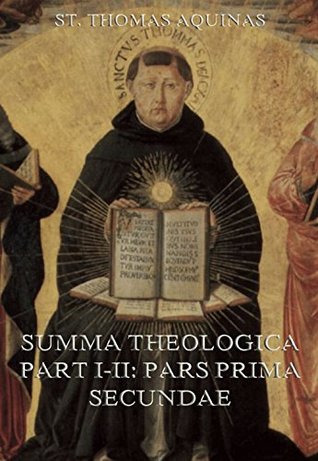
Summa Theologica Part I ("Prima Pars")
by Thomas Aquinas
The Summa Theologiae (Latin: Compendium of Theology or Theological Compendium; also subsequently called the Summa Theologica or simply the Summa, written 1265-1274) is the best-known work of Thomas Aquinas (c.1225-1274), and although unfinished, "one of the classics of the history of philosophy and one of the most influential works of Western literature." It is intended as a manual for beginners in theology and a compendium of all of the main theological teachings of the Church. It presents the reasoning for almost all points of Christian theology in the West. The Summa's topics follow a cycle: the existence of God; Creation, Man; Man's purpose; Christ; the Sacraments; and back to God. (courtesy of wikipedia.com).
This is part 1, 'Prima Pars'.
Aquinas's greatest work was the Summa, and it is the fullest presentation of his views. He worked on it from the time of Clement IV (after 1265) until the end of his life. When he died, he had reached Question 90 of Part III (on the subject of penance). What was lacking was added afterwards from the fourth book of his commentary on the Sentences of Peter Lombard as a supplementum, which is not found in manuscripts of the thirteenth and fourteenth centuries. The Summa was translated into Greek (apparently by Maximus Planudes around 1327), Armenian, many European languages, and Chinese.
It consists of three parts. Part I treats of God, who is the "first cause, himself uncaused" (primum movens immobile) and as such existent only in act (actu) - that is, pure actuality without potentiality, and therefore without corporeality. His essence is actus purus et perfectus. This follows from the fivefold proof for the existence of God; namely, there must be a first mover, unmoved, a first cause in the chain of causes, an absolutely necessary being, an absolutely perfect being, and a rational designer.
This is part 1, 'Prima Pars'.
Aquinas's greatest work was the Summa, and it is the fullest presentation of his views. He worked on it from the time of Clement IV (after 1265) until the end of his life. When he died, he had reached Question 90 of Part III (on the subject of penance). What was lacking was added afterwards from the fourth book of his commentary on the Sentences of Peter Lombard as a supplementum, which is not found in manuscripts of the thirteenth and fourteenth centuries. The Summa was translated into Greek (apparently by Maximus Planudes around 1327), Armenian, many European languages, and Chinese.
It consists of three parts. Part I treats of God, who is the "first cause, himself uncaused" (primum movens immobile) and as such existent only in act (actu) - that is, pure actuality without potentiality, and therefore without corporeality. His essence is actus purus et perfectus. This follows from the fivefold proof for the existence of God; namely, there must be a first mover, unmoved, a first cause in the chain of causes, an absolutely necessary being, an absolutely perfect being, and a rational designer.
BUY NOW
Kindle Edition, 1553 pages
Published July 21st 2012 by Jazzybee Verlag
Subscribe
Get Bible verse every day in your inbox
Read on Mobile


Group of Brands


© 2026 Bibleportal.com All rights reserved.
Thomas Aquinas was an immensely influential philosopher and theologian in the tradition of scholasticism, known as Doctor Angelicus and Doctor Communis.
He was the foremost classical proponent of natural theology, and the father of the Thomistic school of philosophy and theology. His influence on Western thought is considerable, and much of modern philosophy was conceived as a reaction against, or as an agreement with, his ideas, particularly in the areas of ethics, natural law and political theory.
The philosophy of Aquinas has exerted enormous influence on subsequent Christian theology, especially that of the Roman Catholic Church, extending to Western philosophy in general, where he stands as a vehicle and modifier of Aristotelianism, which he fused with the thought of Augustine.
... Show more