
- Bible
- Read the Bible
- Bible Versions
- Verse of the Day
- Reading Plans
- Verses by Topic
- Books of the Bible
- Bible Images
- Study
- Commentaries
- Concordances
- Dictionaries
- Encyclopedias
- Sermons
- Bible Atlas & Maps
- BP Wiki
- Devotionals
- Today's Devotionals
- Light of the World
- All Devotionals
- Inspirational Quotes
- More
- Picture Quotes
- Videos
- Inspirational
- Bible Study
- What The Bible Says
- Bible Q&As
- Daily Bread
- Bible by Genre
- Bible Stories
- Random Bible Verse
- Community
- Store
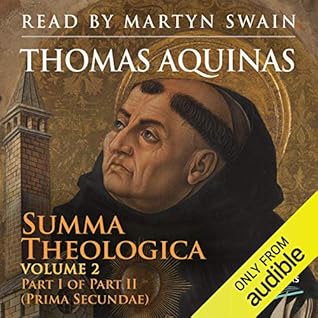
Summa Theologica, Volume 2: Part I of Part II (Prima Secundae)
by Thomas Aquinas
Publisher's Summary
Summa Theologica consists of three main parts. The second part is divided in two, and this recording presents Prima Secundae - Part I of Part II. Taken in its entirety, Summa Theologica forms an essential contribution to the canon of Catholic doctrine and was written in the last decade of his life by Thomas Aquinas (1225-1274), an Italian-born Dominican friar. Although he died before completing it, the body of thought it contains is a continuing influence to the education and guidance of students of theology in the main Christian traditions.
Prima Secundae comprises seven essential treatises on the subjects of:
The last end
Human acts
Passions
Habits
Vice and sin
Law
Grace
Within these treatises the writer considers a vast range of topics. In the Treatise on the Last End he explores and illuminates the Catholic understanding of human actions and related questions on reason and appetite design and causality. In the Treatise on Human Acts his subject is the will and the nature of good and evil. In the Treatise on the Passions he undertakes a detailed consideration of the nature and importance of the major feelings and emotions: love and hatred, concupiscence and delight, pain and sorrow, fear and daring, and anger. In the Treatise on Habits he examines the relationships existing between habits and their causes and effects as well as the nature and essence of the intellectual, moral, cardinal, and theological virtues. The treatise ends with a consideration of the beatitudes and blessings of the Holy Ghost. The Treatise on Vice and Sin deals with understanding the essential nature of vice and sin, the internal and external causes of sin, the role of human free will, the role of the devil, the corruption of nature, and the differences between venial and mortal sins and their corresponding punishments. The Treatise on Law compares and contrasts the various types of law: eternal, natural, human, and law as revealed in the Old and New Testaments with detailed consideration of ceremonial and judicial precepts. The Treatise on Grace considers its necessity essence cause and effects.
As in the rest of Summa Theologica, the Prima Secundae is logically structured. Each main heading or question is subdivided into points of inquiry or numbered articles. Each article is then formulated as a series of numbered objections to the idea to be postulated, followed by their counter statements. Aquinas’ summation is preceded by the phrase ‘I answer that...’ which then clarifies the issue under discussion. There are also individual replies for further clarification where necessary.
Long considered a classic text in philosophy and theology, Summa Theologica now offers the listener detailed expositions and considerations of the thinking of figures such as St. Paul (referred to as the Apostle) as well as non-Christian figures such as Aristotle (referred to as the Philosopher), Boethius, Muslim writers including Averroes (Ibn Rushd) (referred to as the Commentator) and Avicenna (Ibn Sina), and the Sephardic Jewish scholar Moses Maimonides (referred to as Rabbi Moses), among others. The translation used has been formally attributed to Fathers of the English Dominican Province, though it is generally accepted it was the work of one man: Father Laurence Shapcote. It is read with clarity and fluency by Martyn Swain.
Public Domain (P)2020 Ukemi Productions Ltd
Summa Theologica consists of three main parts. The second part is divided in two, and this recording presents Prima Secundae - Part I of Part II. Taken in its entirety, Summa Theologica forms an essential contribution to the canon of Catholic doctrine and was written in the last decade of his life by Thomas Aquinas (1225-1274), an Italian-born Dominican friar. Although he died before completing it, the body of thought it contains is a continuing influence to the education and guidance of students of theology in the main Christian traditions.
Prima Secundae comprises seven essential treatises on the subjects of:
The last end
Human acts
Passions
Habits
Vice and sin
Law
Grace
Within these treatises the writer considers a vast range of topics. In the Treatise on the Last End he explores and illuminates the Catholic understanding of human actions and related questions on reason and appetite design and causality. In the Treatise on Human Acts his subject is the will and the nature of good and evil. In the Treatise on the Passions he undertakes a detailed consideration of the nature and importance of the major feelings and emotions: love and hatred, concupiscence and delight, pain and sorrow, fear and daring, and anger. In the Treatise on Habits he examines the relationships existing between habits and their causes and effects as well as the nature and essence of the intellectual, moral, cardinal, and theological virtues. The treatise ends with a consideration of the beatitudes and blessings of the Holy Ghost. The Treatise on Vice and Sin deals with understanding the essential nature of vice and sin, the internal and external causes of sin, the role of human free will, the role of the devil, the corruption of nature, and the differences between venial and mortal sins and their corresponding punishments. The Treatise on Law compares and contrasts the various types of law: eternal, natural, human, and law as revealed in the Old and New Testaments with detailed consideration of ceremonial and judicial precepts. The Treatise on Grace considers its necessity essence cause and effects.
As in the rest of Summa Theologica, the Prima Secundae is logically structured. Each main heading or question is subdivided into points of inquiry or numbered articles. Each article is then formulated as a series of numbered objections to the idea to be postulated, followed by their counter statements. Aquinas’ summation is preceded by the phrase ‘I answer that...’ which then clarifies the issue under discussion. There are also individual replies for further clarification where necessary.
Long considered a classic text in philosophy and theology, Summa Theologica now offers the listener detailed expositions and considerations of the thinking of figures such as St. Paul (referred to as the Apostle) as well as non-Christian figures such as Aristotle (referred to as the Philosopher), Boethius, Muslim writers including Averroes (Ibn Rushd) (referred to as the Commentator) and Avicenna (Ibn Sina), and the Sephardic Jewish scholar Moses Maimonides (referred to as Rabbi Moses), among others. The translation used has been formally attributed to Fathers of the English Dominican Province, though it is generally accepted it was the work of one man: Father Laurence Shapcote. It is read with clarity and fluency by Martyn Swain.
Public Domain (P)2020 Ukemi Productions Ltd
BUY NOW
Audible Audio
Published August 8th 2020 by Ukemi Audiobooks
Subscribe
Get Bible verse every day in your inbox
Read on Mobile


Group of Brands


© 2026 Bibleportal.com All rights reserved.
Thomas Aquinas was an immensely influential philosopher and theologian in the tradition of scholasticism, known as Doctor Angelicus and Doctor Communis.
He was the foremost classical proponent of natural theology, and the father of the Thomistic school of philosophy and theology. His influence on Western thought is considerable, and much of modern philosophy was conceived as a reaction against, or as an agreement with, his ideas, particularly in the areas of ethics, natural law and political theory.
The philosophy of Aquinas has exerted enormous influence on subsequent Christian theology, especially that of the Roman Catholic Church, extending to Western philosophy in general, where he stands as a vehicle and modifier of Aristotelianism, which he fused with the thought of Augustine.
... Show more