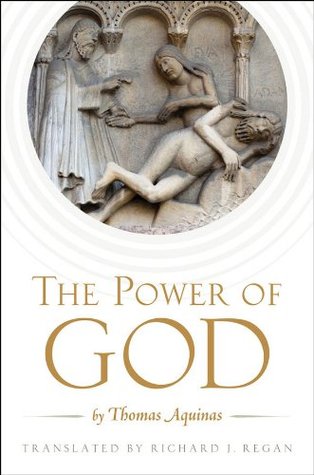
In the De potentia, Thomas Aquinas runs a series of disputations on the power of God. The treatise considers ten questions related to God's power to create external things, namely the universe, angels, and human beings. His explanation of creation here is the most developed treatment found in any of his writings, but the principal purpose of the work is to analyze the internal life of God--that is, the Trinity. According to Aquinas, we predicate the Persons of the Trinity as relations, not as absolute things, and he examines the processions of the Son and the Holy Spirit in the light of reason.
The complete De potentia is a very long document. In this new translation, Fr. Richard Regan offers an abridged version that passes over some of the full text while retaining what is most important when it comes to following the flow of Aquinas's thought.



Thomas Aquinas was an immensely influential philosopher and theologian in the tradition of scholasticism, known as Doctor Angelicus and Doctor Communis.
He was the foremost classical proponent of natural theology, and the father of the Thomistic school of philosophy and theology. His influence on Western thought is considerable, and much of modern philosophy was conceived as a reaction against, or as an agreement with, his ideas, particularly in the areas of ethics, natural law and political theory.
The philosophy of Aquinas has exerted enormous influence on subsequent Christian theology, especially that of the Roman Catholic Church, extending to Western philosophy in general, where he stands as a vehicle and modifier of Aristotelianism, which he fused with the thought of Augustine.
... Show more