— A Classic — Includes Active Table of Contents — Includes Religious Illustrations
Amongst the seventy-two Opuscula, or minor works, of St. Thomas Aquinas there are three which treat of the religious life and calling. The first of these is now offered to the English reader. The two others have a special interest of their own. They were the outcome of the historic controversy on the religious orders, raised, in St. Thomas’s day, by a powerful and influential anti-regular party, of which William of St. Amour was the recognised and indomitable champion and leader. These two Opuscula will appear in English in a subsequent volume. I venture to predict that they will not fail to attract the attention of many readers in the English-speaking world. They are more than old enough to have made history, yet they are singularly appropriate and apposite to-day—more than six hundred years after they were written—when, as in the thirteenth century, the religious orders are again on their trial in several countries in Europe.
Aeterna Press

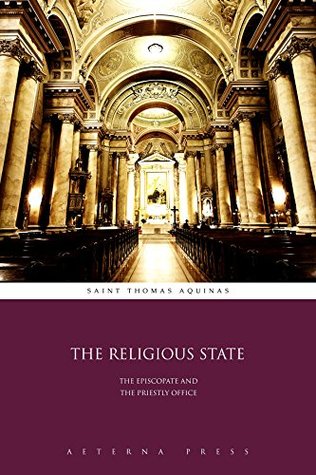


Thomas Aquinas was an immensely influential philosopher and theologian in the tradition of scholasticism, known as Doctor Angelicus and Doctor Communis.
He was the foremost classical proponent of natural theology, and the father of the Thomistic school of philosophy and theology. His influence on Western thought is considerable, and much of modern philosophy was conceived as a reaction against, or as an agreement with, his ideas, particularly in the areas of ethics, natural law and political theory.
The philosophy of Aquinas has exerted enormous influence on subsequent Christian theology, especially that of the Roman Catholic Church, extending to Western philosophy in general, where he stands as a vehicle and modifier of Aristotelianism, which he fused with the thought of Augustine.
... Show more